




DXPR Builder 2.8 Adds AI Page Creation and Editing Tools to Drupal

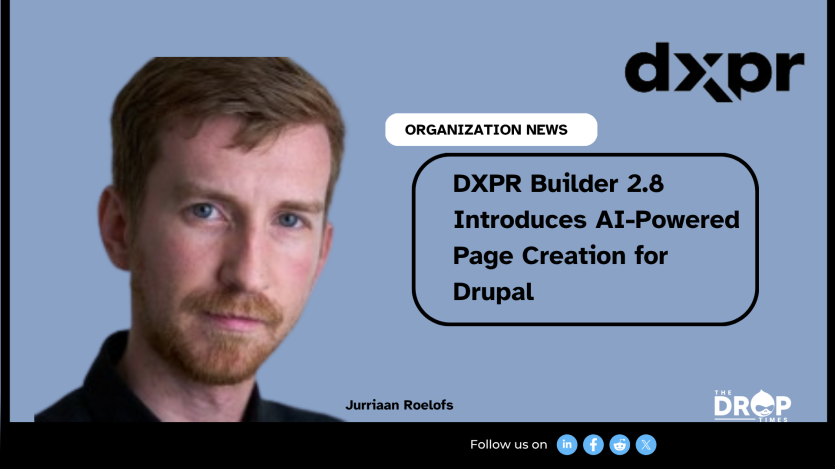
DXPR Builder 2.8 introduces AI-powered page building for Drupal, enabling users to generate and edit complete webpages with natural language prompts. The release, shared by Jurriaan Roelofs, builds on ideas he outlined in a 2023 interview with The DropTimes about enabling non-technical users to create webpages by describing what they want.
According to the announcement, the new version allows full-page generation from a single prompt, producing structured layouts with sections, columns, and reusable components aligned with the active Drupal theme. Users can also build pages incrementally, refining individual sections while retaining control over layout and structure.
The release introduces AI-assisted editing across the interface. Users can rewrite entire pages or selected sections without altering layout structure, generate and modify images within the editor, and produce long-form content with headings and structured sections. A tone-of-voice setting allows a consistent writing style across generated outputs.
One feature highlighted in demonstrations is competitor page reconstruction, in which users enter a URL and generate a structurally similar layout using native DXPR Builder components. The system recreates layouts using placeholder or generated assets rather than copying source code, allowing teams to adapt designs within Drupal workflows.
The announcement also states that DXPR Builder integrates with multiple AI providers, including OpenAI, Google, Anthropic, xAI, and Mistral, and can switch between them if one becomes unavailable. AI usage is managed through a credit-based system with monthly allocations and optional paid extensions.
Layouts continue to be stored as standard Bootstrap HTML, maintaining compatibility with Drupal’s architecture and avoiding vendor lock-in. Installation is handled through Composer using composer require 'drupal/dxpr_builder:^2.8', allowing integration into existing Drupal projects.
The release reflects a shift toward embedding AI directly within Drupal’s content authoring workflows, where users describe intent and refine outputs iteratively rather than assembling pages manually.
This direction aligns with broader work across the Drupal ecosystem, including initiatives such as Drupal Canvas and the proposed Context Control Center, which aim to bring structured guidance, content context, and AI-assisted workflows into core authoring experiences. While DXPR Builder implements these ideas within a contributed page builder, ongoing work in Drupal core and related initiatives suggests a parallel effort to define how AI integrates with structured content, editorial control, and reusable design systems.

ASK: Drupal Community Needs Your Support
View all →
Disclosure: This content is produced with the assistance of AI.
Note: The vision of this web portal is to help promote news and stories around the Drupal community and promote and celebrate the people and organizations in the community. We strive to create and distribute our content based on these content policy. If you see any omission/variation on this please reach out to us at #thedroptimes channel on Drupal Slack and we will try to address the issue as best we can.

Related Organizations

Related People


You may also like