



DrupalCamp Ottawa 2026 to Highlight Drupal 11, AI Workflows, and Accessibility Practices

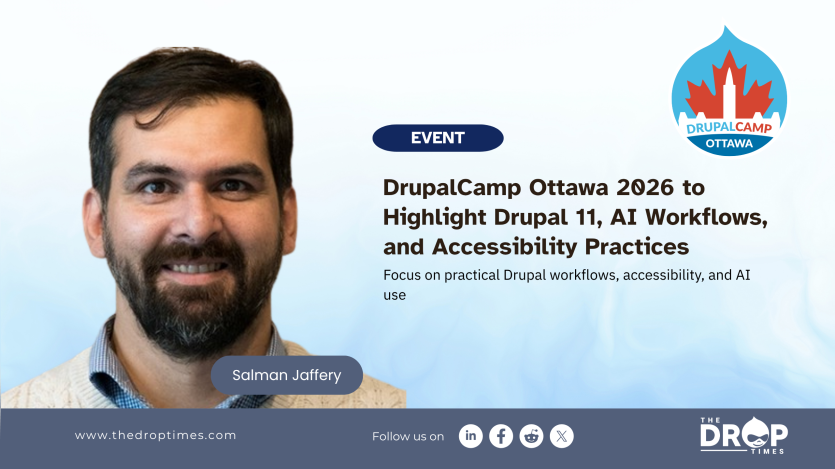
Set for 1 May 2026 at the Canada Science and Technology Museum, DrupalCamp Ottawa returns with a programme that reflects how Drupal work is being executed across projects rather than how it is introduced. The free, full-day event brings together developers, designers, content strategists, and public-sector teams, with a focus on Drupal 11 upgrades, Recipes, Drupal CMS, accessibility, multilingual delivery, and the integration of artificial intelligence into everyday workflows.
The event is structured to support participation across experience levels without separating audiences into rigid tracks. Introductory sessions, such as Drupal 101, provide clear entry points, while advanced sessions run in parallel, allowing attendees to move between levels based on their needs. This design keeps the event cohesive while still accommodating technical depth.
Across the programme, accessibility is treated as a baseline requirement rather than a specialised topic. Sessions integrate accessibility considerations into content, design, and development workflows, encouraging teams to address them earlier in the process. The expectation is not mastery within a day, but a shift in approach that helps teams avoid common implementation mistakes.
Multilingual delivery receives similar attention, shaped by both Ottawa’s bilingual context and broader improvements within Drupal. Sessions explore translation workflows, configuration strategies, and the growing role of AI-assisted multilingual processes. This reflects a wider change in how multilingual capabilities are approached, moving from a secondary consideration to an early planning requirement in project lifecycles.
The Drop Times connected with the organisers to understand how the programme has evolved. Salman Jaffery, one of the organisers, described a clear shift in how the event is framed.
The shift was really from ‘here’s what’s new’ to ‘here’s what you should be doing next.’
This shift is evident in the stronger emphasis on Drupal 11, Recipes, and the Drupal CMS, with sessions focusing on workflows teams are expected to adopt in active projects. Artificial intelligence is also positioned within these workflows, appearing across content, automation, and multilingual processes rather than as a separate discussion track.
“It’s less about AI as a standalone topic, and more about how it fits into the day-to-day work people are already doing.”
Beyond sessions, the event's structure reflects an understanding that interaction plays a central role in knowledge exchange. The venue layout, museum access, and informal spaces are designed to bring participants together across roles, including developers, designers, and institutional stakeholders. These shared environments support conversations that extend beyond formal presentations and contribute to practical problem-solving.
The camp's operational model remains a defining feature. DrupalCamp Ottawa continues to operate without an entry fee, a decision that depends on coordination across sponsorship, logistics, and volunteer participation. Organisers emphasise that sustaining this model requires deliberate planning rather than scale alone.
“For a free event to work at this scale, it really has to be intentional. It’s not just about making it free; it’s about making sure everything around it supports that decision.”
This includes designing sponsor participation around engagement rather than visibility, and managing attendee flow and registrations to maintain balance. The approach reflects a broader emphasis on community interaction as a core value rather than a secondary outcome.
The camp also reflects its local environment. Ottawa’s strong public-sector presence influences recurring themes such as accessibility, governance, and multilingual delivery, while the programme remains relevant to agencies and contributors beyond the region. The event serves as both a reflection of local practice and a space for ideas to circulate more broadly within the Drupal ecosystem.
Success is measured less by attendance numbers and more by participants' outcomes. Organisers point to connections formed, ideas exchanged, and continued engagement within the community as indicators of impact. Returning participants and expanded networks are seen as signs that the event continues to serve its purpose.
DrupalCamp Ottawa 2026 will feature keynote participation from Rod Martin and a programme spanning beginner to advanced topics, alongside networking opportunities, refreshments, and access to museum exhibits. Further details, including registration and session information, are available on the official DrupalCamp Ottawa website.
 Kazima AbbasKazima Abbas is a sub-editor at The Drop Times

ASK: Drupal Community Needs Your Support
View all →
Note: The vision of this web portal is to help promote news and stories around the Drupal community and promote and celebrate the people and organizations in the community. We strive to create and distribute our content based on these content policy. If you see any omission/variation on this please reach out to us at #thedroptimes channel on Drupal Slack and we will try to address the issue as best we can.

Related Events


Related People


You may also like