



New PHP Starter Framework Attempts to Simplify Server-Rendered App Setup

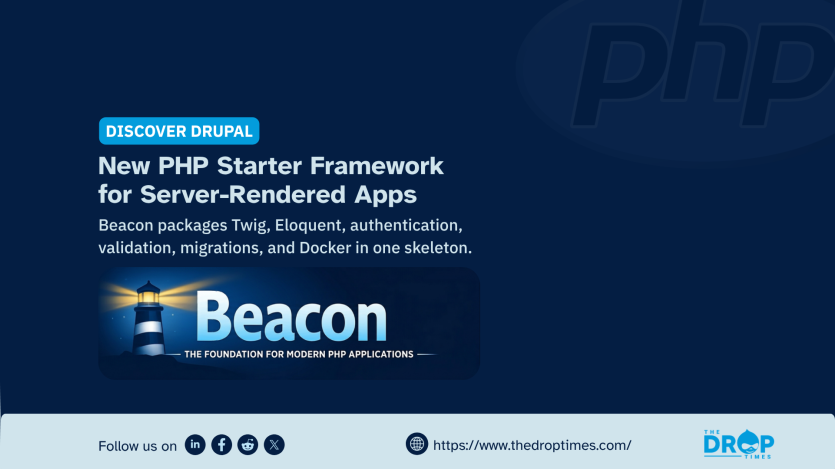
Open-source developers have a new PHP application starter in Beacon, a framework created by developer Steffen Haase for server-rendered projects that do not require a JavaScript-first starter stack. Beacon requires PHP 8.5 or later. Haase introduced the project in a Medium post, stating that it is intended as an alternative starting point rather than a replacement for Laravel or Symfony.
According to Haase, Beacon grew from repeated experience with applications that needed routing, dependency injection, authentication, validation, migrations and templating without requiring a separate frontend framework or JavaScript build pipeline. He said the objective was to provide a coherent PHP foundation containing features he uses across many projects. The project remains a work in progress, and Haase has asked other PHP developers for feedback on its architecture and trade-offs.
Beacon combines Twig templates with established PHP packages, including Laravel’s illuminate/database component, symfony/routing, symfony/validator, PHPMailer, Monolog, Carbon, Ramsey UUID and phpdotenv. The project is distributed on Packagist as shworx/beacon. Version 1.3.0 lists PHP ^8.5.0 as its minimum runtime requirement.
The project documentation describes an opinionated application skeleton with controllers, middleware, models, services, Twig views, database migrations, Docker configuration and tests. It also covers routing, dependency injection, validation, mailing, request handling and helper utilities. These components are assembled as a ready-to-use project structure rather than presented as independently selected packages.
Beacon occupies a narrower position than Laravel or Symfony rather than attempting to replace them. Its proposition is to pre-assemble a Twig-first, server-rendered PHP foundation so developers can begin without first choosing a frontend framework, starter kit or JavaScript build pipeline. That distinction reflects Haase’s stated motivation without turning the project into a direct framework rivalry.
For Drupal developers, the comparison is architectural rather than migratory. Drupal also relies on Composer, Twig and Symfony components, but adds content modelling, configuration management and an extension ecosystem that Beacon does not attempt to provide. Beacon therefore offers a smaller setting in which to examine routing, middleware, validation and dependency injection outside a CMS.
The project remains at an early stage. At review on 10 July 2026, Packagist reported nine installs and no dependents, while the GitHub repository showed ten stars, two forks and no open issues or pull requests. Those dated figures support treating Beacon as an emerging open-source framework experiment rather than an established production ecosystem.

ASK: Drupal Community Needs Your Support
View all →
Disclosure: This content is produced with the assistance of AI.
Note: The vision of this web portal is to help promote news and stories around the Drupal community and promote and celebrate the people and organizations in the community. We strive to create and distribute our content based on these content policy. If you see any omission/variation on this please reach out to us at #thedroptimes channel on Drupal Slack and we will try to address the issue as best we can.

Related People


You may also like