



Study Proposes 13 Areas for Measuring Government Open Source Maturity

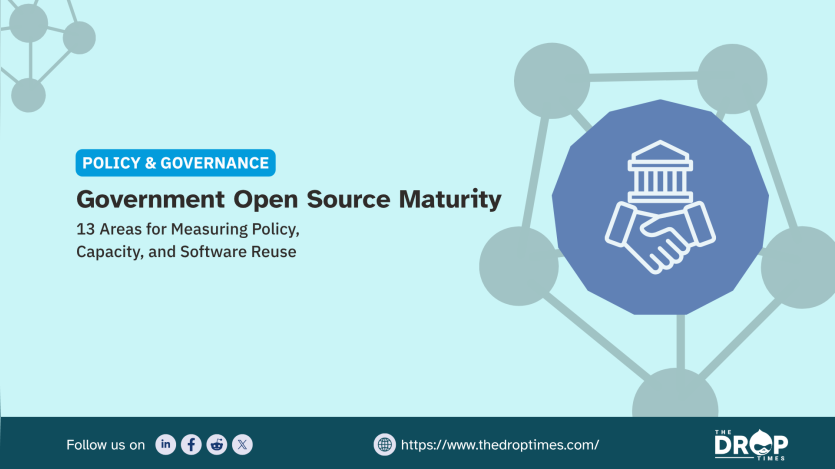
Researchers Johan Linåker and Sachiko Muto of RISE Research Institutes of Sweden have proposed 13 areas for measuring how governments enable open source software. Their open-access paper, Advancing Digital Government through Open Source Indicators, was published online on 11 July 2026 in Journal of Systems and Software. The study examines policy and institutional support across 16 digitally mature countries using policy and regulatory documents, country reports, and semi-structured interviews with current or former government representatives. Interviewees reviewed the country findings, followed by additional member checking of the combined report. The study extends an earlier report commissioned by the Danish Agency for Digital Government and Local Government Denmark.
The study’s central distinction is between announcing an open source policy and building the institutional capacity to carry it out. It identifies inbound policies for acquiring open source software, outbound policies for releasing publicly funded software, and external-facing measures intended to support national technology industries, with examples of the latter in South Korea, Japan, and Colombia. Government rationales include reducing duplicate spending and vendor dependence, improving interoperability, strengthening digital sovereignty, increasing transparency, and addressing security. The paper presents security both as a potential risk, because publicly available code can expose vulnerabilities, and as a benefit of transparent review and collaborative maintenance.
Policy intent, the authors argue, depends on implementation through central public bodies, Open Source Program Offices at several levels of government, neutral steward organisations, subnational collaboration, guidance, communities of practice, training, software catalogues, common metadata, and shared code-development platforms. Smaller public bodies may need to pool resources for governance and maintenance because they cannot sustain specialist capacity independently. The country cases also show that support initiatives can become inactive when mandates or temporary funding expire. Successful reuse sometimes begins with software developed by one public organisation and later placed under collaborative governance involving other public bodies and external contributors.
The proposed framework covers 13 areas:
- inbound policy;
- outbound policy;
- external-facing policy;
- public-sector Open Source Program Offices;
- neutral stewardship bodies;
- subnational activity;
- policy support and capacity-building;
- engagement with national and international open source ecosystems;
- guidance for acquiring open source software;
- guidance for releasing software;
- skills and training;
- public-sector software catalogues; and
- national code-hosting and version-control platforms.
Suggested measures examine policy maturity and coverage, software acquisition and release, funding and participation, training outcomes, catalogue and metadata use, project activity, contributor onboarding, and platform accessibility. The authors do not present a country ranking or a ready-to-adopt index; they say the indicator set is too extensive for wholesale use and should be prioritised and adapted to national contexts. They also caution that the research focuses on digitally mature countries, generally relies on a small number of interviewees for each country, captures a changing policy landscape at one point in time, and does not include vendors, civil society organisations, or the broader open source ecosystem among its interview subjects.
The paper does not assess Drupal or any other content management system directly. For public-sector Drupal teams, however, the framework offers a checklist for examining whether procurement rules, code-release procedures, shared maintenance, software discovery, supplier capacity, and contribution pathways support meaningful reuse. Publishing source code alone would represent only one part of the institutional support described by the study.


ASK: Drupal Community Needs Your Support
View all →
Disclosure: This content is produced with the assistance of AI.
Note: The vision of this web portal is to help promote news and stories around the Drupal community and promote and celebrate the people and organizations in the community. We strive to create and distribute our content based on these content policy. If you see any omission/variation on this please reach out to us at #thedroptimes channel on Drupal Slack and we will try to address the issue as best we can.

Related People


You may also like