



Atelier Packages Drupal as a Self-Contained Site Builder

Website owners can run Atelier as a self-contained Drupal site builder and test a disposable browser demo hosted by Drupal Forge. Shibin Das, founder of FlowDrop, introduced the AIncient Labs project in a LinkedIn post as an attempt to make Drupal usable by people without prior experience with the platform. Each installation creates and configures its own curated Drupal site rather than connecting the console to a separate existing site.
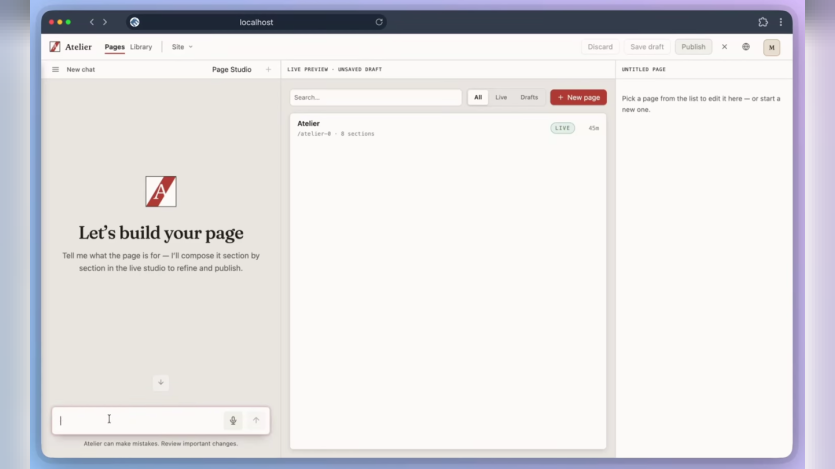
Atelier keeps much of Drupal’s conventional administrative interface outside the default workflow. Through the operator console, users can describe pages in plain language, edit structured fields, preview changes, and approve publication. The design system and global controls apply branding, navigation, and site identity across pages, while FlowDrop exposes Drupal capabilities to the assistant as tools. Drupal remains underneath for structured content, revisions, workflows, translation, menus, and media, and experienced users can access more of the platform beyond the supported defaults.
Atelier requires Docker and currently offers a desktop application, a Homebrew-managed command-line option, a one-line installer, and a manual Docker Compose path. During onboarding, site owners connect an AI provider or a local Ollama server. The public Drupal Forge sandbox instead supplies a shared trial connection. Sites can be exported as static HTML for deployment without a running Drupal application. The Drupal codebase is licensed under GPL-2.0-or-later, while the browser-side React console uses the MIT license.
Image Attribution Disclaimer: At The Drop Times (TDT), we are committed to properly crediting photographers whose images appear in our content. Many of the images we use come from event organizers, interviewees, or publicly shared galleries under CC BY-SA licenses. However, some images may come from personal collections where metadata is lost, making proper attribution challenging.
Our purpose in using these images is to highlight Drupal, its events, and its contributors—not for commercial gain. If you recognize an image on our platform that is uncredited or incorrectly attributed, we encourage you to reach out to us at #thedroptimes channel on Drupal Slack.
We value the work of visual storytellers and appreciate your help in ensuring fair attribution. Thank you for supporting open-source collaboration!

ASK: Drupal Community Needs Your Support
View all →
Note: The vision of this web portal is to help promote news and stories around the Drupal community and promote and celebrate the people and organizations in the community. We strive to create and distribute our content based on these content policy. If you see any omission/variation on this please reach out to us at #thedroptimes channel on Drupal Slack and we will try to address the issue as best we can.

Related Drupal Initiatives

Related Organizations

Related People


You may also like