



DrupalCamp England 2026: From Experimentation to Implementation

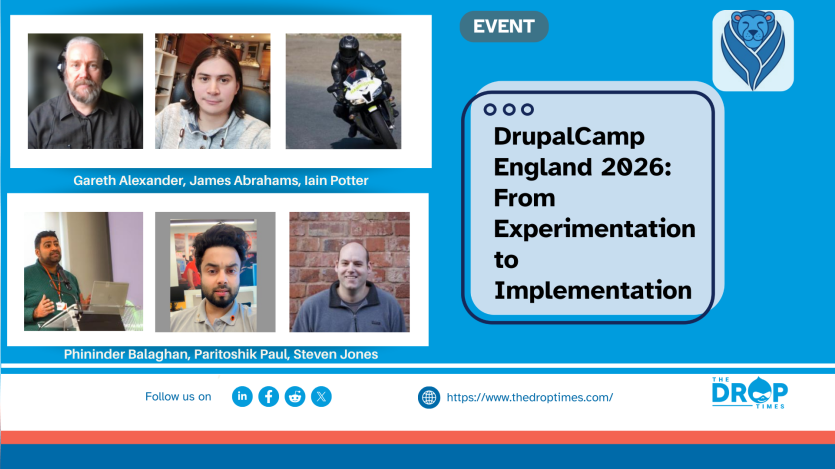
DrupalCamp England returns on 28 February–1 March 2026 at the University of Salford with a programme that signals a clear shift in tone: 2026 is no longer about experimenting with artificial intelligence in Drupal, but about implementing it responsibly, architecturally, and at scale.
After a strong debut in Cambridge, DrupalCamp England enters its second edition with expanded space, a broader programme, and a more defined intellectual focus. What began as a national gathering is quickly becoming a forum for examining where Drupal is heading next — particularly as AI moves from proof-of-concept demonstrations into production workflows.
Saturday features curated sessions spanning digital transformation, accessibility, architecture, and modern Drupal practices. Sunday turns toward hands-on workshops, AI-focused training, “Drupal in a Day,” and contribution sprints. The structure reflects a deliberate progression: from discussion to application.
Fixing What’s Missing in Drupal’s Architecture
Gareth Alexander, alongside Tony Barker, addresses a structural gap many Drupal teams encounter but rarely formalise. Their session, Same Image, Different Story: Why Drupal Needs Contextual Architecture, explores how missing contextual modelling affects accessibility compliance, editorial workflow efficiency, storage duplication, and media governance.
“If you are a developer, a site builder, a content strategist, an accessibility advocate, or anyone interested in helping to shape Drupal's content architecture future, we have a call to action and will outline steps on how we can make Drupal better.”
The session moves beyond diagnosis, outlining practical next steps toward architectural refinement within core and contributed ecosystems. For teams wrestling with duplicated media assets or contextual alt text challenges, the discussion connects governance, usability, and long-term maintainability.
Beyond the code, Gareth is looking forward to something just as important.
“I love getting together with community members. It is easy to become siloed and work only within a bubble, but events like this bring other enthusiasts together. It reminds me we have an amazing group of people in the community working on remarkable things.”
AI Agents and Production-Ready Value
James Abrahams presents Drupal CMS AI – No-code Visual AI Agent Builder, showcasing the Flowdrop UI for Agents module. Originally demonstrated to the European Commission Drupal Community of Practice and at a related hackathon, the interface consolidates agent orchestration into a unified visual environment.
The system works alongside existing agents such as the Drupal CMS AI Assistant, enabling integration with external services through MCP while allowing teams to configure and generate AI agents through visual workflows. The emphasis is on reducing operational friction between prototype and production.
“AI has truly taken off and 2026 is the year where we need to produce real value and no longer PoCs. It has been slower than I had hoped, but it is really the case now.”
“Honestly, one thing I'd say about DrupalCamp England is don't listen to me. There are many talks from many people doing important work with AI. The AI community in Drupal is much bigger now.”
James was among the earliest advocates driving structured AI experimentation within Drupal. His reflection underscores a broader institutional shift: AI development in the ecosystem is no longer concentrated around a small pioneering group but distributed across multiple contributors with deep technical backgrounds.
The shift is practical. AI tooling in Drupal is moving beyond isolated proofs-of-concept toward integrated workflows. Visual interfaces are lowering the barrier to orchestrating agents, while integration patterns between Drupal and external systems continue to mature.
In the most recent Driesnote, integration patterns such as Figma-to-Drupal workflows were publicly demonstrated, reflecting experimentation moving into tangible tooling. Parallel efforts are underway to integrate orchestration layers such as Claude Code directly into Drupal environments, enabling AI agents to be managed within structured application contexts rather than external sandboxes.
Increasingly, the emphasis is not novelty but operational value — ensuring AI capabilities align with governance, architecture, and measurable outcomes.
Winning the Answer in an AI-Driven Web
Iain Potter, in Protect the Brand, Promote the Brand: Navigating the New Era of AI Bots, examines how AI-driven discovery is reshaping digital visibility. The session cites AI bots as accounting for 51% of web traffic — a 300% increase that is disrupting traditional search and referral patterns.
As conversational interfaces increasingly mediate how users find and interpret information, the competitive landscape shifts from attracting clicks to ensuring accurate representation within AI-generated answers. Structured data, governance, and technical clarity become critical to maintaining authority in this environment.
The session reframes brand protection not as a marketing exercise alone, but as an architectural responsibility — understanding how automated systems interpret, surface, and contextualise Drupal-powered content.
From Artificial to Augmented Intelligence
Dr Phininder Balaghan, in The Augmented Future: Winning with AI, reframes AI not as a replacement but as augmentation, questioning whether experimentation has translated into measurable return on investment.
“We’ve been focusing on the ‘Artificial’ in AI since the ‘Big AI Bang’, but really we should be focusing on ‘Augmentation’.”
He describes what he calls the “PoC graveyard” — initiatives that stall because AI is positioned as a substitute for human judgment rather than as a structured enhancement of it. The discussion bridges leadership strategy and engineering implementation, reinforcing governance, delivery alignment, and sovereignty over data and models.
Design Systems That Scale
Paritoshik Paul presents Building a Design System Using UI Pattern Suite in Drupal, focusing on sustainable, component-driven front-end architecture across Drupal 10 and 11 builds.
The session centres on the UI Suite ecosystem, a community-driven initiative aimed at strengthening structured interface development within Drupal’s existing entity, field, and templating systems. Rather than treating components as isolated layout elements, the approach emphasises alignment with Drupal’s internal rendering architecture and long-standing content modelling paradigms.
Drawing from practical implementation experience, Paritoshik examines how reusable UI Patterns can be structured, versioned, and integrated with tools such as Field Groups, Field Templates, and Views to support long-term maintainability. The focus is on establishing repeatable front-end governance that scales with project complexity rather than relying on ad hoc design decisions.
Within the wider context of DrupalCamp England 2026, the session reinforces a consistent programme theme: architectural maturity depends on clarity, reuse, and systems thinking — whether in AI orchestration or interface design.
Concurrency, Performance, and the Power of PHP Fibers
Steven Jones brings a deep technical focus to DrupalCamp England 2026 with his session, Suspending Reality: PHP Fibers in Drupal Core and beyond. PHP Fibers were introduced in PHP 8.1 and are now gaining real traction in Drupal core, contributing to significant performance improvements in Drupal 11.3 and enabling applications to handle larger volumes of traffic without sweeping architectural rewrites.
This session is aimed at PHP and Drupal developers who are completely unfamiliar with Fibers, curious about how they differ from other concurrency models, or ready to go deeper if they already know a little. As Steven explains,
“People should attend my session because it'll give them a good grounding in what can be a confusing and complicated subject: Concurrency in PHP, specifically looking at Fibers that were introduced in PHP 8.1.”
He will show how Drupal core has used Fibers to drive performance improvements without vast restructuring and how developers can apply the same thinking in their own projects. The session also addresses common misconceptions about what Fibers are not, what problems they do and do not solve, and how to approach debugging tools and error handling so that if developers find themselves in the middle of a Fiber’s execution, they know what’s what. Attendees will leave with a clear understanding of what PHP Fibers actually are, where they appear in Drupal today, and how to develop and debug with them confidently.
“I'm most excited to reconnect with the Drupal community again at Drupalcamp England 2026, there are lots of lovely people coming and it's always great to catch up and find out what people are up to!”
A Community in Transition
From its inaugural gathering in Cambridge to its expanded presence in Salford, DrupalCamp England mirrors Drupal’s own evolution — from experimentation to implementation, from exploration to refinement.
Across two days, discussions centre on production-ready AI, contextual architecture, scalable design systems, and responsible governance.
Programme details and registration information are available via the official DrupalCamp England website.
 Alka ElizabethMy puns are intended.

ASK: Drupal Community Needs Your Support
View all →
Note: The vision of this web portal is to help promote news and stories around the Drupal community and promote and celebrate the people and organizations in the community. We strive to create and distribute our content based on these content policy. If you see any omission/variation on this please reach out to us at #thedroptimes channel on Drupal Slack and we will try to address the issue as best we can.

Related Event Sessions


Related Events



Related People


You may also like