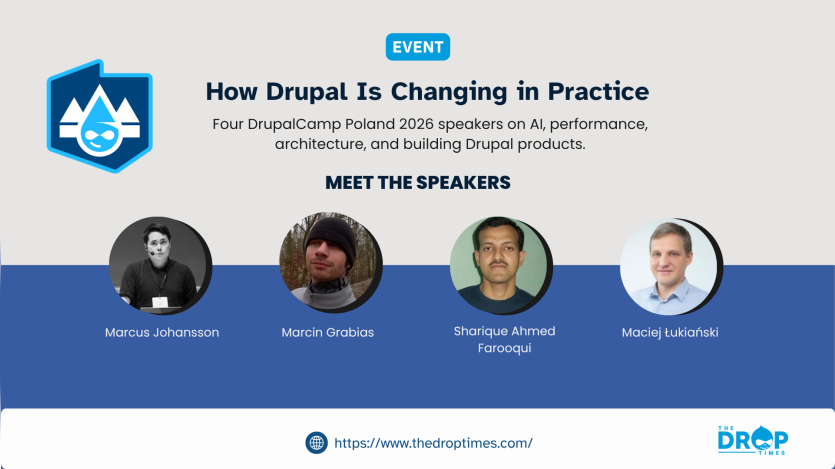
Speakers heading to DrupalCamp Poland 2026 are using their sessions to examine how working with Drupal is changing across AI, performance, architecture, and product delivery. The conference takes place on 12 September 2026 at Wrocław Technology Park, bringing developers, technical leads, project managers, business representatives, and other open-source practitioners together for a one-day programme. Organisers say DrupalCamp Poland has now brought the community together across 15 editions.
The current programme puts several changes affecting Drupal teams into the same room. Artificial intelligence appears in sessions on language-model hallucinations, agentic support and maintenance, the effect of AI tools on development, and Drupal AI itself, while other talks cover Cache API, headless Drupal Canvas, visual site building with Display Builder, architecture, operational problems, and Drupal-based products. Taken together, the schedule is less about showing that Drupal can do another task and more about the decisions developers and agencies must make as the platform, its surrounding tools, and delivery expectations continue to change.
Ahead of the conference, The DropTimes reached out to four DrupalCamp Poland speakers about why their sessions matter, what attendees should take away, and what they are looking forward to at the event. Their written responses range from the rapidly developing Drupal AI ecosystem and performance work below familiar caching APIs to architectural variety and the challenge of turning Drupal expertise into a product people can adopt without first becoming Drupal specialists. The conference opens at 9:30 CEST, with the current programme running through 16:50 CEST at the Delta Building, 9 Duńska Street; the venue information says tickets include the sessions, a meal, a coffee break, and access to the evening afterparty.
Marcus Johansson, a maintainer of the Drupal AI module, will present Drupal AI module 2.0 from 16:05–16:50 CEST in Room 1. The English-language session presents the Drupal AI module as a framework rather than a single feature, with attention to its architecture, core concepts, helper capabilities, and wider goals. The session description also points to AI Agents and AI Automators as examples of frameworks being built around that foundation.
The 2.0 wording needs some context for readers following the project outside the conference. As of 10 September 2026, Drupal.org lists a `2.0.x-dev` development branch for the AI project, while stable releases remain on the 1.x line, so the session title should not be read as an announcement that a stable Drupal AI 2.0 release is already available. Drupal.org describes the AI project as the technical foundation for integrating language models and automation into Drupal, with AI Automators able to populate fields from existing context and AI Agents providing a framework in which agents can act on Drupal configuration and content through tools.
In written responses to The DropTimes, Marcus said the broader pace of that work is central to what he wants attendees to understand. One reason to attend, he said, is:
“To get an understanding of what can be done with AI and just how fast everything is moving and what you can do today with Drupal.”
–Marcus Johansson
He also wants people to come away with a clearer view of what is happening across Drupal, Drupal AI, and the wider AI Initiative rather than treating the session as a demonstration of one isolated AI feature.
Marcus is also watching developments outside his own session. He singled out Pierre Dureau's Display Builder, the HTMX-powered visual builder, scheduled from 15:10–15:55 CEST in Room 1, after previously seeing pieces of the work. He told The DropTimes that checking the project's current status at the conference would be particularly interesting to him.
Marcin Grabias, a senior Drupal engineer, will approach another familiar Drupal problem from below the surface in Cache API, dlaczego "mi się nie aktualizuje"?. The Polish-language session is scheduled for 11:45–12:30 CEST in Room 2 and begins with situations many Drupal developers recognise: an entity or configuration is changed, but a custom block, controller, or other output does not reflect that change as expected. The official session scope covers how Cache API works, what Drupal caches and when, using caching correctly in custom code, and practical caching conventions.
Marcin told The DropTimes that the talk grew from several problems he encountered while working for a local agency near the end of 2025. Investigating what initially looked like straightforward caching mistakes led him into Drupal's Render API, lazy builders, and newer performance work using PHP Fibers, which he described as evidence that Cache API is only the visible part of a larger performance problem.
“So the session is about cache API, render API and further optimizations.”
–Marcin Grabias
Drupal core's recent performance work gives that progression additional context. PHP Fiber support was introduced into Drupal's default Renderer and BigPipe rendering systems in Drupal 10.2, allowing placeholder rendering to suspend while other pending rendering work proceeds, and Drupal 11.3 replaced the older path-alias preload cache with a Fiber-based mechanism that can collect alias requests across Fibers and load them together. Drupal's change record advises custom and contributed module developers to use placeholders and #lazy_builder correctly where appropriate so rendered elements can benefit from this and related performance improvements.
Marcin said his aim is therefore broader than preventing stale output after an administrator edits an entity or configuration. He wants attendees to understand enough of the relationship between caching and rendering to avoid those errors while also improving overall site performance. His session turns a common debugging complaint into a route toward understanding why Drupal's caching behaviour depends on how custom output is rendered, invalidated, and deferred.
Sharique Ahmed Farooqui, a Drupal developer and open-source contributor, will take a wider architectural view in Drupal - unlimited possibilities. The English-language session runs from 16:05–16:50 CEST in Room 2 and uses different Drupal use cases to discuss the basic architectural approaches behind them. The official description ranges from smaller standalone websites to multilingual and multisite systems, intranets, news portals, e-commerce projects, integrations, and platforms that can act as a backbone for many sites.
For Sharique, the useful point is not simply that Drupal supports a long list of site types. He told The DropTimes that after about 15 years working on Drupal projects, he still encounters cases he has not handled before, which is why he wants the session to expose attendees to different approaches within the limited time available.
“I'm trying my best to bring different approaches in limited time slot.”
–Sharique Ahmed Farooqui
Sharique said the principal takeaway should be a new use case or a different way of approaching Drupal project delivery that attendees can carry into their own work. He is also looking forward to reconnecting with fellow Drupal practitioners and agency owners after spending some time away from Drupal-focused activity. His response acknowledged the professional side of those community conversations as well, including the possibility that reconnecting at the camp could lead to another substantial project.
Maciej Łukiański, chief executive officer and co-founder of Droptica, will focus on a different problem facing Drupal agencies: how to avoid competing only as another supplier of project hours. His English-language session, Market differentiation by building a product on Drupal - the example of Open Intranet, is currently scheduled from 10:00–10:45 CEST in Room 1. Maciej said the talk is for agencies tired of tenders, hourly-rate comparisons, and being placed beside several similar Drupal companies, and will use Open Intranet to show how building a product changed those sales conversations and what went wrong during its first year.
Maciej's central argument is that a recognisable product changes the reason a potential customer approaches an agency.
“When you have a product, people come for that product. They stop lining you up next to other Drupal shops.”
–Maciej Łukiański
He stressed that the session is not intended as a tour of Open Intranet features, but as an examination of what had to change when the company moved from selling Drupal expertise alone to presenting a defined Drupal-based product.
Several of his lessons concern barriers that Drupal developers may barely notice because the underlying tools are already familiar to them. Maciej said the product needs its own website rather than appearing to be another page on an agency website, and he believes installation must become as approachable as systems such as WordPress or PrestaShop if people outside the Drupal development community are expected to adopt it. Composer and DDEV may feel simple to experienced Drupal developers, he said, but they can become a barrier for the people expected to evaluate or operate a product.
The same principle extends into administration. Maciej said concepts such as nodes, taxonomies, and view modes should be hidden where they create unnecessary complexity for an intranet administrator, because a user guide cannot compensate for an interface that exposes implementation details the user does not need. Drupal Recipes have helped the Open Intranet work, he added, but configuration assembly alone did not produce the user experience the team wanted, which led it to develop additional modules.
Maciej also described DrupalCamp Poland as his home camp and said he considers this year's programme particularly strong. At the time of his response, he said he was looking forward to discussions around products and digital sovereignty, but the conversations he most wanted were the less formal ones with agencies considering whether they could ship something of their own rather than relying entirely on client work. That interest fits the argument behind his session: differentiation is not only a question of marketing a Drupal agency differently, but of deciding whether the agency has something distinct for customers to buy.
The common thread across the four speakers is a question of what Drupal expertise now requires in practice. Knowing an API or a module remains important, but their sessions also point toward understanding the systems underneath cached output, deciding how AI should interact with Drupal, choosing architecture according to the problem rather than habit, and designing Drupal products for people who should not need to understand Drupal internals. That mix of technical depth and delivery decisions gives DrupalCamp Poland 2026 a programme concerned as much with how Drupal is used as with what the software can do.
DrupalCamp Poland 2026 takes place on 12 September 2026 at Wrocław Technology Park in Wrocław, Poland, followed by an evening afterparty. Programme details can change close to the event, so attendees should check the conference site for the latest schedule, session information, venue details, and ticket availability. More information is available on the official DrupalCamp Poland 2026 website.
Image Attribution Disclaimer: At The Drop Times (TDT), we are committed to properly crediting photographers whose images appear in our content. Many of the images we use come from event organizers, interviewees, or publicly shared galleries under CC BY-SA licenses. However, some images may come from personal collections where metadata is lost, making proper attribution challenging.
Our purpose in using these images is to highlight Drupal, its events, and its contributors—not for commercial gain. If you recognize an image on our platform that is uncredited or incorrectly attributed, we encourage you to reach out to us at #thedroptimes channel on Drupal Slack.
We value the work of visual storytellers and appreciate your help in ensuring fair attribution. Thank you for supporting open-source collaboration!
Disclosure: This content is produced with the assistance of AI.
Note: The vision of this web portal is to help promote news and stories around the Drupal community and promote and celebrate the people and organizations in the community. We strive to create and distribute our content based on these content policy. If you see any omission/variation on this please reach out to us at #thedroptimes channel on Drupal Slack and we will try to address the issue as best we can.










 Kazima AbbasKazima Abbas is a sub-editor at The Drop Times