



Metaverse Standards Forum Introduces Sneeze Browser Engine

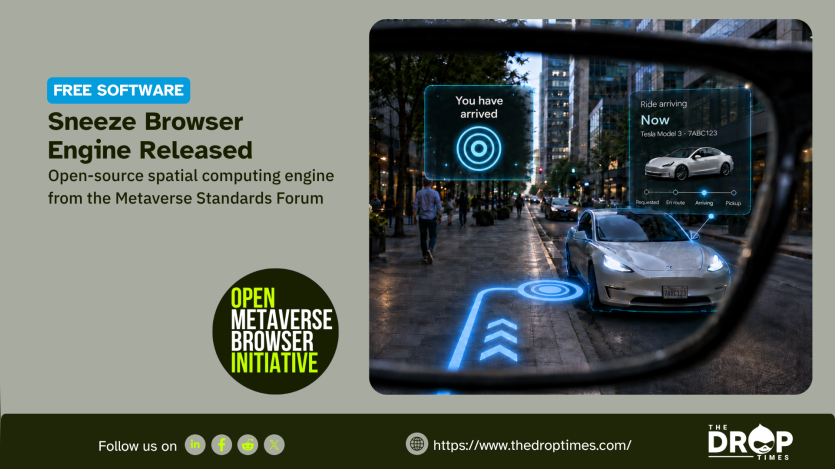
Developers can now access Sneeze, an open-source metaverse browser engine introduced by the Metaverse Standards Forum. The Forum introduced the engine through its Open Metaverse Browser Initiative on 15 June 2026. The release says Sneeze is available under the Apache 2.0 licence and is intended to support spatial services across mobile, desktop, augmented reality (AR), and virtual reality (VR) devices.
The release matters because Sneeze attempts to address what the Forum describes as the absence of a standards-based spatial platform for multi-origin 3D scenes, proximity-based service discovery, and shared presence. The engine is being presented as infrastructure that organisations can embed in browsers or use to build native metaverse browsers. The announcement provides architecture categories and standards references, but it does not include performance data, implementation case studies, or security audit findings.
Sneeze enables self-hosted spatial content that organisations can run on their own infrastructure, according to the announcement. The Forum says the engine can discover and load spatial content based on physical proximity, such as when a user moves through an airport, hospital, or factory. It is also designed to let multiple services contribute to one scene while keeping operators separated through per-service WebAssembly sandboxing.
The technical design centres on multi-origin scene composition through the Scene Object Model (SOM), which the release describes as a way for independent services to contribute to a shared spatial scene. Each operator writes to its own branch of the scene graph, limiting access to another service's data or content. The Forum says the same spatial experience can be shared across AR glasses, VR headsets, phones, and desktops without separate downloads.
Sneeze builds on internet and spatial computing standards cited in the release, including HTTPS, TCP/IP, DNS, ANARI, OpenXR, SPIR-V, glTF, WebAssembly, and Decentralized Identifiers. The release says the new layer is the spatial composition model, related hosting and access infrastructure, and the Sneeze engine itself. Architecture and API documentation are available through the Sneeze documentation.
Neil Trevett, president of the Khronos Group and the Metaverse Standards Forum, told Hypergrid Business that Sneeze focuses on the browser engine layer, including rendering, standards, and interoperability, rather than user-facing features such as avatars, profiles, inventories, or messaging. Sean Mann, co-founder and CEO of RP1 and a Metaverse Standards Forum board member, said in the Forum announcement that RP1 tested a metaverse browser prototype on the current web stack before developing Sneeze through OMBI.
Alongside Sneeze, the University of Rochester launched the Open Metaverse Academic Alliance (OMAA) to connect universities and research institutions with OMBI-related standards work. The release says member institutions will conduct research on the browser engine, contribute to the open-source project, and prepare students and researchers for spatial computing work. It also says the alliance will work with enterprise organisations and invites participation from academic institutions worldwide.
The OMBI team is scheduled to present the project at AWE 2026 in Long Beach, California, during a fireside chat at 16:30 PDT on 16 June 2026. A second roundtable on the OMBI architecture and roadmap is scheduled for 13:40 PDT on 17 June 2026. The release says RP1 is building a native metaverse browser powered by Sneeze and will share further details during and after the event.
Reference: Metaverse Standards Forum Introduces Sneeze, the World’s First Open Metaverse Browser Engine (15 June 2026)

ASK: Drupal Community Needs Your Support
View all →
Disclosure: This content is produced with the assistance of AI.
Note: The vision of this web portal is to help promote news and stories around the Drupal community and promote and celebrate the people and organizations in the community. We strive to create and distribute our content based on these content policy. If you see any omission/variation on this please reach out to us at #thedroptimes channel on Drupal Slack and we will try to address the issue as best we can.

You may also like