



How Public-Sector Work Broadens the Drupal Developer Role

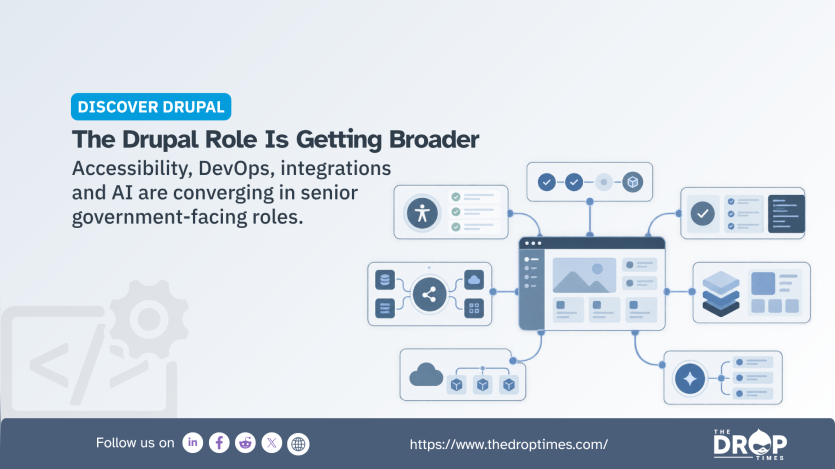
Senior Drupal roles in government-facing teams can describe work that reaches far beyond building and maintaining a content management system. Selected North American vacancies reviewed by The DropTimes combine accessibility, testing, security, delivery pipelines and systems integration with Drupal architecture and development. The job title remains platform-specific, but the responsibilities can extend across much more of the application lifecycle.
Several postings show why those skills cluster together. A Fearless Drupal frontend role for a federal health care platform combines Web Content Accessibility Guidelines compliance, Cypress testing, Git workflows, Single Directory Components and Storybook with a requirement to obtain and maintain Public Trust clearance. RIVA Solutions, Inc. adds Section 508, the U.S. Web Design System, FISMA and FedRAMP to CI/CD, automated testing and Drupal security work, while NuAxis Innovations describes integrations with Login.gov and other government systems alongside vulnerability remediation, audit logging and security-authorisation activities. Accessibility, security and controlled delivery appear here as part of the engineering environment surrounding Drupal rather than concerns added after development.
That breadth does not make Drupal expertise incidental. ASSYST asks its senior developer to architect enterprise Drupal applications, build custom PHP modules and themes, integrate APIs and backend systems, tune performance and maintain the platform's security posture. NuAxis similarly requires Drupal 10 experience spanning custom entities, modules, Webform, REST and JSON:API integrations and configuration management. What expands is not a replacement for platform knowledge, but the range of responsibilities senior developers are expected to carry around it.
Operational responsibility widens the role further. RIVA's lead Drupal position combines architecture and custom development with CI/CD, automated testing, DevOps, security patching and configuration hardening. NuAxis expects developers to run Drupal in containerised environments using Docker or Kubernetes, promote applications through CI/CD and maintain update and security discipline. A Canadian CGI role follows a similar pattern, pairing Drupal architecture and integrations with accessibility, CI/CD, containerised development environments and government digital delivery practices.
Frontend work adds another dimension. The Fearless role centres on Drupal 10 and 11 while asking developers to work with Single Directory Components, Storybook and Web Components, write Cypress end-to-end tests and maintain accessibility across digital interfaces. React and progressively decoupled Drupal architectures appear among its preferred qualifications. The result is a frontend role defined not simply by theming, but by component architecture, design-system implementation, testing and integration with a wider JavaScript ecosystem.
AI-assisted development appears at the edge of this broader remit rather than at its centre. NuAxis asks for substantial experience with AI-assisted programming tools in a governed environment while retaining requirements around Drupal, APIs, containers, accessibility and federal security work. Precise Software Solutions, Inc. likewise asks developers to use GitHub Copilot, Claude and ChatGPT for coding, debugging and documentation within a role that also spans Drupal, Python, Java and Linux and requires Public Trust eligibility. In both cases, AI tooling is layered onto conventional engineering responsibilities rather than presented as a substitute for them.
The commercial enterprise market provides a useful contrast. Infosys places Drupal 9, 10 and 11 inside a wider stack that includes Salesforce, Spring Boot, microservices, React, Vue, Angular, AWS and IBM Cloud. Its requisition also describes AWS Bedrock for Drupal content authoring and landing-page generation and names several AI tools for development, testing, documentation and application modernisation. The posting does not identify a government customer, so it should not be treated as evidence about public-sector hiring, but it shows another way a Drupal role can broaden inside a larger enterprise application and cloud environment.
These vacancies do not establish that this type of Drupal role is new or becoming more common. Some positions have remained open or reappeared across multiple months, making listing dates a poor basis for claims of a recruitment surge. What the postings do show is how several employers define senior Drupal work when the platform sits inside complex delivery environments: strong Drupal knowledge combined with accessibility, security, deployment, integration and newer development tooling. In that context, “Drupal developer” identifies the platform at the centre of the job, but not necessarily the boundaries of the work.
References
ASK: Drupal Community Needs Your Support
View all →
Disclosure: This content is produced with the assistance of AI.
Note: The vision of this web portal is to help promote news and stories around the Drupal community and promote and celebrate the people and organizations in the community. We strive to create and distribute our content based on these content policy. If you see any omission/variation on this please reach out to us at #thedroptimes channel on Drupal Slack and we will try to address the issue as best we can.

You may also like