



Nginx and PHP Release Security Fixes Affecting Drupal Hosting

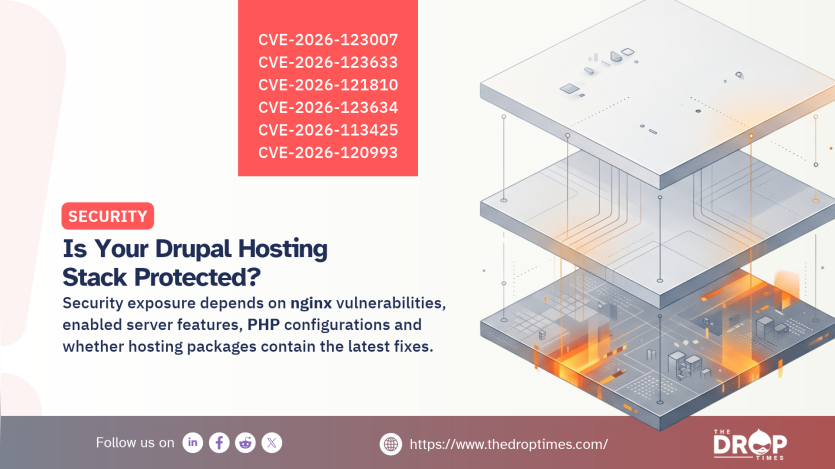
Security updates released for nginx on 18 November 2026 and PHP on 19 November address vulnerabilities relevant to Drupal hosting. Nginx versions 1.31.9 and 1.30.7 fix multiple web-server flaws, according to the project's release announcement. PHP has since issued security releases 8.2.36, 8.3.37, 8.4.28 and 8.5.13.
Both developments are relevant to Drupal hosting because they affect software used to deliver and execute web applications. Nginx handles incoming web traffic and can forward application requests to PHP, which executes Drupal's code. Security flaws in these components can affect a deployed website even when Drupal core and contributed modules are fully patched. The actual exposure depends on server configuration, installed packages and the availability of security fixes.
PHP Releases Critical Security Updates
The PHP Security Team announced on 18 November that its regular release cycle would include fixes for critical issues, some requiring non-default configuration or uncommon setups. On 19 November, PHP published security updates for the supported 8.2, 8.3, 8.4 and 8.5 branches. The official changelog now documents the fixes, while NHS England's security alert reports seven critical, four high and six moderate-severity vulnerabilities, alongside an issue in a bundled library.
Administrators should now compare the published vulnerability details and fixed versions against their runtime configurations, installed extensions and hosting environments. The upstream versions released on 19 November are PHP 8.2.36, 8.3.37, 8.4.28 and 8.5.13. Distribution-maintained builds may carry equivalent backported fixes under different package revisions. The presence of a vulnerable PHP branch alone does not establish that every Drupal installation is exploitable through every reported flaw.
The November security updates are separate from the October PHP2Shell security emergency, which involved two critical PHP vulnerabilities and prompted emergency maintenance across several services, including Drupal.org infrastructure. The November releases do not establish that every newly fixed issue is a recurrence of those October vulnerabilities.
Nginx Fixes HTTP/2 and Other Configuration-Dependent Vulnerabilities
The nginx security advisories identify multiple vulnerabilities corrected in versions 1.31.9 (mainline) and 1.30.7 (stable). Among them is CVE-2026-123007, a memory-corruption vulnerability involving HTTP/2 flow control. Another, CVE-2026-123633, is a use-after-free issue affecting HTTP/2 processing when available worker connections are insufficient. Both require HTTP/2 to be enabled, although the additional exploitation conditions differ.
Security researchers Nir Ohfeld and Tomer Schwartz, writing in a Wiz Research report published on 18 November, described successful unauthenticated remote code execution involving the two HTTP/2 vulnerabilities. The researchers demonstrated exploitation of CVE-2026-123007 on an nginx server serving ordinary static files over HTTPS, without a vulnerable backend application or third-party module. Their report also describes code execution through CVE-2026-123633 in affected reverse-proxy configurations.
Wiz assigned both vulnerabilities a critical CVSS 4.0 score of 9.2. The nginx project uses its own severity classifications, listing CVE-2026-123007 as major and CVE-2026-123633 as medium. The distinction matters because the upstream advisory ratings and independently demonstrated exploitation impact are different forms of security assessment.
Other fixes address a use-after-free vulnerability in HTTP/3, CVE-2026-121810; resolver-related memory corruption, CVE-2026-123634; and a mail-proxy use-after-free issue, CVE-2026-113425. Additional vulnerabilities involve TLS request-body processing, stream-module certificate validation and particular combinations of the try_files and alias directives. The mainline release also addresses a PROXY protocol issue, CVE-2026-120993, that does not affect the stable 1.30 branch.
Each vulnerability has its own affected-version range and configuration requirements. The presence of nginx on a Drupal server does not establish exposure to every issue, and disabling HTTP/2 does not address the full advisory set.
Linux Distributions Report Different Patch Statuses
Linux distribution packages do not always use the same version numbers as upstream nginx releases. Distributors can backport security corrections into older software branches, making package revision numbers and security advisories essential for confirming whether an installation is protected.
On 18 November, AlmaLinux announced patched nginx packages for supported streams across AlmaLinux 8, 9 and 10, as well as AlmaLinux Kitten 10. The distribution also identified retired streams that will not receive the fixes, including the default nginx 1.14 stream on AlmaLinux 8. Administrators using packages from third-party repositories or hosting control panels must confirm updates with those providers separately.
Debian's security tracker for CVE-2026-123007, checked on 19 November 2026, listed several packages as vulnerable. These included the Trixie security package 1.26.3-3+deb13u10. The same tracker marked Debian unstable package 1.30.6-4 as fixed, despite its upstream version number being lower than nginx 1.30.7. Package status is subject to change as security updates become available.
DDEV Clarifies Risk in Default Development Setups
DDEV maintainer Randy Fay addressed the vulnerabilities in an 18 November technical note. According to Fay, normal DDEV configurations are not exposed to the five nginx memory-corruption vulnerabilities discussed under the nginx2root name. DDEV generally uses Traefik as its front-facing router, forwarding HTTP/1.1 traffic to the nginx container, and does not enable the affected nginx features by default.
Fay advised users who have customised nginx configurations or exposed development containers to untrusted networks to review their setups. The assessment concerns DDEV's default development architecture and should not be treated as a security assessment of production Drupal hosting environments.
What Drupal Hosting Teams Should Check
Drupal administrators can begin by identifying installed nginx and PHP versions, checking which web-server features are enabled and reviewing the security updates supplied by their operating-system distributions or hosting providers. Commands including nginx -v, nginx -T and php -v can help establish the software and configuration in use. However, command-line PHP may differ from the PHP-FPM runtime used by a website, and nginx's displayed upstream version may not reflect backported security fixes. Configuration output can contain sensitive information and should not be published without review.
Hosting teams should establish whether HTTP/2 or HTTP/3 connections terminate at nginx or at a separate reverse proxy. Temporarily disabling HTTP/2 may reduce exposure to the two HTTP/2 vulnerabilities while updates are prepared, but it does not protect against the other reported issues and can affect services that depend on HTTP/2, including gRPC. Applying the appropriate security patches remains the preferred response.
Once patched packages are installed, administrators should confirm that updated nginx and PHP processes are running and test affected services. PHP's 19 November security releases are now available, so teams should consult the published changelog, confirm the relevant fixed version or distribution backport, and review their runtime configurations. These infrastructure maintenance tasks cannot be completed solely by updating Drupal core or contributed modules.
References
-
-
-
-
-
NGINX2Root: Patched nginx packages released (18 November 2026)
-
Is DDEV Affected by nginx2root? (18 November 2026)

ASK: Drupal Community Needs Your Support
View all →
Disclosure: This content is produced with the assistance of AI.
Note: The vision of this web portal is to help promote news and stories around the Drupal community and promote and celebrate the people and organizations in the community. We strive to create and distribute our content based on these content policy. If you see any omission/variation on this please reach out to us at #thedroptimes channel on Drupal Slack and we will try to address the issue as best we can.

You may also like