



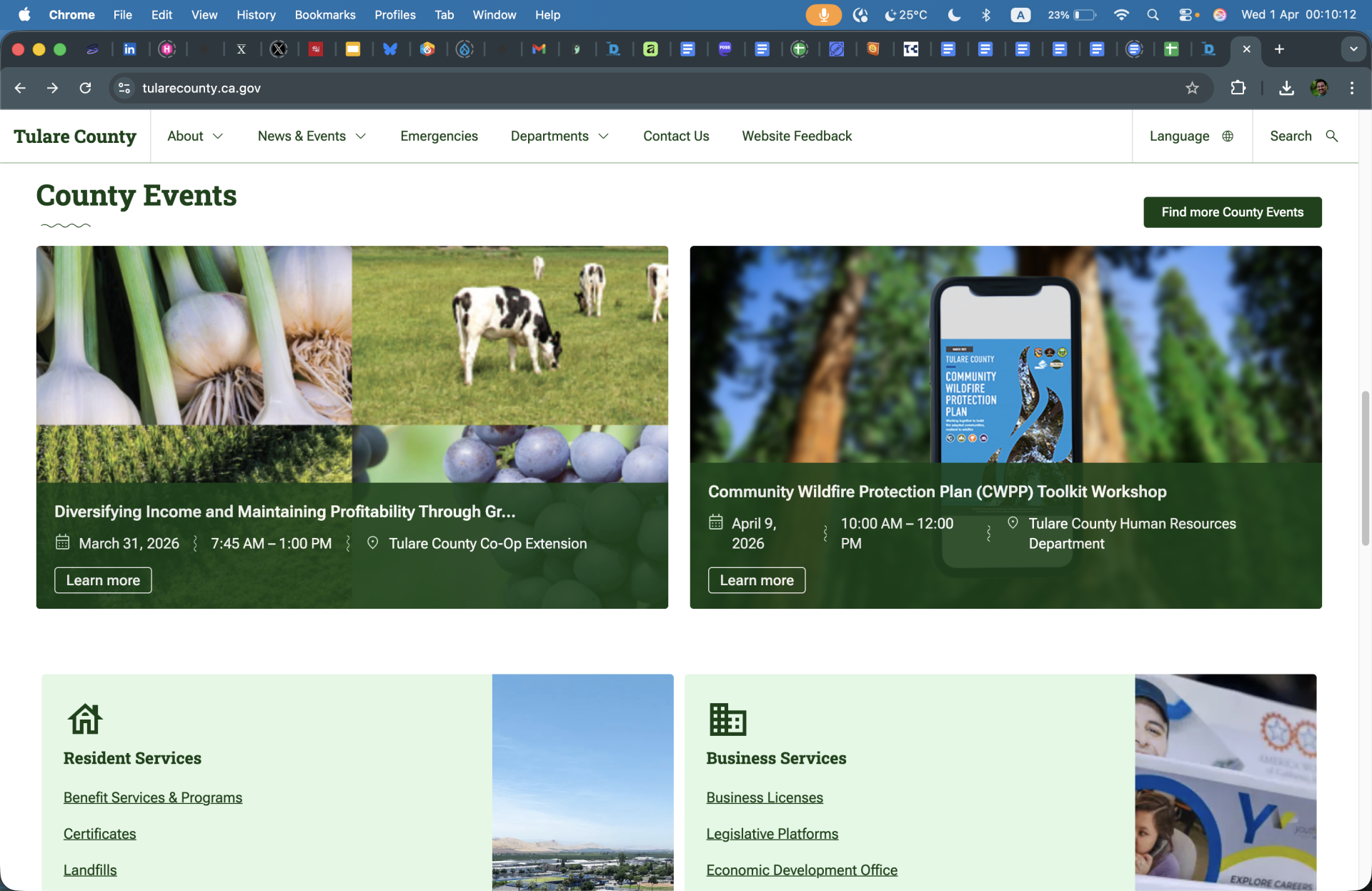
Tulare County Migrates 50 Sites to Drupal Using Acquia Site Factory


Tulare County migrated more than 50 departmental websites to a unified Drupal platform, replacing a fragmented Mura CMS implementation with a multi-site architecture built on Acquia Site Factory.
The implementation was carried out by Hounder, which worked with Tulare County using Acquia’s platform stack to consolidate independently managed departmental sites that had inconsistent design, navigation, and content structures. This fragmentation increased maintenance overhead and made it difficult for residents to locate services. The migration also coincided with the deprecation of the Mura CMS, requiring a transition to a platform capable of supporting long-term scalability and governance.
Multi-Site Architecture with Centralized Control
A single Drupal codebase is deployed through Acquia Site Factory, enabling centralized control while supporting multiple sites and domains. The architecture supports shared configuration, reusable templates, and standardized patterns across county services while maintaining separation between departmental content.

Platform Stack and Supporting Tools
The implementation uses a technology stack centered on Drupal and Acquia services. In addition to Acquia Site Factory, the platform incorporates Acquia Cloud for hosting and infrastructure, Acquia DAM for centralized asset management, and Google Translations to support multilingual access across the county’s services.
Custom Migration Pipeline and Data Reconstruction
Content migration from Mura required a custom pipeline built to interact directly with the legacy system’s SQL database. Mura stores content using GUID-based structures, with separate identifiers linking pages, components, and media assets. The implementation team first reconstructed sample pages manually to understand how fragmented data could be reassembled, establishing a repeatable blueprint for migration. Based on this, scripts were developed to identify individual page elements and assemble them into complete Drupal entities. This approach enabled consistent transformation of legacy structures into Drupal’s content model while preserving relationships between components and dependencies.
The same process was applied to media assets, which were stored either as hashed data within the database or as separate files. Migration scripts converted these into usable files and integrated them into Drupal’s file system, ensuring continuity between content and associated media.
The migration process resulted in 7,228 pages and approximately 16,000 media assets being transferred into Drupal. Once validated, the pipeline enabled repeatable migrations, allowing new or updated data to be extracted and transformed with minimal manual intervention.
In addition to structural migration, the implementation also addressed navigation challenges identified in the previous system. A task-based navigation layer was introduced to allow users to locate services based on actions rather than departmental structures, reducing dependency on internal organisational knowledge.
This migration approach allowed legacy content structures to be normalised into Drupal’s entity system while maintaining referential integrity across content and media.
Governance Model for Distributed Authors
Governance was structured to support more than 300 content authors across the platform. Custom roles and permissions were implemented to restrict access by department, ensuring that authors could create, edit, and manage content within their assigned scope without visibility into unrelated sections. This model was applied consistently across both shared departmental sites and standalone domains within the multi-site environment.
Measured Performance Improvements
Performance improvements were measured following the migration. Page load times were reduced from approximately 4.5–6.5 seconds in the previous system to 0.7–1 second on the Drupal platform.
We began with journey mapping workshops to understand how residents interact with county services and where friction existed. That informed both the site structure and navigation model. On the design side, we focused on creating a consistent visual system that reflects the county’s identity while remaining accessible and easy to maintain. The shift to a unified platform also resulted in significant performance improvements, with internal measurements indicating up to an 85% increase in site speed.
Department-Specific Applications and Integrations
The platform includes custom applications developed to support specific departmental workflows. These include an inmate search system for law enforcement, tools for managing animal services records and tracking lost or found animals, and a GIS-based mapping system to help residents identify waste management services based on location.
These integrations extend the platform beyond content delivery, supporting operational use cases across departments and reducing reliance on external systems.
Hounder has become a close and trusted partner. Their flexibility and commitment to our success are unmatched.
This case study is based on material provided by Hounder. The DropTimes has edited the submission for clarity, structure, and formatting. Technical details and performance figures are presented as provided.
 Hayden BaillioMaking government websites not suck since before it was cool.
Image Attribution Disclaimer: At The Drop Times (TDT), we are committed to properly crediting photographers whose images appear in our content. Many of the images we use come from event organizers, interviewees, or publicly shared galleries under CC BY-SA licenses. However, some images may come from personal collections where metadata is lost, making proper attribution challenging.
Our purpose in using these images is to highlight Drupal, its events, and its contributors—not for commercial gain. If you recognize an image on our platform that is uncredited or incorrectly attributed, we encourage you to reach out to us at #thedroptimes channel on Drupal Slack.
We value the work of visual storytellers and appreciate your help in ensuring fair attribution. Thank you for supporting open-source collaboration!
ASK: Drupal Community Needs Your Support
View all →
Note: The vision of this web portal is to help promote news and stories around the Drupal community and promote and celebrate the people and organizations in the community. We strive to create and distribute our content based on these content policy. If you see any omission/variation on this please reach out to us at #thedroptimes channel on Drupal Slack and we will try to address the issue as best we can.

You may also like