



Basel-Stadt Platform Combines Drupal, AI Chatbot, and User-Centred Public Information

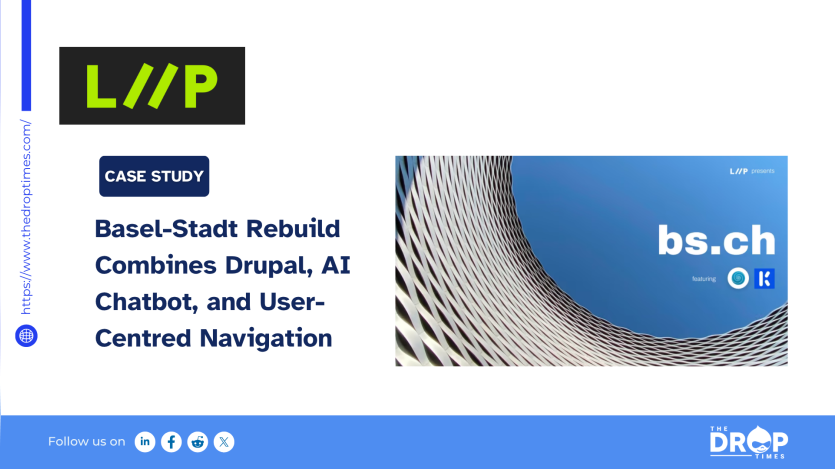
Reorganising government information around citizen needs rather than administrative structures became a central objective in the relaunch of the Basel-Stadt cantonal website, documented across a recent Liip case study and related project documentation. The rebuild replaced department-oriented navigation with topic-based access paths intended to help users locate services and information through everyday concerns such as mobility, housing, and parking.
The new platform combines Drupal with a headless frontend architecture built using Nuxt and Vue. According to Liip, Elasticsearch powers site-wide search while targeted caching improves frontend responsiveness across the platform. The project also introduced “Alva”, described as the first AI-powered chatbot developed for a Swiss canton, designed to answer questions using information sourced directly from the cantonal website.
The relaunch reflects a broader shift in how public-sector information systems are being structured around user behaviour rather than institutional hierarchies. Instead of expecting residents to understand the internal organisation of government departments, the platform attempts to surface information through user tasks, needs, and contextual queries.
Editorial governance and long-term content operations formed a major part of the rebuild. More than 300 editors participated in workflow restructuring, training, and collaborative content production supported by a shared governance and content strategy model. Liip additionally developed the open source blökkli editor to support in-page editing, mobile previews, collaborative review workflows, and long-term maintenance across the platform.
The accompanying “Alva” project documentation places particular emphasis on answer reliability and public trust. According to Liip, the chatbot underwent an extended testing phase involving both user feedback and evaluation by cantonal administration experts tasked with identifying incorrect or misleading responses before deployment.
Liip states that feedback gathered during testing was also used to improve the underlying website content itself, meaning adjustments made for the chatbot simultaneously affected the broader public information platform. The chatbot additionally identifies which source pages and articles were used to generate answers, allowing users to verify information directly and access official documentation referenced in responses.
The project materials frame the chatbot less as an isolated AI feature and more as an extension of the wider information architecture strategy behind the relaunch. In that model, search, navigation, editorial governance, and AI-assisted question answering operate as connected layers intended to improve how residents access public-sector information.
Liip’s documentation also highlights the operational complexity involved in maintaining editorial consistency across multiple departments and hundreds of contributors. The governance model introduced during the rebuild was designed to support sustainable editorial quality rather than treating the relaunch as a one-time redesign effort.
The Basel-Stadt project reflects a broader pattern emerging in public-sector Drupal implementations, where accessibility, content governance, AI-assisted service delivery, and long-term editorial maintenance are increasingly being treated as interconnected operational concerns rather than separate technical initiatives.
References
ASK: Drupal Community Needs Your Support
View all →
Disclosure: This content is produced with the assistance of AI.
Note: The vision of this web portal is to help promote news and stories around the Drupal community and promote and celebrate the people and organizations in the community. We strive to create and distribute our content based on these content policy. If you see any omission/variation on this please reach out to us at #thedroptimes channel on Drupal Slack and we will try to address the issue as best we can.

Related Organizations

You may also like