

Dori Kelner on Burnout, Trust, and Building a Human Workplace

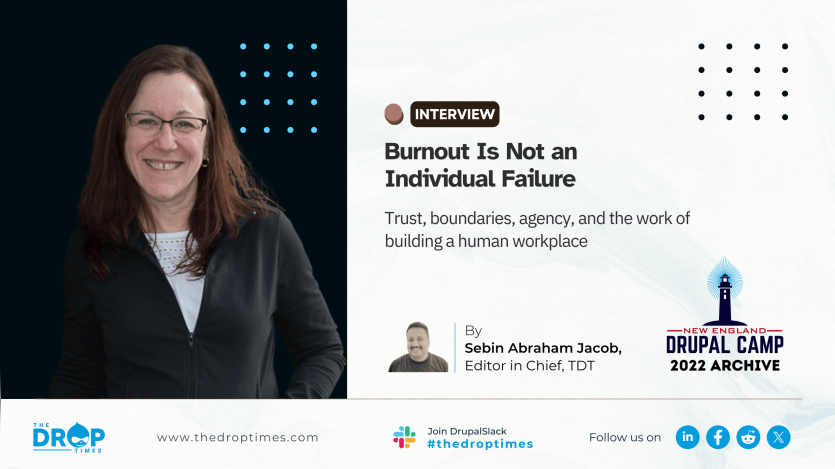
Ahead of NEDCamp 2022, The DropTimes spoke with Dori Kelner about burnout, workplace culture, leadership, and the role of trust, boundaries, agency, and dignity in creating a more human workplace. At the camp, she presented “How to Lead a Human Workplace.”
At the time of the conversation, Kelner was vice president of Human Workplace at Esteemed and founder and principal of Insightful Culture. A longtime member of the Drupal community, she reflected on her path from running a Drupal agency to working on stress management, resilient leadership, and cultural change. She also argued that preventing burnout requires shared responsibility across organizations, managers, and employees.

This written interview was originally published as part of The DropTimes’ short speaker interview series around NEDCamp 2022.
Editor’s note: References to professional roles, pandemic-era workplace conditions, remote and hybrid work practices, and the term “quiet quitting” reflect the context when this conversation took place in November 2022.
TDT [1]: Please introduce yourself and your work in Drupal.
Dori Kelner: My passion is creating workplaces where people can thrive and find happiness. I am a corporate wellness expert, serving as Esteemed’s VP of Human Workplace. Esteemed specializes in people operations and human capital management. My work at Esteemed allows me to help and support our clients in creating people-driven workplaces. Organizations that put people first see significant benefits to morale, ethics, and their bottom line.
TDT [2]: The Drupal community often says that people “come for the code but stay for the community.” How were you first introduced to the community?
Dori Kelner: I’ve been in the Drupal community for about 15 years, initially joining as the owner of a Drupal agency. I was introduced to Drupal when my agency recognized that we needed a robust platform to serve our nonprofit clients. Drupal fit the bill, and over the past 15 years, I’ve made wonderful connections with the community by participating in camps and cons. When I decided to change careers, I knew that the Drupal community would continue to support me.
TDT [3]: What are you presenting at NEDCamp 2022, and who should attend your session?
Dori Kelner: My session at NEDCamp presents a framework for creating the 21st-century human workplace and what leaders need to do personally to support a workplace dedicated to fulfillment and happiness. With people “quiet quitting” in droves, we must understand the value of building engagement, community, and connection. Whether current leaders or aspiring leaders, we all need to embrace the essential skills necessary for serving others.
TDT [4]: With more companies continuing the remote or hybrid work practices they began during the pandemic, work-life balance has to find a new equilibrium. In such an environment, how do you think employees can overcome burnout?
Dori Kelner: It’s easy for us to place the onus on individuals to manage their own mental health. However, it is incumbent on organizations to normalize mental health and cultivate a supportive culture.
Individuals fighting a broken system will not be able to avoid burnout alone.
Organizations, managers, and employees must collectively see the importance of building harmony between work and life and recognize that work is merely one element we all need to juggle daily.
- Organizations need to ensure that employees understand how their role fits into the organizational mission, and employees who do not have this clarity need to ask for it.
- Organizations need to respect work hours, and employees need to enforce boundaries.
- Organizations need to give people agency in where and how work gets done, and employees need to make accommodations to work effectively in different settings.
- Organizations need to treat all people with dignity, and employees need to support one another when they perceive injustice.
When organizations build a culture of trust and caring, employees will find themselves working in flow, the optimal zone for managing their energy. They will face burnout far less frequently, and they will have the tools they need should they recognize the signs of burnout arising.
 Sebin A JacobFighting procrastination at every step is a journey half accomplished
Image Attribution Disclaimer: At The Drop Times (TDT), we are committed to properly crediting photographers whose images appear in our content. Many of the images we use come from event organizers, interviewees, or publicly shared galleries under CC BY-SA licenses. However, some images may come from personal collections where metadata is lost, making proper attribution challenging.
Our purpose in using these images is to highlight Drupal, its events, and its contributors—not for commercial gain. If you recognize an image on our platform that is uncredited or incorrectly attributed, we encourage you to reach out to us at #thedroptimes channel on Drupal Slack.
We value the work of visual storytellers and appreciate your help in ensuring fair attribution. Thank you for supporting open-source collaboration!


ASK: Drupal Community Needs Your Support
View all →

Disclaimer: The information provided about the interviewee has been gathered from publicly available resources. The responsibility for the responses shared in the interview solely rests with the featured individual.
Note: The vision of this web portal is to help promote news and stories around the Drupal community and promote and celebrate the people and organizations in the community. We strive to create and distribute our content based on these content policy. If you see any omission/variation on this please reach out to us at #thedroptimes channel on Drupal Slack and we will try to address the issue as best we can.
Related Organizations

Related People
Related Events


You may also like