



Drupal Security Advisories Highlight Need for AI Code Governance

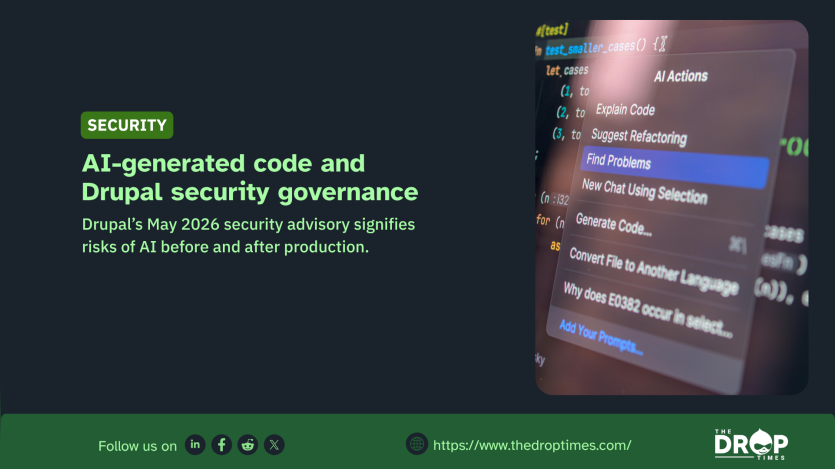
Security response across Drupal’s May and June 2026 core advisories shows why AI-assisted development still needs governance after code enters production. The May advisory, SA-CORE-2026-004, concerned a highly critical SQL injection vulnerability in Drupal core affecting sites that use PostgreSQL databases. The issue was not caused by AI-generated code, but it provides a clear operational example of why maintained platforms, known owners, and tested update processes matter when security risk becomes urgent.
The broader lesson for Drupal teams is not that AI-assisted development should be avoided. It is that generated code that still becomes part of a production system that must be reviewed, patched, monitored, and owned. Multiple sources point to the same conclusion: the speed of generation does not eliminate the need for secure architecture, dependency awareness, and accountable maintenance.
The Drupal Security Team issued advance notice through PSA-2026-05-18 on 18 May 2026, warning that a core security release would arrive on 20 May 2026 between 17:00 and 21:00 UTC. The notice urged site owners to set aside time for updates, as exploits could be developed within hours or days. Drupal.org later updated SA-CORE-2026-004 on 22 May 2026 at 04:30 UTC to say exploit attempts were being detected in the wild.
That sequence illustrates the value of Drupal’s coordinated security process. Advance notice, scheduled releases, and documented remediation gave site owners time to prepare before technical details became widely useful to attackers. Those safeguards still depended on each site having version awareness, maintenance access, database knowledge, and a process for applying and testing updates quickly.
Miggo Security’s research adds a direct AI-security dimension to the same advisory. In a 21 May 2026 report, Eliana Vuijsje and Roy Cohen said they used Claude to generate a working exploit for CVE-2026-9082 within 51 minutes of detecting the public patch, at a token cost of less than US$10. The exercise required human guidance and did not document a real-world compromise, but it showed how quickly public patch information can be analysed and converted into exploit logic after disclosure.
Related Drupal core advisories in June 2026 reinforce the same maintenance point. On 17 June 2026, Drupal published SA-CORE-2026-005, a critical PHP object injection advisory involving JSON:API write access in rare configurations. Further advisories addressed server-side request forgery, improper validation, and cache poisoning and open redirect, each requiring maintainers to understand affected versions, enabled modules, and configuration exposure.
Independent research on AI-generated applications adds a wider software governance context. Escape.tech reported that its team analysed more than 5,600 publicly available AI-generated applications and identified more than 2,000 vulnerabilities, more than 400 exposed secrets, and 175 instances of personally identifiable information. The findings do not show that every generated application is unsafe, but they do support caution when generated output is deployed to public-facing systems without review.
Veracode reported in 2025 that 45% of tested AI-generated code samples failed security checks and introduced OWASP Top 10 vulnerabilities. The company said it tested more than 100 large language models across Java, Python, C#, and JavaScript. Its findings also indicated that models had improved at producing functional or syntactically correct code without corresponding improvement in secure-code performance.
Practitioner experience points in the same direction, though it should be treated as industry interpretation rather than independent proof. In a 30 June 2026 commentary published on Bizcommunity, Adolf Lategan, CTO at Rogerwilco, wrote that the agency increasingly encounters AI-generated code in websites and applications clients ask it to maintain or improve. He argued that such code may work for its intended function while lacking the security controls, architectural discipline, and long-term maintainability required for business-critical systems.
Rogerwilco’s Drupal example is useful because it concerns maintenance under pressure, not because it establishes the facts of the vulnerability. Lategan said the agency had 21 enterprise client sites to secure during the May release window and reviewed, implemented, peer-reviewed, and tested patches as they landed between 19:00 and 23:00 SAST. He also said the agency’s environments were largely unaffected by the underlying vulnerability, which underscores a practical point: patch readiness is required before a team knows whether a specific configuration is exposed.
For Drupal teams, the practical issue is operational accountability. AI can support prototyping, documentation, testing, troubleshooting, and review, but generated output still needs threat modelling, peer review, dependency management, and a defined owner before it reaches production. Drupal’s May and June 2026 security advisories show that when a vulnerability becomes active, security depends less on how fast code was produced and more on whether the system can be understood, updated, tested, and maintained under pressure.
References
 Allen JasonAllen without organs


ASK: Drupal Community Needs Your Support
View all →
Disclosure: This content is produced with the assistance of AI.
Note: The vision of this web portal is to help promote news and stories around the Drupal community and promote and celebrate the people and organizations in the community. We strive to create and distribute our content based on these content policy. If you see any omission/variation on this please reach out to us at #thedroptimes channel on Drupal Slack and we will try to address the issue as best we can.

You may also like