


Matthew Saunders Makes Community Trust a Focus of Board Candidacy

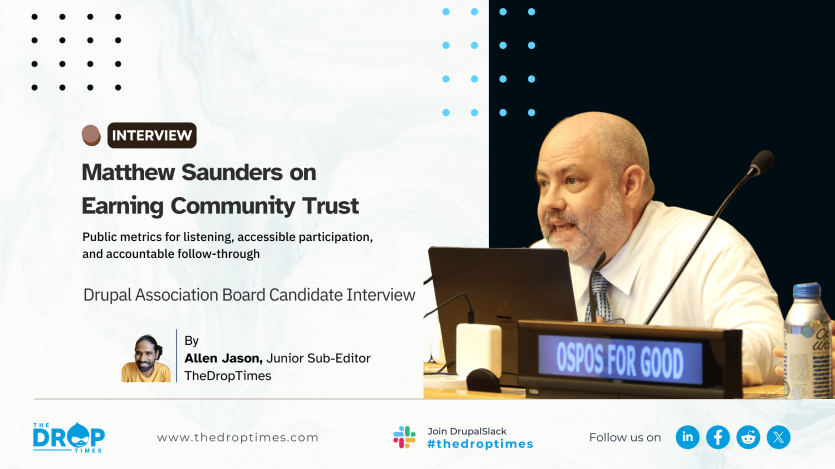
Longtime Drupal community organiser Matthew Saunders says his candidacy for the Drupal Association Board is shaped by a measurable concern: how the Association can earn community trust through consistent listening, accessible participation, and public accountability.
In written answers to TheDropTimes’ Allen Jason, Saunders connects responsible support for AI-related work, organisational contribution, beginner access, digital sovereignty, neuroinclusion, accessibility, and financial resilience through a common question: how the Association can make its decisions, commitments, and results visible to the community.
Saunders has been part of the Drupal community since 2006 and previously served on the Drupal Association Board. His community work has included DrupalCamp Colorado, the Event Organizers Working Group, Drupal Colorado Inc., and the Drupal AI Strategic Initiative.
Drawing on that experience, he proposes structured contribution partnerships, clearer entry points for new users and organisers, universal-design improvements, recurring community surveys, quarterly listening sessions, and public tracking of consultation commitments. His stated measure of success is at least a ten-percentage-point improvement in respondents who say the Association listens, explains its decisions, and acts consistently with Drupal’s values.
This interview is part of TheDropTimes’ (TDT) series with candidates for the at-large seat on the Drupal Association Board. TDT sent each candidate five common questions and two candidate-specific questions to help readers compare their priorities, experience, and approach to the Association’s role.
Interviews in this series are being published as candidates return their completed responses.
TDT [1]: As AI-assisted and agentic site-building grows, what role should the Drupal Association play in protecting Drupal’s open-source values, data privacy, maintainer well-being, and freedom from vendor lock-in?
Matthew Saunders: The Drupal project is responsible for the software. Maintainers, initiative leads, and contributors make decisions about architecture, coding standards, contribution policies, and quality through the project’s established governance processes. The Drupal Association should respect that boundary. Its role is to provide the infrastructure, funding, convening power, advocacy, and organisational continuity that allow the project and its community to address AI responsibly.
The Association can protect Drupal’s values through the choices it controls. When it funds work, forms partnerships, selects vendors, hosts services, or promotes an initiative, it should ask how data is handled, whether users retain meaningful control, and whether the work supports provider choice and portability. It can convene maintainers, agencies, users, privacy experts, and AI practitioners so that the people affected by these technologies help shape the conversation. It can also advocate publicly for open standards, transparent systems, self-hosted options, and architectures that give organisations the freedom to change providers.
Maintainer well-being belongs in that enabling role as well. AI-assisted tools may increase the volume of code, documentation, issues, and support requests reaching the project, but the Association does not decide what maintainers must accept or guarantee the quality of those contributions. It can listen to maintainers, help secure funding and sponsored contribution time, improve the infrastructure they rely upon, and ensure that investment in innovation includes investment in the people carrying the work.
The technical community determines what Drupal builds; the Association helps create the conditions in which that work can remain open, sustainable, and worthy of trust.
TDT [2]: Drupal benefits from enterprise users, agencies, and public institutions, but contributions are still uneven. What should the Drupal Association do to turn more of that use into visible support through developer time, code, documentation, infrastructure, or funding?
Matthew Saunders: The Drupal Association should make contribution easier to understand, easier to plan, and more visible. I have worked inside agencies, small businesses, and a global enterprise, and I know that organisations often support Drupal less than they could because contribution is treated as an informal activity rather than part of their operating model. Developers may need approval to contribute during working hours, legal teams may be uncertain about releasing code, and managers may not know which work would be most valuable. The Association can help by giving organisations practical contribution frameworks that cover developer time, documentation, infrastructure, mentoring, event support, and recurring funding.
I would like to see the Association create a contribution partnership program in which organisations make a public, measurable commitment appropriate to their size and capacity. That commitment might include a number of sponsored contribution hours, funding for maintainers, support for documentation, infrastructure credits, or staff time devoted to mentoring new contributors. The Association could connect participating organisations with clearly identified community needs, provide guidance for internal contribution policies, and publish an annual account of what those commitments produced. The project’s maintainers would continue to decide what code is accepted and how technical work is prioritised.
Recognition should reward sustained contribution rather than one-time visibility. Organisation profiles, partnership benefits, event recognition, and marketplace placement could reflect verified financial and non-financial support. Public institutions and enterprise users should also be encouraged to include contribution expectations in procurement and vendor contracts. The goal is to make support for the commons a normal cost of benefiting from the commons, while recognising that valuable contribution includes far more than code.
TDT [3]: How should the Drupal Association balance investment in enterprise tooling with simpler entry points for junior developers, hobbyists, and new site builders?
Matthew Saunders: Enterprise users provide revenue, employment, technical investment, and demanding use cases that strengthen Drupal. Junior developers, hobbyists, students, and new site builders provide renewal. They become tomorrow’s maintainers, agency founders, trainers, and community leaders. A healthy ecosystem needs both, so accessibility cannot be treated as something we will address after enterprise priorities have been satisfied.
The project’s maintainers and initiative leaders should continue to determine Drupal’s technical direction. The Association can ensure that its funding, promotion, infrastructure, events, and partnerships support clear entry points into that work. I would prioritise better beginner documentation, guided ways to try Drupal without first assembling a complex local environment, structured contribution pathways, mentoring, and support for camps and meetups where people often make their first real connection to the community.
Beginner documentation also needs to cover community participation. I am currently working through the Event Organizers Working Group to update the documentation for running Drupal camps, often called the event playbook. Organising a local event should not require access to unwritten knowledge or an established network of insiders. Clear guidance can help new organisers understand governance, budgeting, sponsorship, accessibility, volunteer management, and succession planning. That creates more places where new users and contributors can find their way into Drupal.
We should measure whether these entry points work. Useful indicators would include the time required for a new user to build a functioning site, the number of first-time contributors who return, participation in mentoring programs, the number and geographic spread of community events, and whether new organisers can use the playbook successfully. Enterprise capability may demonstrate how far Drupal can scale, but a newcomer’s first experience determines whether the community will continue to grow.
TDT [4]: If digital sovereignty is increasingly defined through national ownership, where does that leave a global open-source project like Drupal? How should the Drupal Association argue that distributed international stewardship can offer a credible form of sovereignty?
Matthew Saunders: National ownership can be an important part of digital sovereignty, particularly when governments are concerned about jurisdiction, security, procurement, and dependence on foreign technology companies. Ownership alone does not guarantee meaningful control. A government can choose a domestic vendor and still become dependent on proprietary software it cannot inspect, modify, or maintain without that vendor’s permission. Sovereignty depends on practical agency: knowing how a system works, controlling where data resides, having the ability to change providers, and retaining the capacity to operate the technology over time.
A global open-source project such as Drupal offers a different model. Its code can be inspected, hosted within national borders, adapted to local requirements, and supported by local organisations. At the same time, no single government, company, or vendor controls the entire project. Responsibility is distributed across an international community, which makes the technology more resilient when a particular supplier disappears, changes direction, or becomes politically unacceptable.
During United Nations Open Source Week, I heard governments and public institutions repeatedly ask who controls the technology, who can inspect it, who can maintain it, and what happens if a vendor goes away. Drupal has a strong answer to those questions. A country can maintain local control over its infrastructure and data while benefiting from software stewarded by a community distributed across jurisdictions.
That is sovereignty built through shared capacity and the freedom to leave, rather than dependence on a single owner.
The Drupal Association should make this case more clearly to governments, nonprofits, and public institutions. It can document Drupal’s governance and international contributor base, develop procurement guidance around open standards and portability, build relationships with public-sector open-source programs, and convene organisations working on digital sovereignty. The Association’s role is to help the world understand that distributed international stewardship can provide local control, resilience, and accountability without requiring every country to build and maintain an isolated technology stack.
TDT [5]: What neuroinclusion, accessibility, and universal design improvements would you prioritise for Drupal.org, issue queues, events, and contributor tools?
Matthew Saunders: I would begin by reducing unnecessary cognitive load and making participation more predictable. WCAG conformance provides an essential technical baseline, but accessibility also includes how easily someone can understand where they are, what is expected of them, and what will happen next. Drupal.org needs clearer task-based navigation, consistent language, better search, fewer competing calls to action, and the ability to save progress and return later. Those improvements help people with ADHD, dyslexia, autism, anxiety, fatigue, and cognitive disabilities, and they make the site easier for everyone.
Issue queues and contributor tools need clearer pathways for people who do not already understand Drupal’s unwritten conventions. Templates should explain what information is needed and why. Issue summaries, status labels, ownership, and next steps should be easy to find. Contributors should have more control over notification volume and be able to receive useful digests instead of a constant stream of updates. Keyboard navigation, screen-reader support, colour contrast, plain language, and mobile usability should be tested throughout the contribution process.
Events need the same attention. I am currently working through the Event Organizers Working Group to update the event playbook, and I would like accessibility and neuroinclusion built into that guidance. Organisers need practical help providing advance information about venues and schedules, captions and transcripts, quiet spaces, planned breaks, remote or asynchronous participation, and clear ways to request accommodations. Speakers and volunteers also benefit from knowing expectations before they arrive rather than having to infer them in a busy environment.
The people affected by these systems should help design and test them, and that work should be compensated when possible. I would measure progress through accessibility audits, usability testing with disabled and neurodivergent participants, task completion and abandonment rates, accommodation feedback from events, and whether first-time contributors return. My neuroinclusion advocacy comes from lived experience. I know how much energy people spend navigating systems that assume everyone processes information, communicates, and participates in the same way.
Universal design asks us to stop treating that effort as the individual’s responsibility and start removing the barriers we control.
TDT [6]: If you are elected, how should the community judge whether the Drupal Association has been successful by the end of your two-year term? What measurable outcomes would you want to see?
Matthew Saunders: I would want the community to judge the Drupal Association against a public scorecard, rather than relying on general statements that things are improving. During the first six months of the term, the Association should establish clear baselines, publish two-year targets, and report progress regularly. Those measures should cover community trust, financial resilience, participation, and the accessibility of the systems the Association manages.
Trust should be measured through a recurring community survey using consistent questions, published results, and demographic and geographic breakdowns where privacy allows. We should know whether people believe the Association listens, explains difficult decisions, reflects Drupal’s values, and provides meaningful ways to participate. The Association should also track how often community consultation changes a proposal, how quickly it responds to major concerns, and whether board decisions include clear reasoning and follow-up.
Financial success should include progress toward a sustainable reserve, more diverse sources of revenue, stronger membership retention, and less dependence on a small number of organisations or events. Participation measures should include growth in individual membership, broader geographic representation, sustained organisational contribution commitments, support for local events, and the number of first-time participants who return. Accessibility measures should include completed audits, barriers resolved, accommodation feedback, and usability testing with disabled and neurodivergent community members.
I would also expect the Association to report honestly when a target is missed and explain what it will change. Success at the end of two years would mean that more people understand what the Association does, more people can participate in its work, its finances are more resilient, and the community has credible evidence that its voice influences decisions. Trust cannot be declared by the board. It has to show up in the Association’s practices and in what the community reports back.
TDT [7]: If elected to represent the community on the board, what is the single most important, measurable outcome you intend to deliver by the end of your term, and what specific metrics do you want the community to use to evaluate your success?
Matthew Saunders: The single most important outcome I would pursue is a durable system of community listening and accountability, backed by measurable evidence that trust in the Drupal Association has improved. This follows directly from how I think an elected director should represent the community: listen systematically, identify patterns, bring them into the boardroom, and close the loop afterwards.
During the first six months of my term, I would push for a baseline community survey using questions that can be repeated annually. The survey should measure whether people believe the Association listens to the community, explains its decisions, reflects Drupal’s values, and gives people meaningful opportunities to participate. Results should be published with geographic and demographic detail where privacy and response numbers allow.
The process should also include at least quarterly listening sessions across different time zones, followed by public reports describing what the Association heard, what action it will take, what it will not take forward, and why. Formal consultations should receive a published response within 60 days. Commitments arising from those consultations should have an owner, a status, and a public record of progress. Confidentiality will sometimes limit detail, but it should not prevent the Association from explaining its principles or reporting what happens next.
By the end of the term, I would want to see at least a ten-percentage-point improvement from the baseline in the number of respondents who agree that the Association listens, explains its decisions, and acts consistently with Drupal’s values. The community should also be able to verify that listening sessions occurred, responses were published, and commitments were tracked. A board member cannot produce trust through a personal initiative or a communications campaign. I can help build the systems through which the Association earns it, and I am prepared to be judged by whether those systems exist and whether the community says they worked.
 Allen JasonAllen without organs


ASK: Drupal Community Needs Your Support
View all →
Disclaimer: The information provided about the interviewee has been gathered from publicly available resources. The responsibility for the responses shared in the interview solely rests with the featured individual.
Note: The vision of this web portal is to help promote news and stories around the Drupal community and promote and celebrate the people and organizations in the community. We strive to create and distribute our content based on these content policy. If you see any omission/variation on this please reach out to us at #thedroptimes channel on Drupal Slack and we will try to address the issue as best we can.
Related Organizations