



Drupal AI Context Beta 3 Adds Import Sources and Per-Agent Limits

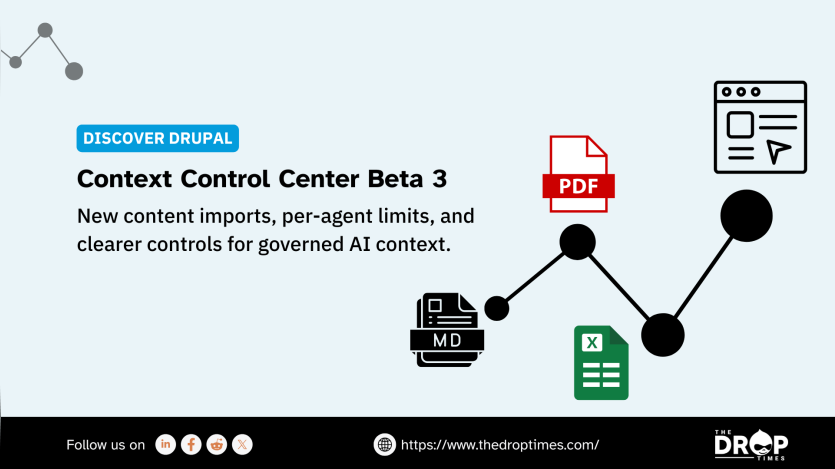
Context Control Center 1.0.0-beta3 was released on 18 July 2026 with new import routes, per-agent context limits and redesigned administration pages. The official release notes say it works with Drupal 10.5 or later in the 10.x series and Drupal 11.2 or later. The release requires version 1.4 of the Drupal AI module, with support for 2.x, and credits about 100 issues across features, fixes, accessibility, security and documentation.
The Drupal AI Context project, also known as Context Control Center, lets sites centrally manage information supplied to artificial intelligence agents. Beta 3 extends that workflow from content ingestion to scoped selection, agent-level limits and inspection of selected items. Earlier DropTimes coverage of beta 2 examined the project’s broader governance model and scope controls.
In a 28 July 2026 release article published by Salsa Digital, Kristen Pol, project lead for AI Context, grouped the changes around authoring, selection, administration, architecture, performance and security. Optional integrations with Document Loader, AI File to Text and Document Loader Webpage support plain text, Markdown, PDF, Word, spreadsheet and webpage sources. Organisations can therefore reuse existing policies, product information and editorial guidance without manually rebuilding the material as context items.
Administrators can set per-agent maximums for global items, total context items and tokens, overriding site-wide defaults. They can choose minimal or match-all selection, while conditional subcontext selection can ask an AI provider to identify relevant child items. Child items can also override inherited scope, allowing broad policies to carry narrower language, section or entity-specific instructions.
Redesigned listing and item pages show workflow state, context scope, hierarchy, estimated token use and available operations. A new Extensions page identifies optional importers, revision comparison and entity-targeting features, together with the dependencies required to enable them. Beta 3 also makes context items bundleless, makes Scheduler optional and provides post-selection and post-render events for contributed or custom integrations. New installations disable usage tracking by default and increase the default total context limit from five to ten.
Existing installations should run Drupal’s database updates after upgrading. Update hooks convert context fields from text_long to string_long, remove the former bundle configuration and update renamed use-case and provider values. Administration routes also move from /admin/ai/context to /admin/config/ai/context, which can affect custom integrations, automated tests and documentation containing hard-coded paths.
The release fixes an access-control issue that could show context-item content or management links without the required permissions. Performance changes narrow candidate scans, batch usage-tracking queries and avoid loading the full context catalogue when an agent has no scope subscriptions. The sources provide no benchmark results, so these changes represent implementation improvements rather than measured performance gains.
The Salsa Digital article recommends testing beta 3 outside production, particularly for upgrades, document and webpage imports, agent limits, conditional subcontext selection, multilingual moderation, larger context libraries and custom event integrations. Restricted and unpublished items should be part of that testing because the release includes access and workflow changes in those areas. As of 31 July 2026, the GitLab milestones list beta 4, RC1 and version 1.0 in sequence, but those planning ranges are not confirmed release commitments. The current Drupal.org release list still shows beta 3 as the latest release, so teams should treat Context Control Center as a structured evaluation target rather than a routine production dependency. Drupal.org’s security advisory policy covers stable releases, but stable status would not remove the need for site-specific permission, import, provider-cost and upgrade testing.


ASK: Drupal Community Needs Your Support
View all →
Disclosure: This content is produced with the assistance of AI.
Note: The vision of this web portal is to help promote news and stories around the Drupal community and promote and celebrate the people and organizations in the community. We strive to create and distribute our content based on these content policy. If you see any omission/variation on this please reach out to us at #thedroptimes channel on Drupal Slack and we will try to address the issue as best we can.

You may also like