




HTML vs HTMX: Architecture, Performance, Use Cases, and Trade-Offs

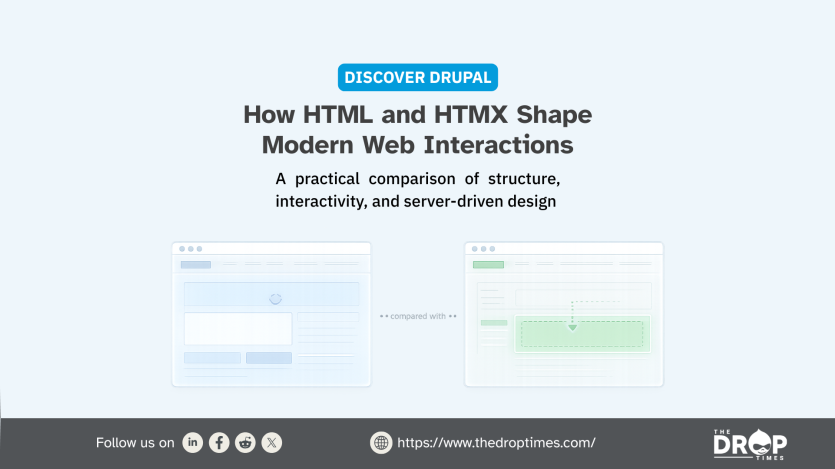
Comparisons between HTML and HTMX can be misleading because the two technologies do not occupy the same layer of the web stack. HTML is the markup language browsers use to structure documents, links, forms, headings, images, and other page elements. HTMX is a JavaScript library that extends HTML elements with attributes for issuing requests and replacing selected parts of a document.
The practical comparison is therefore between conventional HTML navigation and HTML enhanced with HTMX. In a traditional server-rendered application, following a link or submitting a form commonly causes the browser to navigate to another document or load the server's response as a new page. HTMX can instead issue a request from an element and swap returned markup into a specified part of the current document.
Native HTML links and forms provide a relatively simple request-and-navigation model. HTMX adds attributes including hx-get, hx-post, hx-put, hx-patch, and hx-delete for issuing different HTTP requests. Other attributes can control what triggers the request, which element receives the response, and how the returned markup is inserted.
This model generally keeps interface rendering on the server. Instead of requiring the browser to fetch structured data and construct the interface through a separate client-side rendering system, an HTMX endpoint can return HTML that is ready to insert into the page. Rendering templates, application state, and business logic can therefore remain primarily within the existing server application, while client-side JavaScript can still be added where it is useful.
The distinction is different from many single-page application architectures, where JavaScript may handle routing, state management, data fetching, and interface rendering in the browser. HTMX does not require a virtual DOM or a separate frontend application simply to replace part of a page. That can reduce the amount of client-side application code required for some interfaces, but interactive operations still depend on server responses and network conditions.
Servers can also distinguish HTMX requests from ordinary browser navigation. HTMX sends an HX-Request request header, which applications can use when deciding whether to return a complete document or a smaller fragment. A route can therefore serve a normal page when opened directly while returning only the required markup for an HTMX interaction.
That flexibility requires careful handling of URLs and caches. Attributes such as hx-push-url and hx-replace-url can update browser history when an interaction represents a navigable state. When the same URL can return either a complete document or an HTMX-specific representation, caches must also distinguish those responses, for example by using an appropriate Vary response header.
Performance depends on how the application uses the model rather than on HTMX alone. A partial response can transfer less markup than a complete page and avoid replacing document regions that have not changed. At the same time, frequent interactions can create additional server requests, so database work, template rendering, caching, server response time, and network latency remain important parts of overall performance.
The comparison with client-heavy frameworks also needs qualification. HTMX can avoid some frontend infrastructure associated with client-side routing, hydration, and application state, but that does not make every HTMX interface faster than every alternative. A well-cached conventional page, an optimised JavaScript application, or an HTMX interface can each perform well or poorly depending on implementation and workload.
Security responsibilities also remain with the application. HTMX can insert returned markup into the active document, so untrusted content must be escaped or sanitised correctly to reduce the risk of cross-site scripting and related injection problems. Server-side authorisation, output handling, Content Security Policy, and appropriate cross-site request forgery protection still need to be designed for the application.

Accessibility requires similar care when content changes without a full navigation. HTMX remains based on HTML, so semantic markup and progressive-enhancement practices continue to apply. Dynamic updates that users need to know about may require mechanisms such as ARIA live regions, while interactions that replace controls or significantly change context may require deliberate focus management.
Conventional HTML remains appropriate for document-oriented sites and interfaces where native links, forms, and full-page navigation already provide the required behaviour. Articles, documentation, informational pages, and straightforward forms do not automatically benefit from partial updates. Adding an interaction library where no meaningful interaction problem exists can increase complexity without improving the experience.
HTMX becomes more useful when a server-rendered application needs targeted updates without adopting a separate client-rendering architecture. Search results, filters, administrative screens, inline forms, and dashboard components are examples where replacing one part of a page may be preferable to loading another complete document. The server can continue to produce HTML while HTMX coordinates the request and replacement in the browser.
Drupal provides a relevant example of this approach entering an established server-rendered platform. HTMX became a Drupal core dependency in Drupal 11.2, while Drupal 11.3 introduced native integration and converted areas including BigPipe to use HTMX. Drupal core is continuing to maintain its existing AJAX API alongside the newer HTMX API while contributed and custom code has time to migrate.
Drupal 12 development extends that work by adapting core's integration to HTMX 4, whose API includes backward-incompatible changes from HTMX 2. The DropTimes has previously covered the Drupal 12 HTMX 4 work. As of publication, upstream HTMX 4 remains in beta, and Drupal 12 itself has not yet been released; the current Drupal core schedule places Drupal 12.0.0 in the release window beginning 7 December 2026.
More complex applications may still benefit from dedicated frontend architectures. Offline-first applications, graphics-heavy interfaces, collaborative editing systems, and software with extensive client-side state can have requirements that do not fit naturally into a server-driven fragment model. The choice is therefore about where rendering, state, and interaction logic should live rather than about one technology universally replacing another.
HTML and HTMX are ultimately not alternatives in the strict sense because every HTMX interface still uses HTML. The more useful architectural question is whether normal document navigation already meets the interface requirement or whether selected interactions benefit from server-driven partial updates. HTMX extends the first model rather than discarding it.
References
-
Is htmx Just Another JavaScript Framework? (10 January 2024)
-
Web Security Basics (with htmx) (6 February 2024)


ASK: Drupal Community Needs Your Support
View all →
Disclosure: This content is produced with the assistance of AI.
Note: The vision of this web portal is to help promote news and stories around the Drupal community and promote and celebrate the people and organizations in the community. We strive to create and distribute our content based on these content policy. If you see any omission/variation on this please reach out to us at #thedroptimes channel on Drupal Slack and we will try to address the issue as best we can.

You may also like