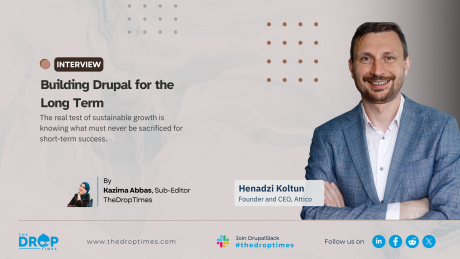



“Drupal Isn’t About Quick Wins”: Henadzi Koltun on Sustainable Growth

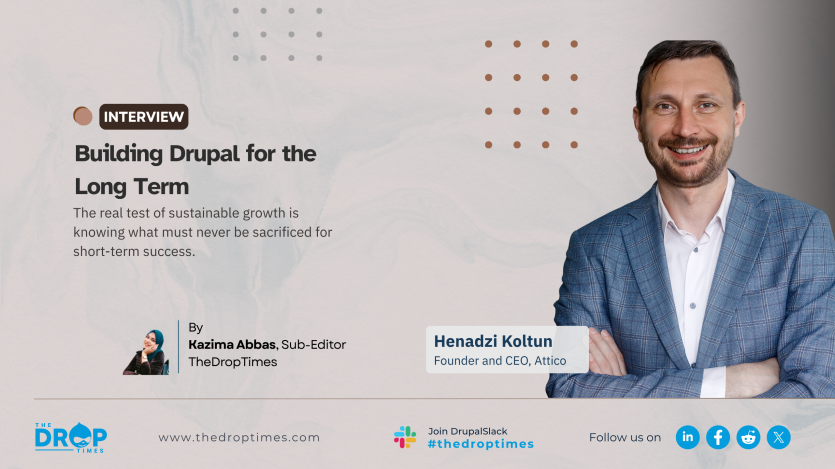
When software products repeatedly fell short of their promises, Henadzi Koltun began looking for alternatives. He found them in open source and chose Drupal 5 for his early projects. Today, he leads Attico.io, the company he founded, drawing on more than 15 years of experience in information technology and digital solutions. His preference for open source has since developed into a broader philosophy about quality, transparency, and the responsibilities of building technology for others.
Growing Attico brought its own challenges, particularly maintaining engineering standards while meeting client expectations and managing an international team. Henadzi says the company's average project span is approaching five years, with 20–25% of its capacity dedicated to ongoing improvements, refactoring, and product adaptation. He also describes the difficult decisions involved in resisting short-term commercial gains that could compromise quality. For him, sustainable growth depends on building systems and relationships that can withstand changing business demands.
In an interview with Kazima Abbas, sub-editor at The DropTimes, Henadzi shared his perspectives on Drupal's evolution, the business case for headless architecture, and the responsible adoption of artificial intelligence. He also discussed why accessibility should extend beyond regulatory compliance and how open-source technologies can support long-term business needs. Across these subjects, he returned to a central principle: technological decisions should deliver lasting value without introducing unnecessary complexity.
“Drupal isn’t about quick wins; it’s about sustainable growth and long-term value.”
TDT[1]: You’ve built your career around Drupal and created Attico from the ground up. What was your mindset when you first stepped into the open-source world, and what personal principles have guided your journey as both a technologist and entrepreneur?
Henadzi Koltun: I have a technical background, so I’ve always approached things with an engineer’s mindset. Back in the 2000s, when the internet was just starting to take off, Google, Facebook, mobile phones, mobile internet — everything was changing incredibly fast.
What really struck me back then was the gap between what providers promised and what they actually delivered. Products often came out raw, buggy, and far from what was advertised. That’s when I started looking for alternatives and found them in open source. These were products driven by the community, not by marketing chasing profit. Promises felt honest, and communication was clear.
When it came time to launch my own projects, the choice was obvious — open source. At the time, the only CMS options were Joomla 1.5 and Drupal 4.7–5, and I went with Drupal 5, which was modern, up to date, and had a strong community. Since then, we’ve really focused on Drupal, and it’s remained our core platform.
TDT[2]: Running a company is one thing; shaping its culture is another. How has your personal leadership style evolved as Attico grew from a small team into an international organisation? What lessons came the hard way?
Henadzi Koltun: I would say that Attico’s management style and the situations we faced are well described in the business literature, such as Adizes’ corporate lifecycle. In the early days, my leadership was driven by curiosity and the desire to experiment, try new things, and influence the market. It was a phase of hands-on, individual work — risky and a bit reckless, which is pretty typical for early-stage entrepreneurs. The first launch was counterintuitive: by logic, the odds were against us. But the lesson learnt was simple — sometimes you just have to try, without overthinking. Otherwise, important projects might never happen.
As things started to work out, our success was built on a strong focus on our clients’ needs. We always wanted to create a product and service we would use ourselves. At the same time, we realised that even a small team needs structured processes to maintain quality and preserve its culture. So, the lesson I’ve learned is that you have to build for scale from the start. Getting your systems in place early on, even with just a few employees, is a total game-changer.
My leadership shifted when the team grew to ten people and beyond. I learned to balance control with trust, giving people space to experiment and grow while ensuring clients receive high-quality results. It’s not easy and requires constant self-reflection, since a founder is always emotionally involved. There’s no universal formula for balance — some founders are driven by growth, others by customer satisfaction.
When we reached an international level and moved to distributed work with the Attico team working across different time zones and locations, all the earlier effort around processes and culture made the transition smooth. Today, my focus is on developing top managers in the company — people with an entrepreneurial mindset who can maintain that balance between discipline and client orientation, preserve a high-performance culture, and adapt the company to new challenges.
TDT[3]: You often emphasise sustainability, not just in technology, but in human relationships. In an industry known for burnout and short-termism, how do you maintain long-term motivation for yourself and for your team?
Henadzi Koltun: In digital and software development, everything moves fast. Technologies, requirements, and client expectations — all keep accelerating. For people with an engineering mindset, that’s not always easy. You feel like you’ve just designed the architecture and stabilised the system — and suddenly you are asked to rethink it all again. This can easily lead to frustration or burnout.
People may feel frustrated during these moments and face many choices, so it’s important to provide strong support and well-designed processes that preserve quality, thoughtful architecture, and reusable, scalable solutions. On one hand, systems often need constant adjustment and refinement. On the other hand, clients are focused on immediate value delivery.
Managers and product owners need quick results, or their leadership and investors may be dissatisfied. This creates pressure, which is natural in the current economic context. Clients often demand delivery within weeks or months and expect scalability within the quarter.
Therefore, we help find a balance between short-term value realisation and long-term foundations that will support the project for years. We aim to build durable digital assets for clients while still delivering fast, effective solutions so they can see measurable results after just a few sprints.
“For me, sustainability isn’t about slowing down — it’s about supporting people in a constantly changing environment.”
For me, sustainability isn’t about slowing down — it’s about supporting people in a constantly changing environment. The team needs to understand why we’re making changes, what value they create, and how they fit into the bigger picture. That maintains long-term motivation.
TDT[4]: Attico now operates in 10 countries, with clients across sectors like health, government, and global consumer brands. How do you adapt your project delivery model to meet the unique demands of each industry without compromising quality or sustainability?
Henadzi Koltun: Attico focuses on high-impact projects that large organisations are driving. These companies may come from different industries, but in many ways they’re quite similar — they’re structured in comparable ways and face similar challenges. They all want to transform, rethink their processes, and evolve their digital ecosystems.
That’s why a solid, foundational approach, open-source standards, Drupal standards, and structured processes work so well for these kinds of organisations. And when there are industry-specific nuances, we’re always ready to adapt.
The Attico team never just executes a project exactly as it’s handed to us. Adaptation requires real client involvement. What we build is always a co-creation process — the client brings deep industry knowledge, and we bring the technology and architectural thinking. As a result, these collaborations turn into sustainable digital projects that last for years, expand over time, and continue to grow in a structured, strategic way.
TDT[5]: Attico’s long average project span, 4 years, is unusual in this field. What’s your approach to client retention, and how do you build partnerships that extend beyond deliverables and into strategy and trust?
Henadzi Koltun: Actually, we’re getting close to 5 years of average project span now. What’s important is that we don’t have to constantly rebuild or redo things, and that’s thanks to the engineering foundation. It allows us to maintain high quality and consistently dedicate 20–25% of our capacity to ongoing challenge, refactoring, and product adaptation — not just shipping new features.
There’s constant learning involved, and we continuously adapt both our development processes and the way we work with clients to respond to change. It’s not something that’s just “given”. It’s a set of principles we stick to and a very disciplined day-to-day practice.
It means following release cycles properly, enforcing quality standards, running ongoing security checks, doing regular audits, and continuously fine-tuning how we operate.
TDT[6]: With a 29.5% CAGR, Attico has scaled impressively. What were some of the most difficult decisions you’ve had to make to protect that growth while staying aligned with your core values of transparency and reliability?
Henadzi Koltun: The hardest decision in this whole journey was simply believing that this approach is actually possible. When you’re a founder building a business, you’re constantly being challenged — by the market, by circumstances, by partners, by clients, by your own team. And at some point, you inevitably ask yourself, “What’s the right move here?” You see other business models that can prioritize short-term profit. They suggest different paths: compromise on your principles, lower the quality a bit, or not be fully transparent about some things. It can feel almost naive to be overly strict about standards when you could just make quick, guaranteed money instead.
But I’m convinced those kinds of success stories are short-lived. That’s why I made a conscious decision to walk away from what looks like a “compromise”, but really isn’t. Our team doesn’t chase quick wins. We believe sustainable growth is possible — with a real focus on quality, transparency, honesty, strong standards, and solid delivery. We don’t have to choose between high quality and commercial success, it’s possible to build both. There are absolutely clients in the market who care about quality and are willing to pay fairly for it.
TDT[7]: You’ve spoken openly about search customisation in Drupal, including boosting relevance by content type. What do you see as the biggest mistake organisations make when implementing search on large-scale platforms?
Henadzi Koltun: First of all, open-source products have a big downside — they don’t get talked about enough in business communities. Not enough budget is allocated to these activities, and the marketing behind them is usually not very aggressive. As a result, many business decision-makers simply don’t even know these products exist.
Second, any open-source product, such as Apache Solr, a search engine, can be effectively integrated into a technology stack, but it usually requires additional setup, customization, and professional implementation work during launch. This often becomes a barrier for businesses, because clients tend to implement open-source products “as is”, and then don’t get the results or performance they expected.
In reality, the budget needed to adapt an open-source product to a client’s needs is usually quite small, while the return on that investment is usually much higher.
“Not every project will gain a commercial advantage from that level of complexity.”
TDT[8]: Drupal’s move toward decoupling and API-first architecture is gaining momentum. From your experience, does this shift actually help enterprise clients in the long run or introduce unnecessary complexity?
Henadzi Koltun: For large companies, the API-first approach is definitely useful, because modern digital products rarely exist as one single system. Usually, it’s a whole ecosystem made up of many connected services.
For example, if a company has a website, it almost always includes a user account, which means you need a registration system and secure data storage that also comply with regulations like GDPR. If there are online purchases, then you need an ecommerce engine and payment services — things that companies usually don’t build from scratch, but simply integrate with existing solutions.
The same goes for CRM, ERP, and other internal or marketing systems. In large organisations, these systems usually already exist, just managed by different teams. So the developers’ job is to figure out how to connect everything properly and make their custom solution work on top of those systems.
API-first architecture is becoming almost a standard for modern marketing and digital products, and Drupal fits this approach well because of its strong integration capabilities. Clients invest in professional implementation and setup, but in return, they get flexibility, customization options, and long-term system scalability.
When we talk about decoupled or headless architecture — where the backend and frontend are separated — it’s important to first think about whether the investment in this approach will actually pay off. Many developers promote this approach because it’s technically interesting and feels modern. But it also makes the system more complex. It introduces additional requirements for security, quality control, and system maintenance, so this approach really makes sense only when there’s a clear business case.
There are situations where decoupled or headless architecture is really useful. For example, when a project has very high traffic loads and performance is critical, like websites where millions of users might visit at the same time within a short period. This could be the official site of the Olympic Games, when visitors around the world access it simultaneously during the opening ceremony.
This approach also works well when businesses want to build omnichannel products — where there’s one backend, and different customer-facing interfaces are built on top of it, like web apps, mobile apps, IoT devices, data dashboards, and so on. In this case, Drupal can act as a central system that manages data and connects to other services through APIs.
But this approach is usually more expensive to develop and implement. That’s why, when a project requires a clear business justification for investments, it’s worth carefully evaluating the architecture and checking whether it’s really needed. Not every project will gain a commercial advantage from that level of complexity.
TDT[9]: When considering a tech stack for a content-rich digital platform in 2025, why does Drupal still make sense? What are its unique advantages, and where do you wish it would evolve faster?
Henadzi Koltun: I see that every 2–5 years, the community and the market start asking whether Drupal is still relevant in the 2020s. Sometimes I even start to feel that Drupal might be becoming outdated. But then, when I attend another European DrupalCon, I hear keynote talks from the community — especially from Dries Buytaert — where these challenges are discussed, and future solutions are presented.
My first reaction is usually that it doesn’t make much sense. It feels like we are moving in the wrong direction — why start another big revolution now, forcing us to rethink and adapt? However, after some time, I realise that these moves are actually very positive and well-thought-out.
Drupal has a very long track record of success. It has proven its viability across different types of projects — from small ones to very large enterprise solutions, from commercial projects to government systems. Over time, the community has gained a lot of experience, learned how to avoid common mistakes, and understands how to apply the platform in different real-world situations.
Another important feature of Drupal is its engineering-driven approach. Since it’s a community-driven product, developers are more likely to under-promote existing features than to neglect making sure the technology actually works and over-delivers on its promises.
There’s also a strong focus on security, since cybersecurity remains a growing trend. In Drupal, there’s a team of specialists who work full-time on data protection and system security.
Drupal is investing a lot in API integrations today. Any product can either use Drupal’s ready-made integrations or build and connect its own. Drupal is also starting to introduce built-in smart features, like automated translations, content suggestions, bulk content tools, and other content management automation features.
Moreover, Drupal is actively evolving in the direction of AI technologies, which are being tested across different projects — both within the stack, where businesses build their own AI layers, and through external integrations. All this proves that Drupal definitely makes sense in 2026 and beyond.
TDT[10]: You’ve alluded to AI-native features and enhanced search as part of your recent work. What is your broader view on how AI should be integrated into Drupal, functionally, ethically, and sustainably?
Henadzi Koltun: Modern AI has a problem — it’s kind of a black box. It usually produces very good results, but sometimes it can generate hallucinations or give clearly harmful or incorrect answers.
If someone working with AI doesn’t fully understand how it works or can’t properly control it, it can lead to the product behaving incorrectly or failing to safely perform its tasks for users. If the product isn’t mission-critical — like an entertainment service — AI mistakes usually aren’t that serious. But Drupal is often used in complex, high-stakes projects, so it’s especially important to avoid risks and catastrophic failures.
That’s why the human-in-the-loop concept is becoming popular — where AI helps automate routine tasks, but the final decisions and control stay with a human. We can’t fully rely on a system that we don’t completely understand, and that hasn’t yet proven its reliability at a very large scale or over long periods of time. It only remains for the person to verify the execution, make sure everything is done correctly, and tick the checkbox to confirm that it can be deployed.
TDT[11]: You’ve been vocal about accessibility being a structural responsibility, not a UI patch. Can you share a moment where accessibility wasn’t just a compliance item but a turning point in improving user outcomes or business results?
Henadzi Koltun: Many businesses see accessibility in digital products as something that’s mainly driven by regulations or European bureaucracy — a requirement they just need to meet to avoid fines or penalties.
Our team looks at this differently. High accessibility standards in digital products are really a response to a major demographic trend sometimes called the “Silver Age” or “Silver tsunami”. Active life expectancy is growing rapidly in developed countries, meaning people aged 50–90 want to stay active as buyers and participants in social life. As a result, digital products — whether commercial, government, or social — need to be adapted for this audience, which is expected to become the majority in about 25 years.
I don’t envy the younger generation today, because they will likely face strong competition from an active and experienced older generation in securing their place in the future — people with experience, resources, and significant remaining energy and capabilities.
That’s why, for companies, accessibility — and more broadly adapting products to people with different needs — can be a strategic choice. It can help shape long-term marketing positioning, attract more loyal and higher-value customers, and improve customer service and user retention.
TDT[12]: As accessibility moves from best practice to legal mandate across the EU, are clients proactively prioritising it, or is your team still having to drive that conversation? What’s your role in shaping that awareness?
Henadzi Koltun: Implementing accessibility isn’t just a task for developers. You can’t just ask programmers to “make the product accessible” and expect it to be done. It requires collaboration across different departments and project stakeholders.
Sometimes you even have to go into the brand side and adjust design elements — for example, changing brand colors if they’re hard to read or don’t meet accessibility requirements. It’s also important to think about content, because accessibility often requires special preparation of texts, interfaces, and user flows.
It’s also not just a technical process; it’s an organisational one. The team can’t fully control everything on its own because branding, content creation, and content delivery are often handled by the client or other agencies.
Attico has successful experience in accessibility implementation. For instance, we implemented accessibility across 90 B2B and B2C websites in multiple regions and languages for a global FMCG company. We’ll be happy to help companies become accessibility compliant and create more attractive products for their audiences.
TDT[13]: You’ve built a company rooted in open source. What do you think the Drupal community gets right about collaboration, and what do you think it still struggles with when it comes to attracting new contributors and leaders?
Henadzi Koltun: This is about a long-term focus. If you invest in this platform now, the results may not appear immediately — it could take a year, two, or three — but in the long run, it works very well. Drupal isn’t about quick wins; it’s about sustainable growth and long-term value.
The Drupal community is very large and diverse — the product is used in different countries and across many types of projects. There are around a million distributors registered on the platform, which shows how popular and stable it is. Personally, we at Attico are actively involved in international events, including conferences, camps, training sessions, and meetups. We contribute back to the Drupal community and beyond by participating as speakers, sponsors, and organisers.
As for the things that Drupal struggles with, I believe that the platform doesn’t really position itself as a “trendy” product, especially among younger audiences. So there’s room to refresh the positioning a bit and make the platform more attractive to young, ambitious entrepreneurs, developers, tech leaders, and designers — while still keeping its strong technological foundation.
TDT[14]: Looking five years ahead, what kind of impact do you personally want to have, not just through Attico but as a contributor to digital transformation, open technology, and the future of inclusive web development?
Henadzi Koltun: When our team works on projects, we’re not just implementing technology or launching a product. We also influence the client’s organisation, how it will operate in the future, what technologies it will use, how people will collaborate, and how the company’s digital products will be built.
That creates a certain level of responsibility: decisions in digital projects can influence the client’s business direction, their technology choices, and the way they work.
We want our work to help support a digital environment that doesn’t lead to monopoly by one product or technology, but instead encourages diversity of solutions, openness, and freedom of choice. We believe technology should make a real impact, which is why we choose projects with purpose. Our team is driven to create solutions that help others and deliver lasting value.
The idea is that everyone should be able to use technology in a way that works best for them and actually get value from it. We’re especially happy when clients share these values and want to build meaningful products that bring value to society. It’s also important that individual engineers and product creators can get recognition, share their knowledge, improve products, and contribute to the development of technology.
 Kazima AbbasKazima Abbas is a sub-editor at The Drop Times


ASK: Drupal Community Needs Your Support
View all →
Disclaimer: The information provided about the interviewee has been gathered from publicly available resources. The responsibility for the responses shared in the interview solely rests with the featured individual.
Note: The vision of this web portal is to help promote news and stories around the Drupal community and promote and celebrate the people and organizations in the community. We strive to create and distribute our content based on these content policy. If you see any omission/variation on this please reach out to us at #thedroptimes channel on Drupal Slack and we will try to address the issue as best we can.
Related Organizations
Related People
You may also like