



Drupal AI 1.5.0 Moves Five Submodules Into Standalone Projects

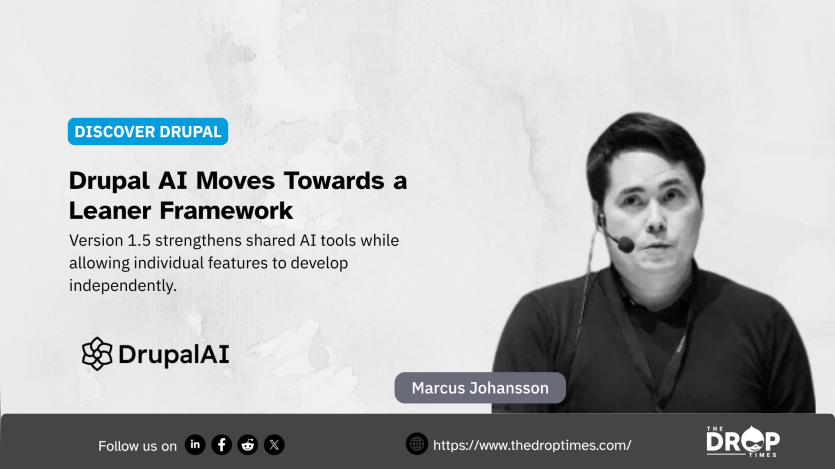
Site builders upgrading to Drupal AI 1.5.0 now receive five previously bundled features through standalone projects. The stable release, published on 25 September 2026, also deprecates AI Search and AI CKEditor within the main package ahead of their planned removal in version 1.6. Drupal AI maintainer Marcus Johansson of FreelyGive explained the restructuring and additional technical changes in a video walkthrough.
The changes mark a shift in how Drupal AI is developed and maintained. The main module will increasingly concentrate on provider integrations, shared abstractions, development tools and reusable frameworks, while applications built on that foundation operate as independent contributed projects. For existing installations, the restructuring changes how individual features are installed, updated and maintained.
Five Standalone Projects and Two Pending Removals
Five features have already moved into standalone projects: AI Content Suggestions, AI Logging, AI Translate, AI Validations and Field Widget Actions. Marcus explained that their former bundled implementations are now hidden stubs that cannot be enabled independently. The replacement projects are included in Drupal AI's Composer dependencies, allowing Composer and Drupal database updates to handle the transition. Administrators should verify that the standalone implementations are available and functioning after upgrading.
AI Search and AI CKEditor follow a different timetable. Both bundled submodules remain functional in version 1.5.0 but are deprecated and scheduled for removal from the main package in version 1.6. New features will be developed exclusively in their standalone projects, while Marcus said the bundled versions will receive only security updates. Sites using either integration should prepare for the change before adopting the next minor release.
The standalone AI Search project has its own release cycle. Marcus recommends installing its 1.3 development branch using composer require 'drupal/ai_search:^1.3@alpha'. That branch remains an alpha release, meaning its release status differs from the stable Drupal AI 1.5.0 package. Administrators must assess compatibility and deployment requirements before replacing their existing integration.
The standalone AI CKEditor project also provides a migration path for existing installations. Its documentation describes a database update process intended to preserve existing configuration when switching to the standalone implementation. Marcus recommends installing the project with composer require 'drupal/ai_ckeditor:^1.4'. Administrators should verify package installation, configuration and editor functionality after completing the upgrade.
Marcus attributed the restructuring to the growth of Drupal's AI ecosystem. Earlier versions bundled numerous features to demonstrate possible applications of AI within a content management system. As alternative contributed modules emerged, maintaining those applications inside the central project became less necessary. Separating them allows different approaches to compete and gives their maintainers greater independence over features and release schedules. Marcus said the transition would continue through versions 1.6 and 1.7.
Chat Processing, Memory and Streaming Guardrails
Beyond the package changes, Drupal AI 1.5.0 expands its chat architecture through reusable chat processors and a separate memory interface. Chat processors accept conversational input and return responses without being tied to a particular chatbot interface. The memory interface separates conversation history from the existing chatbot implementation, allowing developers to introduce different storage backends. Marcus said the architecture draws on Symfony AI and supports further changes to how chatbots and agents are constructed.
Guardrail functionality also receives several additions. A streaming guardrail can examine generated text as it is produced, allowing restrictions to be applied before the complete response is available. The moderation guardrail can use a provider's moderation endpoint rather than relying solely on classification prompts and is designed to fail closed when the required provider is unavailable. Restricted-topic controls also gain semantic matching, allowing related expressions to be evaluated instead of depending exclusively on exact terms. These controls provide additional safeguards but do not guarantee the safety or accuracy of every generated response.
Automators, Search and Developer Tools
Editorial automation has been expanded through Field Widget Actions and AI Automators. Editors can receive a generated suggestion and refine it through a conversational interface rather than accepting a single response. Automator chains can also run directly from entity edit forms, allowing multiple processing steps to contribute to a final field value. Additional functionality enables text automators to use descriptions of images embedded in rich-text content as context. Agent tools can assist developers with configuring automators.
Search and indexing capabilities receive further improvements. Batch embedding requests allow multiple text items to be submitted to a provider in a single call, reducing the number of requests required for large indexing operations. Providers without batch support continue using individual requests. A Search API reranking processor can reorder retrieved results using AI-based relevance assessment, while an extractive question-answering operation returns a matching passage from supplied text together with a score. The release does not provide independently verified measurements of indexing speed or search relevance.
Developer-focused changes include a metadata container that travels with requests through generation and streaming events. The API Explorer can display additional information about token consumption, cached and reasoning tokens where available, and provider rate limits. Observability improvements follow OpenTelemetry's generative AI conventions, while new services support conversion between HTML and Markdown. Several of these capabilities appeared during the 1.5 prerelease cycle and are now included in the stable release.
Upgrade Requirements and Supported Versions
Marcus recommends upgrading through composer update drupal/ai followed by drush updb. Administrators using AI Search or AI CKEditor should also install the relevant standalone packages, review their dependencies and test existing workflows before moving to version 1.6. Drupal.org lists AI 1.5.0 as a stable release covered by the Drupal Security Team's advisory policy. The declared compatibility range includes Drupal 10.5 and Drupal 11.2 or later within their respective major versions, but does not include Drupal 12.
Further details about the changes, dependencies and supported versions are available on the Drupal AI 1.5.0 release page.
References
-
-
-
AI CKEditor change record | Drupal.org, Drupal.org
-


ASK: Drupal Community Needs Your Support
View all →
Disclosure: This content is produced with the assistance of AI.
Note: The vision of this web portal is to help promote news and stories around the Drupal community and promote and celebrate the people and organizations in the community. We strive to create and distribute our content based on these content policy. If you see any omission/variation on this please reach out to us at #thedroptimes channel on Drupal Slack and we will try to address the issue as best we can.

Related Drupal Initiatives

Related People


You may also like