




US Nonprofits Seek Funding Reset After Democrats Win Congress

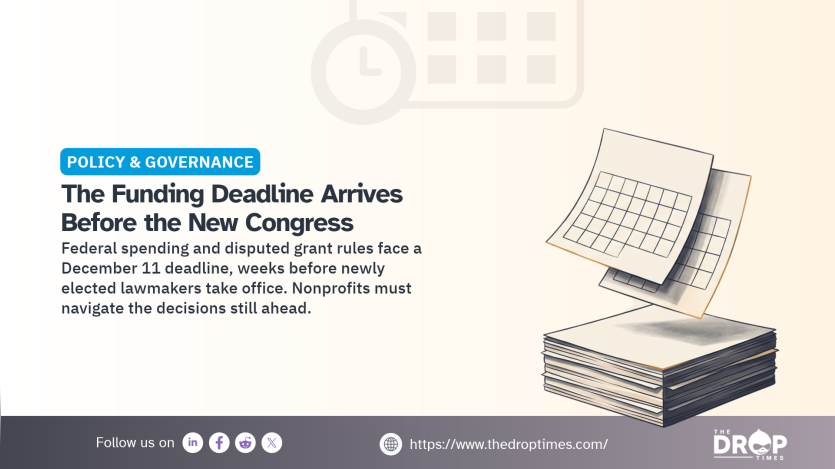
Nonprofit leaders are seeking a restoration of federal funding and a change in congressional oversight priorities after Democrats won control of both chambers of the US Congress in the November 2026 midterm elections. In a report published by The Chronicle of Philanthropy on 5 November 2026, Alex Daniels documented hopes that lawmakers would reverse interrupted grants and reconsider policies affecting charitable organisations. The election gives Democrats control of the incoming Congress, but it does not immediately restore funding or settle disputed grant requirements.
The expected reset follows a period of government funding disruptions that affected nonprofit programmes, staffing and services. The new congressional majorities will be able to shape appropriations and conduct oversight of the Trump administration, although the administration retains substantial executive authority over federal agencies. An immediate complication is that the current government funding measure expires on 11 December 2026, before the newly elected Congress takes office on 3 January 2027. Nonprofits therefore face decisions under the existing congressional and regulatory arrangements before any longer-term change in direction can take effect.
Akilah Watkins, president and CEO of Independent Sector, told the Chronicle that she wants federal funding restored for research, human services, education and safety-net programmes. Other nonprofit leaders anticipate changes in the congressional committees investigating charitable organisations and their donors. Kathleen Enright, president and CEO of the Council on Foundations, also identified proposed restrictions affecting tax-exempt organisations and federal grantmaking as continuing concerns. Their expectations concern what the incoming Congress may pursue, rather than changes already enacted.
Recent research helps explain why funding restoration is a priority. An October 2026 study by the Urban Institute found that 49% of nonprofits receiving government funding experienced at least one disruption during 2025, equivalent to 35% of nonprofits overall. The disruptions included cancelled funding, delayed payments, pauses, freezes and orders to stop work. The study covered government funding at federal, state and local levels, so its findings should not be read as a measure of federal cuts alone.
A companion Urban Institute study examined how those disruptions affected nonprofit employees and the communities they serve. Among nonprofits with staff, 30% of those experiencing government funding disruptions reported reducing employee numbers, compared with 20% of staffed nonprofits overall. The research also identified reductions in services and organisations' ability to meet demand. These findings establish that the funding uncertainty preceding the election had operational consequences beyond the loss or delay of individual awards.
The immediate challenge is federal spending. Congress enacted a continuing appropriations measure on 2 September 2026 that maintains government funding through 11 December. Lawmakers must agree on further appropriations or another temporary extension to prevent a funding lapse. The measure also temporarily restricts the Office of Management and Budget (OMB) from finalising its proposed Uniform Grants Regulation, which would revise government-wide requirements for federal financial assistance.
The proposed regulation, published on 29 May 2026 by OMB and 41 federal agencies, would change aspects of grant administration and the relationship between government-wide requirements and individual agency rules. A Congressional Research Service legal analysis explains that the proposal would give OMB's requirements a more direct regulatory role in federal grantmaking. Section 157 of Public Law 119-103 prevents the specified proposal, or a substantially similar rule, from being issued or finalised through 11 December. The restriction does not permanently withdraw the proposal or prohibit every independent change to an agency's grant conditions.
The dispute has continued despite that restriction. In a letter published on 4 November 2026, a coalition of 116 organisations representing nonprofit charities, universities, healthcare providers, public agencies and other federal funding recipients urged Congress to examine agency-specific grant requirements. The coalition alleged that several agencies were advancing provisions resembling elements of the proposed OMB regulation. It argued that these actions could create conflicting requirements and additional compliance costs, and asked Congress to extend the restriction beyond December. The letter documents the coalition's concerns, not a legal determination that every agency action violates the temporary restriction.
Nonprofit associations have already begun explaining what the election and unresolved appropriations mean for their members. The National Assembly of State Arts Agencies (NASAA) published a post-election legislative briefing on 4 November distinguishing current arts funding from proposals awaiting congressional action. The briefing notes that the continuing resolution maintains National Endowment for the Arts funding at its fiscal year 2026 level of $207 million, while a House proposal for fiscal year 2027 would reduce it to $135 million. NASAA also explains how the incoming congressional majority could change future appropriations and oversight without resolving the immediate December funding deadline.
The Afterschool Alliance published a similar appropriations briefing on 9 November. It reported that none of the 12 regular fiscal year 2027 spending bills had passed both chambers and identified a House committee proposal to maintain $1.329 billion for the 21st Century Community Learning Centers programme. The organisation also explained that proposed changes to federal and Education Department grant-management rules could affect states, local educational agencies and nonprofit providers. Its update separates existing programme funding from future appropriations and possible changes to award conditions.
The National Council of Nonprofits has also been coordinating a response to the proposed federal grants regulation. Its 2 November policy newsletter announced a National Day of Action for 10 November, calling for Congress to extend the restriction on OMB's proposal. The organisation's guidance addresses a different immediate decision from the anticipated post-election restoration of grants: whether recipients will continue operating under the existing government-wide framework or face revised rules after December.
These communications demonstrate how intermediary organisations translate federal decisions into information that members can use. They must distinguish money already appropriated from proposed funding, identify which requirements are currently in force and explain when pending decisions could affect programme operations. The examples do not establish that the associations have experienced website failures or inadequate editorial systems. They do, however, show an active publishing responsibility that becomes more complicated when funding levels, grant conditions and legislative deadlines change on different schedules.
The election also raises questions about future oversight of nonprofit organisations. According to the Chronicle, Sara Barba, managing partner at the lobbying firm Integer, expects the House Ways and Means Committee under prospective Democratic chair Richard Neal to examine different organisations and donors from those scrutinised under the outgoing Republican leadership. Barba also expects scrutiny of some nonprofits to continue through executive agencies, including activities involving political advocacy and voter engagement. These are forecasts about institutional priorities, not announced investigations by the incoming Congress.
For organisations responsible for programme guidance, the practical consequence is the need to keep several kinds of information distinct. An enacted appropriation is not the same as a grant award, a proposed regulation is not an operative requirement, and an agency's interpretation may change without the underlying statute changing. A publishing system that records the funding period, programme, issuing authority, effective date and approval status of guidance can make these distinctions easier to maintain. That content-governance model is an editorial and technical interpretation of the documented funding environment, not an industry-wide system identified by the cited research.
Drupal offers established tools for parts of this work. Its core Content Moderation module allows an organisation to retain a published revision while editors review a separate working version. Configurable workflows and permissions can determine who prepares, reviews and publishes changes. Structured content fields can also be configured to record programme identifiers, source references, dates and classifications rather than leaving those distinctions entirely within page text. Such controls can support accountable publishing, but their effectiveness depends on how an organisation models and maintains its information.
A documented Drupal implementation provides an example of governance within a US nonprofit membership association. In an April 2026 Drupal.org case study, Skvare described its Drupal 11 work for the National Association of Addiction Treatment Providers. The implementation connects Webform submissions, membership records and editorial moderation so members can submit jobs, events, news and resources while association staff retain publication authority. The case study also describes automated notifications, membership-based permissions and scheduled expiration of job listings.
The association's implementation is relevant because it demonstrates structured submissions and staff-controlled publishing in a member organisation. It is not evidence that the association uses those workflows for federal funding guidance or that its Drupal project responded to the 2026 election. Drupal also does not automatically determine which government requirements are legally authoritative, synchronise every translation or preserve a complete public record of previously displayed guidance. Those responsibilities require additional configuration, governance procedures and subject-matter review.
The anticipated funding reset therefore presents two different timelines for nonprofits. The incoming Congress may reconsider appropriations and oversight priorities from January 2027, while organisations must continue interpreting existing funding decisions and grant requirements before then. For Drupal teams serving associations, public-interest organisations and government-funded programmes, the immediate technical relevance lies in managing those distinctions accurately: what is funded now, what remains proposed, when requirements apply and which approved information members should rely upon.
References
-
-
-
Continuing Appropriations and Extensions Act, 2027 (Public Law 119-103) (2 September 2026)
-
Uniform Guidance Coalition Letter to Capitol Hill on Agency Actions, Association of American Universities (4 November 2026)
-
A New Congress, a New Advocacy Landscape—but First, a December Funding Deadline, National Assembly of State Arts Agencies (4 November 2026)
-
-
 Allen JasonAllen without organs

ASK: Drupal Community Needs Your Support
View all →
Disclosure: This content is produced with the assistance of AI.
Note: The vision of this web portal is to help promote news and stories around the Drupal community and promote and celebrate the people and organizations in the community. We strive to create and distribute our content based on these content policy. If you see any omission/variation on this please reach out to us at #thedroptimes channel on Drupal Slack and we will try to address the issue as best we can.

You may also like