



Why Some Drupal 11 Module Fixes Have Yet to Reach Official Releases

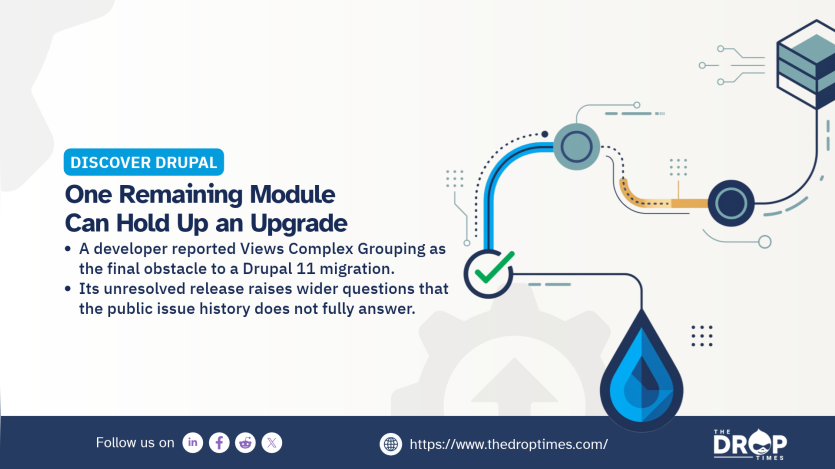
Facing an unfinished Drupal 11 upgrade, a developer posting as apotek said Views Complex Grouping was the last contributed module preventing their team from proceeding. In a Drupal.org issue comment on 10 November 2026, the developer asked for an existing compatibility change to be merged and a release published. They also offered to seek maintainer access if necessary. The public record documents their reported blocker but does not establish why the change had not been released.
Public Drupal.org issue histories describe different reasons compatibility work may remain unfinished or unreleased. A patch for one project failed against the packaged files installed through Composer; other projects required further runtime fixes, had explicit decisions against continued support, or involved contributors without release permissions. For some long-running issues, the public records do not explain the delay. These distinctions matter as Drupal 10 approaches its scheduled end of life on 9 December 2026.
Reviewed Code Without a Released Fix
The Views Complex Grouping compatibility issue originated on 25 March 2024, when Drupal's Project Update Bot created an upgrade request. A reviewer subsequently reported a successful Drupal 10 and 11 test, and the issue reached Reviewed & tested by the community (RTBC) on 11 December 2024. Yet 8.x-1.0-beta3, the project's listed tagged beta in the release listing reviewed for this article, declared compatibility only with Drupal 8, 9 and 10. The user's reported migration blocker gives the missing release practical significance, but the issue timeline alone cannot establish whether additional testing, maintainer capacity, permissions or another factor explains the delay.
According to Drupal.org's issue-status guidance, RTBC indicates that community reviewers consider a change ready for commit, not that it has passed every maintainer or release check. The related Views Field Permissions issue records community review and subsequent patch activity. On 16 April 2026, a contributor said their employer preferred an official package rather than forks, development code or patches. The public issue history documents proposed compatibility changes and requests for an official package, but an RTBC patch or development-branch fix alone does not establish that a supported stable Drupal 11 release is available. The elapsed interval is not evidence that an unchanged, fully approved patch sat idle throughout.
When the Patch Does Not Fit the Distributed Package
A specific packaging problem appears in the Menus attribute Drupal 11 issue. On 19 March 2025, a contributor reported that an automatically generated patch applied to the development branch but not to the tagged 8.x-1.3 release. Contributor abramm explained on 8 April that Drupal.org's release-packaging process had appended lines to the module's .info.yml file, changing the patch's expected context. They supplied a separate patch for the published package. The mismatch explains that patch-application failure, not the entire delay in publishing a Drupal 11-compatible release.
The issue also shows why an automated compatibility report does not settle a release decision. An August 2024 contributor had reported successful testing, but the Project Update Bot's 11 April 2025 run found remaining Drupal 11 compatibility problems that Drupal Rector could not fix, returning the issue from RTBC to Needs review. The public record therefore documents both a package-specific patch mismatch and additional compatibility work. Neither observation establishes why no corresponding release had appeared as of 11 November 2026.
Runtime Testing Found More Than Deprecated API Calls
The AudioField compatibility issue records a series of revisions and reports of additional problems beyond Drupal core-version constraints. A developer reported a LibraryDiscoveryCollector type error in Drupal 11; others identified missing dependencies, obsolete methods and a Drush command calling the removed FileRepository::copyFromRemote() method. Contributors also reported code changes and test coverage intended to address compatibility beyond version constraints. The changes addressed file validation, service-interface types, dependencies and previously untested behaviours rather than merely extending the module's core-version declaration.
One reported defect illustrates the risk: a case-sensitive extension check could silently reject a filename such as SONG.MP3, leaving the audio player absent from the rendered page. The issue also records a separate concern about jPlayer under Drupal 11's jQuery 4 environment. The discussion also documents patches that did not apply consistently to development and distributed packages, underscoring the importance of testing the actual Composer-installed archive. The issue records contributor findings and patch revisions, rather than confirming that all affected functionality works in a tagged Drupal 11 release.
Other issues reinforce the distinction between a successful initial check and functional compatibility. In User Points, an August 2026 review uncovered an outdated Symfony event class and methods removed from Drupal after a May RTBC milestone, returning the proposal to Needs work. In the Switch Page Theme issue, a contributor reported that one proposed merge request caused a white screen on the settings page, while another appeared to remove domain-related functionality. Further patches followed. A developer said in February 2025 that the module was blocking a migration, but the issue comments do not establish the delay's length or cost.
When Continued Support Is a Decision, Not an Accident
Some projects have an explicit maintenance position. The Login Tracker project page marks the module as receiving no further development and lists a stable 2.0.0 release compatible through Drupal 10. In its Drupal 11 discussion, maintainer leewillis77 stated in November 2024 that Drupal 11 support was not planned; a later discussion raised the question of funding the port. That public record identifies a decision about future maintenance rather than an inexplicable failure to respond to a finished fix. It does not quantify the cost of the work or establish that any funding arrangement followed.
Contributors May Lack Permission to Commit or Release
In the Mass Contact co-maintainership request, Drupal contributor Artyom Hovasapyan said on 27 July 2026 that they wanted to help deliver Drupal 11 compatibility but could not commit changes or create releases. Drupal.org project moderator Alberto Paderno explained that an offer may move to the ownership queue after 14 days if existing maintainers have not declined it. He also stated that project moderators cannot grant maintainer permissions on security-advisory-covered projects to applicants who lack the required security opt-in eligibility, although current maintainers have discretion to add co-maintainers. The exchange documents a permission constraint and safeguards; it does not establish that permissions alone prevented a release or that the request was rejected.
The Project Update Working Group Offers a Conditional Route
The Project Update Working Group charter provides a conditional mechanism for compatibility changes that have reached RTBC without maintainer feedback. It requires a canonical issue, a patch or merge request, documented maintainer-contact attempts and specified waiting periods. A group member must then consider review quality, regression risk, test coverage, project relevance and potential new maintainers before deciding whether temporary intervention is appropriate. RTBC does not itself authorise the group to merge or release a change automatically.
Public Project Update Working Group work items document Drupal 11 referrals associated with compatible releases. Varnish purger 8.x-2.3 was published on 18 February 2025 after a documented co-maintainer change. Simple Google Maps 3.1.1 followed a maintainer handover on 22 January, and Font Awesome Icons 3.0.0 was released on 21 January 2025 following work on Drupal 11 compatibility. These examples show documented Drupal 11-compatible releases and, in some cases, changes in maintainership; they do not imply that any outstanding RTBC issue automatically qualifies for intervention.
Some Modules Need Replacing, Not Releasing
Not every unresolved Drupal 11 issue identifies a module that should be ported. The Advanced CSS/JS Aggregation project recommends uninstalling the module on Drupal 10.1 and later because core now supplies much of its former functionality. At the other end of the spectrum, Node Delete Redirect published a stable Drupal 11-compatible 4.0.0 release on 13 March 2026, less than two weeks after its upgrade issue opened. These different outcomes are counterexamples to treating every long-running issue as a neglected release.
Release-branch selection can also lead to false conclusions. OpenID Connect listed a stable Drupal 11-compatible 8.x-1.6 release as of 11 November 2026 even while development of a newer major branch remained at alpha status. A project's latest experimental branch is not necessarily the only version that supports the target core release. The relevant question for an upgrade team is whether a compatible, suitable release exists on any maintained branch, not whether the newest experimental branch is complete.
What the Records Mean for Upgrade Teams
The public histories point to different questions depending on the obstacle. Where a patch fails, developers should check whether it targets the development branch or the archive Composer actually downloads. Where it applies, they still need evidence that important functionality, dependency services, administration forms and commands work on the intended core release. Where maintainers have ended support, replacement may be safer than waiting; where tested development code lacks an acceptable tag, deployment policy and release ownership become separate considerations.
The documented cases are a selected set of Drupal.org issue histories, not a representative sample, and do not establish how frequently these obstacles occur across Drupal's contributed projects. A developer's account of a blocked migration is evidence of that reported experience, not proof that a proposed patch will work for every installation. Some cases identify a specific fault or a maintainer decision; others record an outstanding request without explaining why a release has not followed. Distinguishing those situations is more useful for upgrade planning than treating every unresolved compatibility issue as the same kind of delay.
References
-
Compatibility with Drupal 11 | Drupal.org (27 January 2025)
-
Drupal 11 compatibility | Drupal.org (16 December 2024)
-
Drupal 11 compatibility | Drupal.org (5 April 2025)
-
Drupal 11 compatibility for Switch Page Theme | Drupal.org (22 November 2024)
-
Offering to co-maintain Mass Contact | Drupal.org (27 July 2026)
-
varnish_purge 8.x-2.3 | Drupal.org (18 February 2025)
-
simple_gmap 3.1.1 | Drupal.org (22 January 2025)
-
fontawesome 3.0.0 | Drupal.org (21 January 2025)
-
Drupal 11 compatibility version | Drupal.org (22 July 2025)
-
openid_connect 8.x-1.6 | Drupal.org (18 October 2026)
 Allen JasonAllen without organs
ASK: Drupal Community Needs Your Support
View all →
Disclosure: This content is produced with the assistance of AI.
Note: The vision of this web portal is to help promote news and stories around the Drupal community and promote and celebrate the people and organizations in the community. We strive to create and distribute our content based on these content policy. If you see any omission/variation on this please reach out to us at #thedroptimes channel on Drupal Slack and we will try to address the issue as best we can.

You may also like