



The Hard Part of a Drupal Migration Is What Must Keep Working

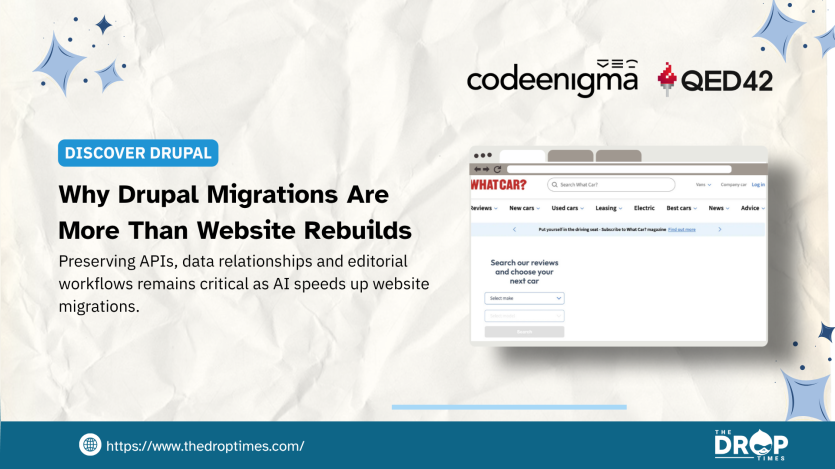
Publishing company Haymarket Automotive needed to replace the Drupal infrastructure behind What Car? without disrupting the applications and services that depended on it. Its search system couldn't delete records directly, vehicle data came from external suppliers, and separate JavaScript applications relied on consistent responses from the CMS. These constraints shaped a migration that involved considerably more than moving editorial content to a newer Drupal installation.
The challenges are documented in a case study published on 4 November 2026 by Code Enigma, the agency responsible for the implementation. They provide a useful comparison with another migration examined by The DropTimes: QED42's AI-assisted reconstruction of its 646-page website on Drupal 11. Although the projects used different approaches and involved different requirements, both expose a problem that can remain hidden behind a successful website launch. Reproducing a website's appearance does not establish that its data, editorial tools and business functions behave correctly.
That distinction is increasingly important as AI promises to make platform migration less expensive. On 28 October 2026, Drupal founder Dries Buytaert predicted that the technical work of moving a website between platforms could approach zero cost within three years. The two cases offer a way to examine what such automation can already accomplish and which responsibilities remain part of migration engineering. They do not establish a like-for-like comparison of conventional and AI-assisted costs.
The Dependencies Behind Haymarket's Drupal Migration
Code Enigma began assessing Haymarket Automotive's publishing infrastructure in 2023. The estate included What Car?, Autocar, Classic & Sports Car and Move Electric, with installations spanning Drupal 7, 8 and 9. Some were operating on considerably outdated PHP versions. The recommended approach was to retain Drupal while establishing a shared Drupal 10 multisite foundation, with What Car? becoming the first website migrated under the programme.
The content migration was substantial. Code Enigma reports that the source estate contained more than 22,800 articles, approximately 82,000 files and 96,000 media entities. Its case study describes a scripted migration but does not independently itemise the number of records successfully transferred. The existing content model also included vehicle-related taxonomies containing tens of thousands of derivatives, trims and engines. Developers used Drupal's Migrate API, Migrate Plus, Migrate Tools and custom plugins to move content while reorganising vehicle information into purpose-built entities.
However, the more revealing difficulties concerned systems outside the CMS. What Car? depended on a Node.js search aggregation service combining editorial content with vehicle information. That service had no direct deletion operation; removed records depended on a nightly full re-ingestion. A replacement CMS therefore had to account for an existing limitation in how search data was updated, rather than assume every content change could be synchronised immediately.
Another complication arose when Haymarket changed its vehicle-data provider from CAP to Autotrader during the programme. According to Code Enigma, the providers represented information differently, requiring developers to derive concepts such as engines and trims from data without equivalent stable identifiers. The agency reports commercial savings from the supplier change but does not provide a quantified comparison of the overall migration costs. The change illustrates how migration requirements can be determined by business decisions and external data contracts rather than Drupal itself.
Frontend compatibility created a further constraint. The CMS supplied content to an existing React application and a Next.js replacement, while other services handled advertising, syndication, user accounts and vehicle-related transactions. Code Enigma rebuilt custom modules responsible for delivering entity updates and used AWS CloudFront rules to serve legacy and replacement components during a staged rollout. The objective was to replace underlying systems without forcing every dependent application to change simultaneously.
These details distinguish the project from a straightforward version upgrade. Its engineering requirements included preserving established behaviour, coordinating changes across services and ensuring that existing applications could continue interpreting Drupal's data. The case study describes What Car? as the first completed migration, but it does not establish when the other three publishing brands reached production on the shared architecture.
When AI Rebuilds a Website That Looks Correct
QED42 approached migration from a different direction. Its X to Drupal framework uses AI-assisted processes to inspect an existing website, identify recurring design and content patterns, and reconstruct those elements in Drupal. Rather than requiring an organisation to redesign its website during replatforming, the framework aims to preserve the existing presentation while rebuilding the content structures and supporting functionality.
The company used the framework to migrate its own website from Webflow to Drupal 11. According to The DropTimes' 29 October 2026 report, based on written responses from Souvik Pal, Senior Backend Engineer at QED42, the project covered 646 public pages, 17 page templates and seven forms. The automated reconstruction work took approximately four days. That figure does not represent the complete delivery process, which also requires review, verification and production preparation.
The most consequential findings emerged during testing. An early version produced pages that looked correct to visitors but stored their content as raw JSON rather than usable Drupal fields. Editors could view the resulting pages without having appropriate editing controls for the content behind them. The company subsequently rebuilt the generated content architecture around typed Drupal fields and native editing interfaces.
Other failures were less obvious. QED42 reported that one development-stage implementation used only two Drupal Media entities to represent 1,359 displayed images. A separate audit identified 14 category listings without working routes. The team also found instances where visually similar components had different editorial purposes, making automatic content classification unreliable without further review. These findings came from QED42's own testing, as reported to The DropTimes, and were not independently reproduced by the publication.
The cases expose a limitation of judging migration success through visual comparison alone. A page can render accurately while its underlying content structure prevents normal editing. Images can display without being properly managed as individual media assets, and navigation can appear complete while some destinations remain inaccessible. A successful reconstruction must therefore account for how the resulting Drupal site will be operated, not simply how closely it resembles the original.
What Cheaper Migration Technology Changes
Buytaert's prediction concerns the declining cost of technical reconstruction as AI agents become more capable of building and verifying websites. His argument also anticipates changes in how organisations evaluate CMS products. Instead of relying exclusively on vendor proposals, buyers could use automated evaluation suites to test alternative platforms against their own requirements, including editorial workflows, accessibility and performance.
The QED42 implementation provides an early example of that direction. Its framework uses staged validation, compares reconstructed pages with source pages and requires further investigation when checks fail. Developers also revised their approach after discovering that apparently successful results could conceal incorrect content associations or insufficient editorial controls. The reported experience supports the value of automation while demonstrating why its output still requires examination.
Drupal's AI Migration module addresses another part of this process. Its first stable release, published on 23 October 2026, supports transforming unstructured website content into Drupal content types, taxonomy, media and Paragraphs. Its documented workflow still requires developers to establish destination content structures, configure an AI provider and define the migration. The module addresses content transformation, not the complete replacement of external business systems.
These capabilities should not be treated as directly equivalent to Haymarket's requirements. QED42's reported production example demonstrates AI-assisted reconstruction of a public-facing website. Haymarket's implementation involved preserving private integrations, vehicle-data relationships and application contracts. Publicly visible pages alone would not reveal all those dependencies. QED42's own reporting identifies authentication, internal workflows, external integrations and custom business logic as areas requiring additional information from the organisation commissioning a migration.
Migration Success Requires More Than Page Parity
The two projects suggest a more demanding approach to migration verification. For Haymarket, an important test was whether applications continued receiving usable content and vehicle information after the CMS changed. For QED42, verification expanded to whether generated content remained editable, images were properly represented in Drupal and every expected route worked. In both cases, technically valid output could still be operationally unsuitable.
These examples establish several distinct acceptance requirements. Content must retain its intended relationships and meaning. External APIs must continue delivering compatible responses, while editorial interfaces must support creating and updating content after launch. Routes, redirects, media and permissions must also be examined independently of visual appearance. None of those checks can be replaced by a single measure of how closely the new website resembles the old one.
Long-term maintenance creates another consideration. Haymarket's documented target was Drupal 10, which is scheduled to reach end of life on 9 December 2026 under Drupal's official release schedule. The case study does not specify the precise What Car? deployment date or confirm the estate's subsequent upgrade status. It therefore cannot establish whether Haymarket currently faces an outstanding support transition. It does illustrate why migration planning must consider the maintainability and supported lifespan of the replacement architecture.
There is also insufficient public evidence to compare the total costs of the two projects. Haymarket's case study does not provide a complete migration budget or independently measured operational savings. QED42's four-day reconstruction figure measures automated execution rather than total project delivery. Neither establishes the cost of reproducing the same requirements through conventional and AI-assisted methods under comparable conditions.
References
-
-
Website migration costs are going to zero (28 October 2026)

ASK: Drupal Community Needs Your Support
View all →
Disclosure: This content is produced with the assistance of AI.
Note: The vision of this web portal is to help promote news and stories around the Drupal community and promote and celebrate the people and organizations in the community. We strive to create and distribute our content based on these content policy. If you see any omission/variation on this please reach out to us at #thedroptimes channel on Drupal Slack and we will try to address the issue as best we can.

Related Organizations


You may also like