



Lovable AI and Drupal Canvas Workflow Enables Rapid Page Assembly

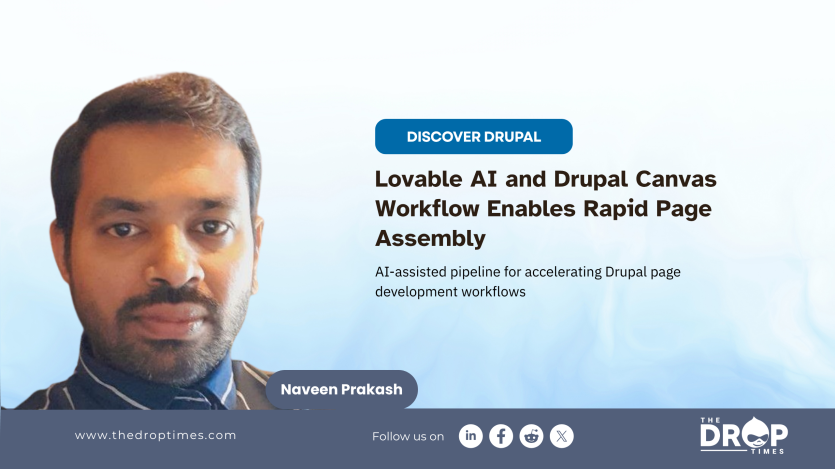
Designing and deploying a Drupal page typically involves multiple stages of design translation, component development, and editorial assembly. A workflow described in a session proposal by Naveen Prakash Duraisamy examines how AI-assisted tools can shorten the process by converting natural-language prompts into deployable Drupal components.
The approach combines Lovable AI with Drupal Canvas and Single Directory Components (SDCs) to move from prompt-based design generation to structured implementation. Rather than relying on sequential hand-offs, the workflow distributes responsibilities across roles: designers generate initial layouts, developers refine exported components, and content editors assemble pages in Drupal’s visual interface.
According to the proposal, the workflow aims to reduce the time required to produce a working Drupal page from a traditional development cycle of several weeks to a prototype assembled in minutes. This shift is positioned as a process change rather than a role replacement, retaining developer oversight while accelerating early-stage production.
Lovable AI is presented as a system capable of generating interface structures from natural language prompts. A prompt, such as creating a tourism website layout, can produce an initial structure with design elements. The generated output can then be reviewed and adjusted before being adapted into Drupal components, including verification of external media references such as Unsplash image identifiers to avoid incorrect asset mapping.
The workflow emphasises that rapid generation requires structural constraints. Drupal Canvas, also known as Experience Builder, provides this governance layer by organising components in a Single Directory. In this model, templates, styles, and configuration are maintained within a single component directory, allowing visual assembly without breaking code organisation.
The proposal outlines a staged process for preparing AI-generated output. After the initial generation, the configuration is refined to meet Drupal Canvas requirements, including enforcing $schema rules, aligning file naming conventions, and restricting component properties to supported data types such as strings, booleans, and numbers.
Once validated, components are exported with a defined separation of concerns. Shared design system styles are placed in a global global.css file, while individual components retain scoped styling within their respective SDC directories. This structure supports reuse while maintaining consistency across implementations.
The exported component library can then be uploaded into Drupal using the Canvas command-line interface, referenced as @drupal-canvas/cli. A command such as npx canvas upload --all validates and imports the component set, enabling integration of AI-generated structures into the Drupal environment.
Once available in Drupal Canvas, editors can assemble pages visually by placing components within the layout interface. Placeholder content generated during the AI phase can be replaced with assets from Drupal’s media library, while predefined component properties control presentation and behaviour.
The proposal positions this workflow as a way to accelerate prototyping without losing Drupal’s enterprise capabilities. Generated components remain standard front-end code, typically React-based, and can be stored in version-controlled repositories. Pages assembled from these components continue to use Drupal features such as moderation workflows, multilingual support, and accessibility standards aligned with WCAG.
Editor’s note: An earlier version of this article, based on a session proposal submitted by Naveen Prakash Duraisamy for DrupalCamp Delhi 2026, was published prior to the event and later removed at the author’s request. It has been republished with updated framing to reflect the workflow’s broader relevance beyond the event context.
 Naveen Prakash DuraisamyMath-lover turned Drupalist, solving customers' toughest problems at Acquia

ASK: Drupal Community Needs Your Support
View all →
Note: The vision of this web portal is to help promote news and stories around the Drupal community and promote and celebrate the people and organizations in the community. We strive to create and distribute our content based on these content policy. If you see any omission/variation on this please reach out to us at #thedroptimes channel on Drupal Slack and we will try to address the issue as best we can.

Related Drupal Initiatives

Related Events


Related Organizations

Related People


You may also like