Semantic Search and RAG Workflows Push Drupal Search Beyond Keywords

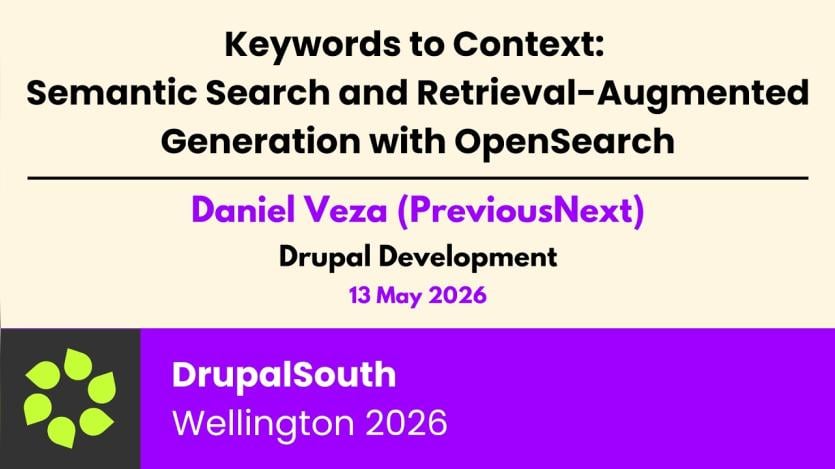
Traditional keyword-based search systems often struggle with natural-language queries and exploratory information discovery, according to a DrupalSouth Wellington 2026 presentation by Daniel Veza of PreviousNext. Expanding on the conference session in a recent article, Veza argues that users increasingly expect search systems to understand intent and meaning rather than simply match exact keywords. The presentation demonstrates how semantic search can retrieve conceptually related content even when queries use different terminology from the source material.
The session explains how semantic search relies on vector embeddings that convert content and user queries into numerical representations of meaning. Rather than matching words directly, OpenSearch compares semantic similarity between embeddings to identify relevant content. Veza demonstrated how this approach can retrieve related results for concepts such as “pet-friendly lodging” and “dog-friendly hotel” despite the absence of identical keywords. The presentation also recommends a hybrid model that combines semantic search with traditional keyword search, using weighted scoring to balance contextual relevance and exact-match precision.
A major focus of the session is Retrieval-Augmented Generation (RAG). Veza describes a workflow in which semantically relevant content is retrieved from OpenSearch and used as contextual grounding for a large language model before generating responses. Rather than returning a list of search results, the system can produce summarised answers based on indexed content while maintaining traceability to source material. The presentation argues that this approach can improve user experience for documentation systems, knowledge bases, support content, and large content repositories.
The implementation examples presented during the session use OpenSearch 3.x, AWS Bedrock models, semantic embeddings, and hybrid search pipelines. Veza also references Drupal integrations, including Search API OpenSearch, Search API Semantic, and Search API Semantic AI, which support indexing and semantic retrieval workflows within Drupal. The session concludes by highlighting practical considerations, including infrastructure cost, latency, model selection, and the trade-offs involved in deploying AI-assisted search systems at scale.

ASK: Drupal Community Needs Your Support
View all →
Disclosure: This content is produced with the assistance of AI.
Disclaimer: The opinions expressed in this story do not necessarily represent that of TheDropTimes. We regularly share third-party blog posts that feature Drupal in good faith. TDT recommends Reader's discretion while consuming such content, as the veracity/authenticity of the story depends on the blogger and their motives.
Note: The vision of this web portal is to help promote news and stories around the Drupal community and promote and celebrate the people and organizations in the community. We strive to create and distribute our content based on these content policy. If you see any omission/variation on this please reach out to us at #thedroptimes channel on Drupal Slack and we will try to address the issue as best we can.

Related Events


Related Organizations


Related People


You may also like