



Drupal Post-Mortem Examines CPU Spike Caused by Bot Traffic and Cache Misses

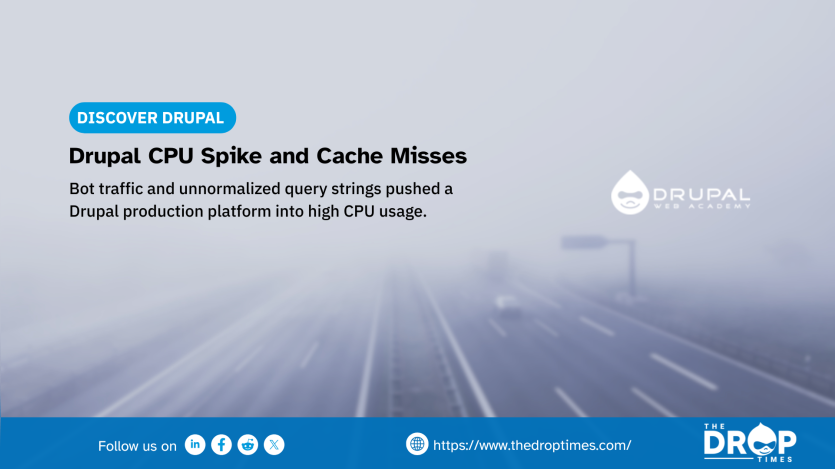
Production instability on a Drupal 11 platform forms the basis of a technical post-mortem that examines how automated traffic pushed application CPU usage to 94% and increased average response times. The illustrative scenario describes a containerized stack using PHP 8.3, PHP-FPM, Redis, Varnish, Cloudflare, New Relic, and Blackfire. According to the article, traffic rose from about 40 requests per second to 140 requests per second within 15 minutes, triggering an investigation into both infrastructure behaviour and application performance.
The analysis identifies bot traffic as the immediate trigger, but attributes the incident to multiple weaknesses. Access logs showed requests with constantly changing query-string parameters, causing Varnish to treat each variation as a separate cache key and raising the cache miss ratio to 78% from a normal level of about 15%. The article outlines mitigation measures, including Cloudflare blocking and challenge rules, Varnish query-string normalisation, cache-miss monitoring, rate limiting for sensitive paths, incident-response runbooks, and regular load testing. It argues that production failures are often caused by a combination of infrastructure gaps rather than a single technical fault and highlights cache-key management, observability, and traffic controls as important safeguards for Drupal platforms.

ASK: Drupal Community Needs Your Support
View all →
Disclosure: This content is produced with the assistance of AI.
Disclaimer: The opinions expressed in this story do not necessarily represent that of TheDropTimes. We regularly share third-party blog posts that feature Drupal in good faith. TDT recommends Reader's discretion while consuming such content, as the veracity/authenticity of the story depends on the blogger and their motives.
Note: The vision of this web portal is to help promote news and stories around the Drupal community and promote and celebrate the people and organizations in the community. We strive to create and distribute our content based on these content policy. If you see any omission/variation on this please reach out to us at #thedroptimes channel on Drupal Slack and we will try to address the issue as best we can.