



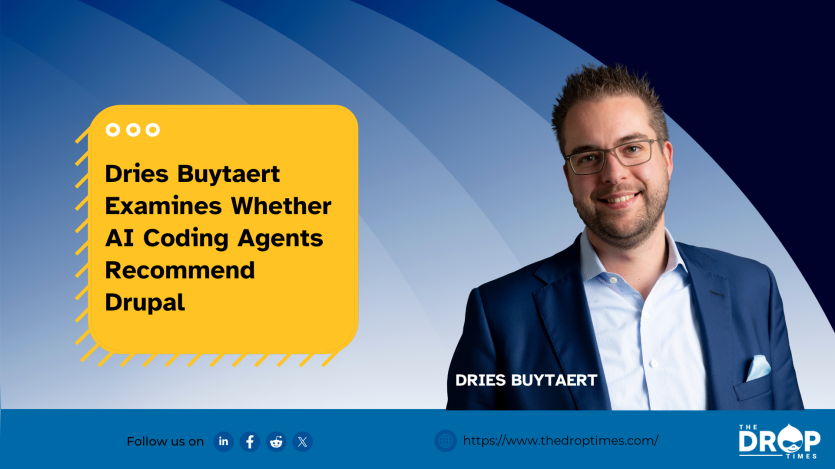
Dries Buytaert Examines Whether AI Coding Agents Recommend Drupal

Evaluating how AI coding agents perceive Drupal was the goal of a recent experiment by Dries Buytaert, who asked an AI assistant to rank technology choices for building a website and explain where Drupal fits among competing platforms.
The experiment follows Dries's recent discussions about how AI agents evaluate software based on factors such as friction, abstraction, and verification rather than capability alone. To explore those ideas in practice, he asked Claude Code, running the Opus 4.7 model to recommend technologies for building a website that required structured content, multiple user roles, integrations, and long-term flexibility.
The AI agent ranked a Next.js and headless CMS combination first, WordPress second, and Drupal third. While Drupal was identified as the platform whose capabilities most closely matched the project's requirements, the agent cited what it described as "session-time risk" as the primary reason for ranking it behind competing options.
According to the published response, Drupal's strongest advantages include its content modeling capabilities, granular permissions and workflows, and its configuration management system and module ecosystem. The agent characterised Drupal's entity and field system as a leading approach for structured content and noted that the platform is particularly well-suited to projects requiring long-term flexibility and editorial complexity.
The analysis also highlighted several challenges. Among them were the time required to install and configure Drupal, uncertainty caused by fragmented frontend approaches, and limitations in AI training data related to modern Drupal development practices. The agent suggested that setup workflows, module selection, and configuration decisions can create friction that affects recommendations during time-constrained development sessions.
When asked how Drupal could become more attractive to AI agents, the response identified five areas for improvement. These included a one-command site scaffold with opinionated defaults, a first-party Model Context Protocol (MCP) server or equivalent typed interface for interacting with live Drupal sites, machine-readable API references tied to specific Drupal versions, wider adoption of Recipes as a primary site-building mechanism, and concise documentation aimed specifically at agent-assisted development workflows.
Dries noted that several of the recommendations align with work already underway across the Drupal ecosystem. He pointed to Drupal CMS, Recipes, Site Templates, and ongoing efforts to make Drupal Core APIs more typed and discoverable. He also highlighted the recent addition of first-party command-line support for applying Recipes as part of broader efforts to simplify Drupal's initial setup experience.
A central takeaway from the experiment is that Drupal's challenges appear to be concentrated in the early stages of adoption rather than in its underlying architecture. According to Dries, AI agents recognise the platform's strengths but often encounter enough setup and configuration friction to influence recommendations before those strengths become fully visible.
While acknowledging that the test was not a formal benchmark and reflected the opinion of a single AI agent, Dries described the results as a useful signal for understanding how agent-driven workflows may influence software evaluation in the future. He plans to repeat the experiment annually to track how Drupal, AI models, and competing platforms evolve over time.
The post concludes with a call for community contributions to Recipes and Site Templates, which Dries believes can help improve Drupal's first-session experience for both people and AI agents. He argues that making common Drupal workflows easier to discover, apply, and verify could reduce the friction that currently affects how AI systems evaluate the platform.
ASK: Drupal Community Needs Your Support
View all →
Disclosure: This content is produced with the assistance of AI.
Disclaimer: The opinions expressed in this story do not necessarily represent that of TheDropTimes. We regularly share third-party blog posts that feature Drupal in good faith. TDT recommends Reader's discretion while consuming such content, as the veracity/authenticity of the story depends on the blogger and their motives.
Note: The vision of this web portal is to help promote news and stories around the Drupal community and promote and celebrate the people and organizations in the community. We strive to create and distribute our content based on these content policy. If you see any omission/variation on this please reach out to us at #thedroptimes channel on Drupal Slack and we will try to address the issue as best we can.

Related People


You may also like