Link Remediator Alpha Builds on USDA-ARS Drupal Maintenance Work

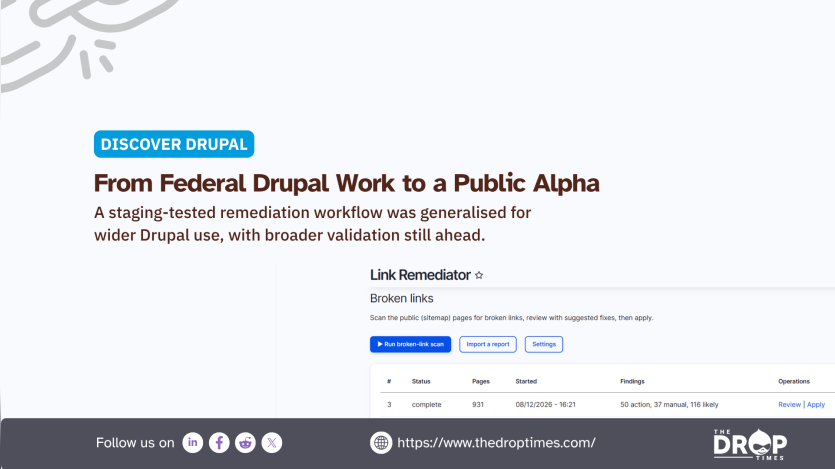
Site administrators can now test the first public alpha of Link Remediator, a contributed module for finding and correcting broken and absolute internal links in Drupal content. Version 1.0.0-alpha1 was released on 15 August 2026 for Drupal 10.2 or later and Drupal 11. In written responses to The DropTimes, Link Remediator maintainer Binquan Wang said the project grew from functionality he developed while supporting the US Department of Agriculture's Agricultural Research Service (USDA-ARS) on a National Agricultural Library Drupal site.
The public module carries forward a maintenance workflow that Binquan said worked in the National Agricultural Library site's development and staging environments, while removing assumptions tied to that implementation. The original workflow had not been deployed to production, so the alpha represents a generalisation of development and staging work rather than a production-tested release. That distinction matters because the contrib version must operate across Drupal configurations and content models that were not part of the original environment.
Binquan said the original requirement was to find a more efficient way to identify and remediate broken or outdated links across Drupal content. As the functionality developed, he concluded that broken links, redirected URLs, outdated domains and large-scale content maintenance were not unique to USDA-ARS. He said the decision to publish the functionality as a contributed project was his after identifying a reusable core.
To prepare the module for contrib, Binquan said he separated reusable functionality from USDA-specific content structures, environments and business rules. The public project keeps the link-remediation workflow but makes site-specific assumptions configurable rather than embedding the original National Agricultural Library implementation. Drupal.org describes the result as a reviewed workflow that separates discovery from content modification and applies approved changes through Drupal APIs.
Binquan said the contrib version remains alpha because validation in one environment does not establish compatibility across the range of Drupal sites. “It was not deployed to production yet, so I want to be careful not to characterize it as a production-tested module,” he told The DropTimes. Before moving beyond alpha, he wants testing across different Drupal versions, content models, field configurations, link types and larger datasets. He also identified automated test coverage, documentation, edge-case handling, usability and compatibility as areas requiring further work.
The module provides controls intended to limit the risk of modifying stored content. It can discover broken and absolute internal links, let administrators approve or reject proposed replacements, and run dry runs before approved changes are applied. For standard Drupal content, writes go through Drupal's Entity API rather than direct database updates, and successful remediation operations are recorded for audit and supported rollback. Drupal.org also says links are re-checked before changes are applied.
The project distinguishes between links it can map to writable Drupal storage and links that require manual handling. Occurrences generated by custom code, Views, external data, custom renderers or other storage can remain unresolved when the module cannot safely map them to an entity field. A locator and remediator plugin API allows additional storage systems to provide their own discovery and write logic while participating in the same review, audit and rollback workflow.
The Drupal.org project page credits USDA-ARS with funding the work from which the reusable module was derived. It separately credits DSFederal, Inc. with supporting development and maintenance through developer time and technical resources. Neither the project documentation nor Binquan's responses establish that the public contributed module has been deployed on a USDA-ARS production site. Drupal.org lists the current release as an alpha for testing and evaluation, outside Drupal's security advisory policy, and recommends development or staging testing with appropriate backups before production changes.
 Allen JasonAllen without organs

ASK: Drupal Community Needs Your Support
View all →
Disclosure: This content is produced with the assistance of AI.
Note: The vision of this web portal is to help promote news and stories around the Drupal community and promote and celebrate the people and organizations in the community. We strive to create and distribute our content based on these content policy. If you see any omission/variation on this please reach out to us at #thedroptimes channel on Drupal Slack and we will try to address the issue as best we can.