



Drupal and EmDash Reflect Diverging CMS Architectures and Operating Models

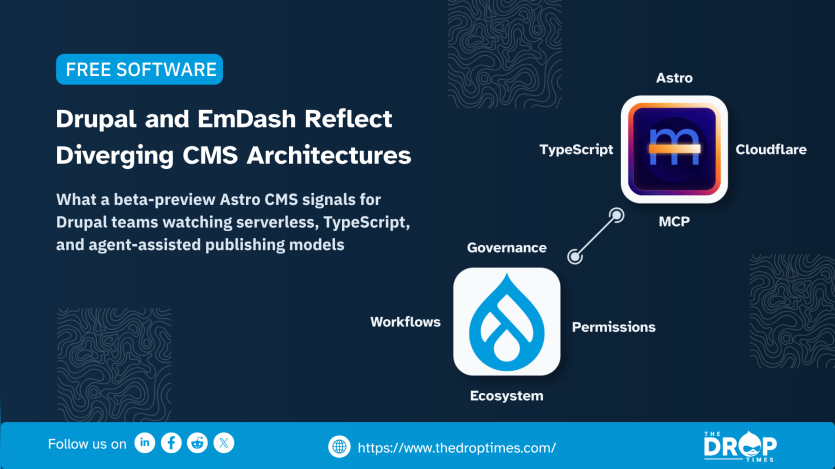
EmDash has drawn attention as a new Astro and Cloudflare-oriented CMS built for TypeScript development and agent-assisted content operations. For Drupal developers and teams, the useful question is what EmDash reveals about newer publishing architectures and where its model differs from Drupal’s established enterprise CMS approach. That makes the comparison less about direct competition and more about changing assumptions in web publishing.
That question matters because the two systems organise content management around different assumptions. Drupal is built on a mature CMS model centred on governance, permissions, workflows, configuration, and a large ecosystem of contributed projects. EmDash starts from a framework-centred model that places content management inside an Astro application and connects it to serverless deployment, typed schemas, and programmatic access.
Infrastructure and Deployment
Drupal commonly runs in persistent hosting environments with relational databases, caching layers, and operational maintenance practices. This model supports complex sites, long-running integrations, and enterprise hosting patterns, but it also requires ongoing infrastructure management. EmDash presents itself as a full-stack TypeScript CMS built on Astro and Cloudflare, and it also supports deployment on Node.js servers with SQLite.
That difference shapes the operating model. Drupal assumes a CMS-centred architecture in which content modelling, editorial workflows, configuration, and extension logic sit inside the platform. EmDash works closer to a framework-centred model, where the CMS integrates into an Astro project and content delivery remains closely tied to the frontend application.
Development Model
Drupal provides a PHP and Symfony-based framework supported by established APIs, configuration management, and structured development practices. It's a model that suits teams needing content entities, permissions, editorial workflows, multilingual support, and integrations within a mature CMS environment. EmDash serves as an Astro-native CMS that integrates content management and frontend delivery within a TypeScript project.
EmDash documentation emphasises typed schemas, generated TypeScript types, and content querying through Astro Live Content Collections. This makes the platform more closely aligned with JavaScript and TypeScript development teams than with traditional CMS implementation teams. The trade-off is maturity: Drupal has a long production history, while EmDash remains in beta preview.
Governance and Editorial Control
Governance creates one of the clearest differences between the two systems. Drupal supports large editorial organisations through workflows and role-based transition permissions, supported by the core Content Moderation module. These features make Drupal suitable for teams that need structured approval processes, role separation, and predictable editorial control.
EmDash places more emphasis on programmatic access and automation. Its documentation describes a built-in Model Context Protocol server, command-line tooling, and APIs that allow agents and developers to manage content, schema, media, taxonomies, menus, and revisions. That model may suit smaller teams or developer-led publishing workflows, but it does not represent the same kind of long-tested editorial governance model that Drupal provides.
Extensibility and Ecosystem Maturity
The two systems also differ in how they approach extensibility. EmDash describes a plugin model based on sandboxed Worker isolates and declared capability manifests when deployed on Cloudflare. This reflects a newer security model for extensions, especially when compared with plugin systems that give extensions broad access to application internals.
Drupal relies on community governance and a long-established contributed project ecosystem. Drupal.org currently lists more than 55,000 contributed modules and more than 3,000 themes. That scale gives Drupal a depth of available functionality that EmDash cannot yet match, but it also reflects a different model of maintenance, review, compatibility, and long-term site stewardship.
Migration and Adoption Considerations
For an existing Drupal site, moving to EmDash would likely require substantial architectural adaptation rather than a simple content transfer. Content structures, workflow models, frontend implementations, extension patterns, and deployment practices differ significantly. The same would apply in reverse: moving an EmDash project into Drupal would require rethinking the application around Drupal’s content model, permissions, configuration, and hosting assumptions.
For a new project, the question is less about migration and more about fit. Drupal suits organisations that need mature governance, complex content structures, established workflows, and a large extension ecosystem. EmDash suits teams that want an Astro and TypeScript-centred publishing stack, Cloudflare-oriented deployment, and deeper integration with programmatic or agent-assisted operations.
What Drupal Teams Should Watch
The value of examining EmDash is not that it offers a direct replacement for Drupal. Its relevance lies in the architectural questions it raises for Drupal developers, agencies, and site owners: how much content management should live inside the CMS, how much should move into the application framework, and how far publishing workflows should depend on automation and agent-accessible APIs.
Drupal and EmDash support different assumptions about governance, infrastructure, staffing, extensibility, and automation. The useful question is not which system is more modern, but what each model asks a team to manage. For Drupal teams, EmDash is worth watching less as a competitor and more as a signal of where some publishing tools are moving.
 Allen JasonAllen without organs
ASK: Drupal Community Needs Your Support
View all →
Disclosure: This content is produced with the assistance of AI.
Note: The vision of this web portal is to help promote news and stories around the Drupal community and promote and celebrate the people and organizations in the community. We strive to create and distribute our content based on these content policy. If you see any omission/variation on this please reach out to us at #thedroptimes channel on Drupal Slack and we will try to address the issue as best we can.

You may also like