



Drupal Cache Playground Visualizes Cache Variations and Invalidation

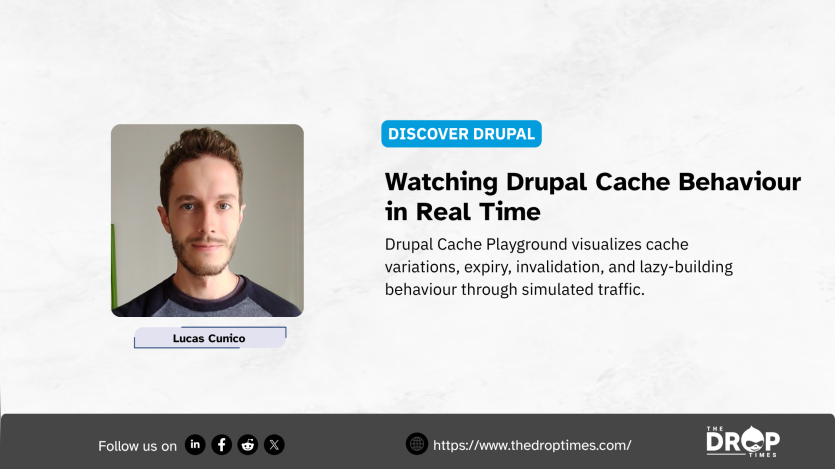
Developers can explore Drupal cache behaviour through Drupal Cache Playground, an interactive browser-based simulation created by Drupal developer Lucas Cunico Kalinowski. In his 17 August 2026 LinkedIn article The Drupal bug that never shows up in the log, Lucas describes cache problems in which Drupal can continue serving an older stored copy even though the underlying data has changed and no application error appears. He says the playground's rules were ported from Drupal core source and verified against Drupal 11.3.10.
The playground reduces Drupal's cacheability system to three questions: what is on the page, who should receive a different version, and when the result should expire. These map to cache tags, cache contexts and max-age, with an additional option for #lazy_builder. Users can send simulated traffic, watch cache variations accumulate and expire, inspect the context values behind different copies, and trigger events that invalidate entries with matching tags. The tool also warns about configurations such as highly variable contexts, unbounded query arguments, missing list tags and unplaceholdered elements with max-age: 0.
Lucas says reading Drupal core while building the tool corrected several of his own assumptions. Among them, newly created entities invalidate relevant list tags rather than their own entity cache tag, placeholders defer an element's cacheability instead of discarding it, and menu blocks depend on configuration tags such as config:system.menu.<id>. The playground includes eight preset scenarios intended to make these interactions visible to developers, QA teams and people learning Drupal caching, while the original LinkedIn article provides the underlying technical reasoning.

ASK: Drupal Community Needs Your Support
View all →
Disclosure: This content is produced with the assistance of AI.
Note: The vision of this web portal is to help promote news and stories around the Drupal community and promote and celebrate the people and organizations in the community. We strive to create and distribute our content based on these content policy. If you see any omission/variation on this please reach out to us at #thedroptimes channel on Drupal Slack and we will try to address the issue as best we can.

Related People


You may also like