

Drupal Association Continues AWS Migration as OSU Open Source Lab Restructures

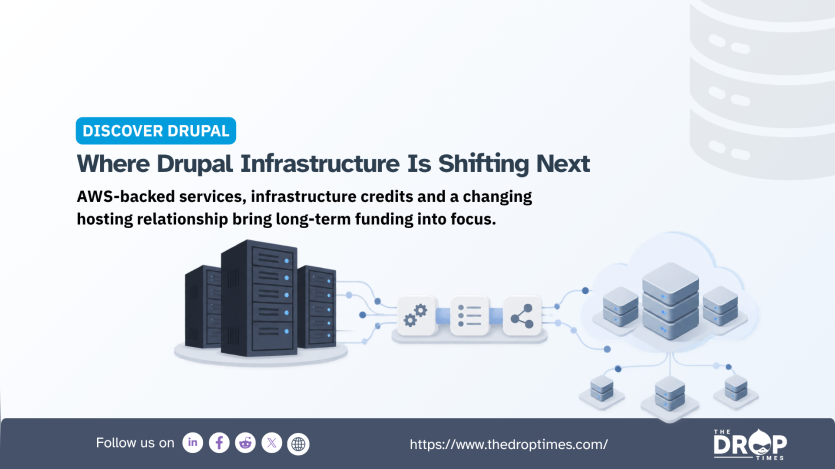
Across Drupal's infrastructure, more essential services are moving from donated hosting at the Oregon State University Open Source Lab to Amazon Web Services as the lab restructures, according to a 21 September 2026 post from the Drupal Association. The Association says the AWS Open Source Credits program has supported Drupal infrastructure since 2025 and allowed the transition to continue without reducing contributor capacity. The post does not identify every service included in the current migration or give a completion date.
Current AWS-backed infrastructure includes Drupal's autoscaling continuous integration runners and Drupal Steward. Drupal's self-hosted GitLab instance hosts 42,382 contributed projects, alongside Drupal core, while the CI runners account for roughly one-third of the Association's cloud footprint. Between 26 August 2025 and 26 August 2026, those runners executed about 4.1 million jobs and consumed approximately 159,800 compute hours.
Security work also depends on the same testing pipeline. The Association says fixes covered by 163 Drupal security advisories during the preceding 12 months were developed, tested and released through the AWS-powered CI system. Drupal Steward, which provides protection during the period between publication of certain security advisories and site patching, also runs on AWS. About 667,000 Drupal sites contact the project's update infrastructure each week, although the September post does not state that the update service itself runs on AWS.
Drupal's use of AWS predates the current migration and the credits introduced in 2025. The Association had already described Drupal.org as operating on a hybrid architecture spanning the OSU Open Source Lab and AWS, while a November 2023 GitLab Acceleration meeting recorded Drupal's GitLab infrastructure as having been fully shifted to AWS. The current transition therefore represents a further movement of services toward AWS rather than the beginning of Drupal's use of the platform.
Further details appeared in a 5 May 2025 Association update, which said critical infrastructure was still operating at OSUOSL, including pre-production environments, mail transport and legacy systems. Some legacy systems remained mid-migration at that point. The September 2026 post does not specify which of those services remain at the lab.
Changes at OSUOSL form a separate but related part of the transition. The lab said on 30 April 2025 that it needed $250,000 in committed funding or could face closure later that year. A 9 May update said community support had funded its team for another year. By February 2026, OSUOSL listed Drupal among 26 projects with co-located hardware that needed to move to Oregon's State Data Center in Salem.
Physical relocation of that infrastructure was completed separately from the Drupal Association's AWS migration. An 11 August 2026 OSUOSL update said approximately 260 servers and all co-located project systems had been moved to Salem, with the physical migration completed in mid-March. The Drupal Association's September post concerns the continuing migration of essential services to AWS rather than that data-centre move.
Longer-term infrastructure funding remains part of the wider context. The Association's 2025 audit and financial overview, published on 4 August 2026, said the cost of operating Drupal.org infrastructure increased from $1.3 million in 2022 to $2.1 million in 2025, a rise of about 61%.
Donated and in-kind services increased from $249,249 in 2022 to $1,011,995 in 2025 and covered 48% of Drupal.org infrastructure spending that year. Those figures include support from multiple vendors and partners and do not identify the value of AWS credits separately. The September migration post also does not state the value, duration or renewal terms of the AWS credits supporting the infrastructure.
Further details are expected through two additional posts in the Association's three-part series. The next instalment is expected to examine community programmes hosted beyond code, while the third will address open source infrastructure in the AI era and what the Association plans to build next.
ASK: Drupal Community Needs Your Support
View all →
Disclosure: This content is produced with the assistance of AI.
Note: The vision of this web portal is to help promote news and stories around the Drupal community and promote and celebrate the people and organizations in the community. We strive to create and distribute our content based on these content policy. If you see any omission/variation on this please reach out to us at #thedroptimes channel on Drupal Slack and we will try to address the issue as best we can.

Related People


You may also like