



W3C Selects WebMCP Polyfill for Pilot as Drupal Tests Agent Tools

Software that helps developers test WebMCP across browser environments has been selected as the second pilot under the World Wide Web Consortium's (W3C) Open Source Program. The consortium announced the selection on 27 October 2026, identifying interoperability as a priority while the proposed interface for browser-based AI agents continues to develop.
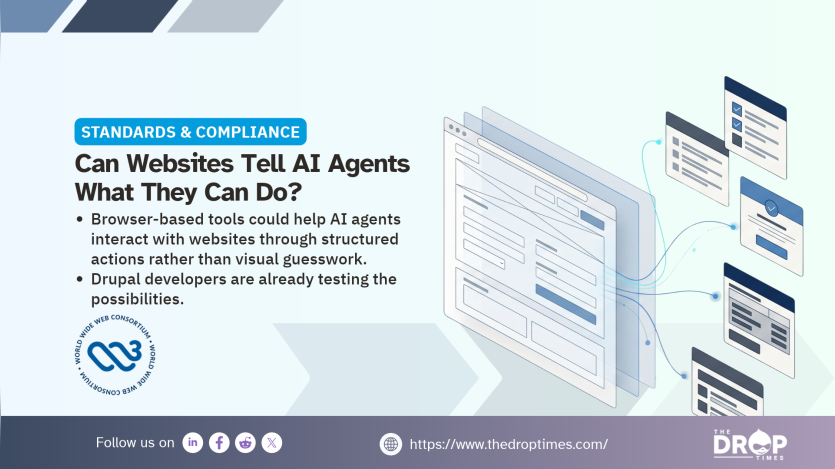
The announcement has relevance for Drupal developers experimenting with ways to expose existing website functions to AI agents. WebMCP allows web applications to register JavaScript functions as structured tools, enabling compatible agents to discover available operations without relying entirely on visual navigation. Drupal contributed projects are exploring both JavaScript-based commands and metadata added to existing forms, although neither approach represents a production-ready standard.
The selected WebMCP polyfill is a compatibility library intended to let developers experiment with the API before native browser implementations become widely interoperable. Ian Jacobs, a member of W3C's Strategy Team, outlined the pilot's initial objectives in the announcement. These include publishing an npm package, developing lifecycle events and declarative support, following changes to the specification and maintaining coverage through Web Platform Tests.
The polyfill's repository documents support for tool registration, discovery, execution, cancellation and change notifications. Declarative forms and certain lifecycle events have not yet been implemented in the documented polyfill version. W3C lists those features as development objectives, while declarative support is being explored separately from the main WebMCP specification. The project also states that communication with an actual browser agent requires support from the browser itself, meaning the library does not independently provide complete agent functionality.
WebMCP remains a draft Community Group Report developed within the W3C Web Machine Learning Community Group. It is neither an approved W3C standard nor a specification on the W3C Standards Track. Google introduced experimental browser support through an origin trial beginning with Chrome 149, which The DropTimes reported in June.
A specification change on 8 October 2026 has particular relevance for Drupal's existing experiments. WebMCP contributors removed the declarative API from the main specification, leaving the JavaScript-based registerTool() interface as its focus. Declarative WebMCP, which uses annotations on HTML forms to describe available tools and their inputs, remains under separate exploration.
Drupal contributor Mark Conroy developed the experimental WebMCP User Forms module, which adds tool metadata attributes to Drupal's login, password-reset and registration forms. The module supports Drupal 10, 11 and 12. Its approach reflects the declarative model that is no longer included in the main WebMCP specification.
Drupal developer Ronald te Brake has also tested declarative WebMCP integration with Drupal Views and Webform. His proof of concept, covered by The DropTimes in September, explored how Drupal's Form API could supply structured information to browser-based agents. The experiment demonstrated possible benefits for form interactions but did not establish general compatibility across browsers or agent implementations.
A newer Drupal project, Sutram, follows the JavaScript-based approach. Created on 16 October 2026, it provides a developer API and command registry that Drupal modules can use to expose functionality through WebMCP, direct JavaScript calls and a console interface. Its demonstration submodules illustrate navigation, page and form operations. The base module supplies the underlying library and console but does not register Drupal commands independently; additional integration modules are required.
According to Sutram's project documentation, commands run within the current page and logged-in user's context, using Drupal permissions and requesting confirmation for actions that are difficult to reverse. These safeguards are described by the project maintainers and have not been independently assessed for this report. Sutram is available as an alpha release compatible with Drupal 11.1 and later versions in the Drupal 11 series. It is not covered by Drupal's security advisory policy.
These browser-based experiments differ from Drupal's existing MCP Server module, which exposes tools and other capabilities to external clients through the Model Context Protocol. WebMCP instead concerns functions made available within an active web application. Both approaches can potentially expose related Drupal operations, but implementing one does not automatically provide the other.
W3C is also considering a draft charter for an Agentic Web Working Group. The proposed scope includes ways to describe website capabilities, represent agent identity and delegated authority, express permissions, and measure the reliability of agent interactions. The group has not yet been formally established under the draft charter.
For Drupal developers, the immediate significance of the polyfill pilot lies in testing how existing application functions can be made available to browser-based agents as the underlying specification changes. Broader adoption will depend on interoperable browser implementations, stable interfaces and appropriate permission controls. Further information about the project's development objectives is available in the W3C announcement.
References
-
W3C Launches Second Pilot of Program to Support Open Source Projects, World Wide Web Consortium (W3C) (27 October 2026)
-
Join the WebMCP origin trial (9 June 2026)
-
WebMCP User Forms | Drupal.org (25 February 2026)
-
Sutram: WebMCP tools and command console for Drupal | Drupal.org (16 October 2026)

ASK: Drupal Community Needs Your Support
View all →
Disclosure: This content is produced with the assistance of AI.
Note: The vision of this web portal is to help promote news and stories around the Drupal community and promote and celebrate the people and organizations in the community. We strive to create and distribute our content based on these content policy. If you see any omission/variation on this please reach out to us at #thedroptimes channel on Drupal Slack and we will try to address the issue as best we can.

You may also like