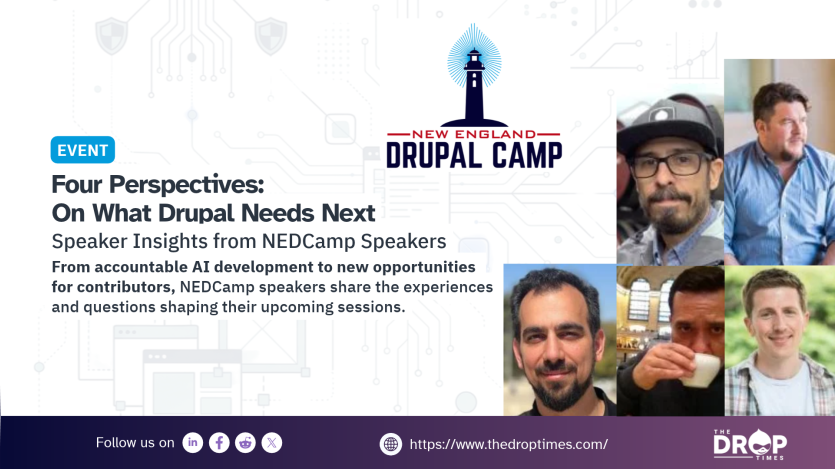
Speaking ahead of New England Drupal Camp (NEDCamp) 2026, five presenters have shared their perspectives with The DropTimes on responsible AI development, Drupal's reputation among developers, emerging front-end capabilities, commercial opportunities for smaller projects, and the future of community participation. Their contributions draw on professional experience, developer research, technical experimentation, and longstanding involvement in the Drupal ecosystem.
Scheduled for 13–14 November 2026 at Rhode Island College in Providence, Rhode Island, NEDCamp 2026 will bring together Drupal developers, contributors, and other web professionals. The five speakers will present on Saturday, 14 November, addressing different questions about how Drupal is developed, evaluated, used commercially, and sustained as an open-source community. Their responses to The DropTimes offer a closer look at the experiences and arguments behind those sessions.
Jim Birch on Building Trust Into AI-Assisted Development
Birch told The DropTimes that AI is already being used by development teams, whether or not their organisations have introduced formal policies. He believes the more important question is how teams can use these tools responsibly and demonstrate that the resulting work meets established standards.
At Kanopi, teams working with Drupal and WordPress have spent the past year experimenting with AI-assisted development and establishing procedures around its use. Birch said the experience involved trial and error, including identifying practices that worked and changing those that did not. His presentation will draw on what the agency has implemented rather than make a general argument for AI adoption.
This isn't a session about convincing people to use AI. It's about making sure we can trust the work it helps us produce.
–Jim Birch, engineering director and AI practice lead, Kanopi Studios
Birch plans to demonstrate several layers of AI governance, including internal and client-facing policies, repository-level safeguards, reusable agent skills, and requirements for human review. These measures are intended to give development teams consistent expectations for using AI tools and evaluating their output.
Documentation is another area of emphasis. Birch wants teams to be able to show clients how AI-assisted work was reviewed, who was responsible for approving it, and which validation checks were completed. His session will demonstrate how those details can be recorded as part of the development process.
He will also examine adversarial testing for AI-powered features built into Drupal and WordPress websites. Such testing involves deliberately attempting to manipulate or break AI functionality before it reaches production. Birch argues that teams introducing these features must understand how users could exploit their behaviour rather than rely only on whether they function as intended.
Attendees can expect practical examples, checklists, and open-source tools for adapting these approaches within their own teams. Birch's central concern is ensuring that human responsibility remains visible and verifiable even as AI takes on a larger role in development.
John Money Examines Drupal's AI Perception Gap
While Birch is concerned with the accountability of AI-assisted work, John Money, director of product marketing at Acquia, is examining how developers perceive Drupal and what they increasingly expect from a content management system. His presentation, "The Future of Drupal in Just Five Words," draws on research into the factors influencing CMS selection, retention, and replacement.
Money shared a finding from a survey of 575 developers. Among the 389 respondents familiar with Drupal, participants provided 1,167 word responses when asked for the first three words that came to mind about the platform. Only five of those responses mentioned AI.
The survey, commissioned by Acquia and conducted by Coleman Parkes in July 2026 across the United States, United Kingdom, and France, also examined what developers want from their platforms. According to Acquia's published findings, 53% said poor support for AI or agentic workflows would be a reason to leave a CMS, making it the leading reason apart from cost. Another 49% said they would consult an AI assistant when researching a content management system.
Money sees a gap between Drupal's capabilities and the way developers describe the platform. Although respondents associated Drupal with established characteristics such as flexibility, reliability, security, and open source, AI was largely absent from their spontaneous descriptions.
Drupal already has much of what they want. We just aren’t saying it.
–John Money, director of product marketing, Acquia
Money argues that familiar descriptions such as "flexible" and "great community" do not sufficiently distinguish Drupal for potential buyers or in the information surfaced by large language models. With developers increasingly using AI assistants to research platforms, he believes Drupal needs to communicate its capabilities in more specific terms.
His presentation will also examine what chief information officers expect from AI and why governance is important in enterprise purchasing decisions. Money intends to discuss the relationship between AI readiness, structured content, and organisational control rather than treating AI integration as a standalone feature.
He will identify five words that he believes Drupal should be associated with, supported by developer research and examples of capabilities available in the platform. Money's argument is that Drupal must communicate its strengths while addressing the expectations developers now bring to CMS evaluations.
Ashraf Abed Wants Drupal to Reach Beyond Enterprise Projects
Abed told The DropTimes that the economics of open-source development are changing. He believes expensive custom projects have become more difficult to sell, while individuals are also facing a more challenging technology employment market. Rather than concentrate solely on surviving those conditions, he argues that developers and agencies need business models that allow them to build sustainable careers.
His proposed approach places greater emphasis on the value clients receive throughout a website's lifecycle, from initial development and hosting to maintenance and ongoing improvements. He also considers reducing unnecessary complexity essential to making Drupal more accessible to customers with smaller budgets.
We need a strategy that lets us actually thrive instead of just trying to get by.
Ashraf Abed
Ashraf Abed
–Ashraf Abed, founder, Drupito
Abed argues that Drupal's development ecosystem has concentrated heavily on large organisations since Drupal 8, leaving a substantially larger potential customer base underserved. He points to the fact that small businesses represent 99.9% of US businesses and believes Drupal professionals should find ways to serve more of them. His comparison between the 0.1% and 99.9% is an argument about Drupal's market focus, rather than a measured breakdown of its existing customers.
For agencies and independent developers, he sees an opportunity to rethink how smaller projects are priced, delivered, hosted, and maintained. Winning lower-budget projects profitably requires a combination of technical efficiency, streamlined operations, and service offerings that customers can understand without extensive technical knowledge.
Abed plans to discuss both technical and non-technical strategies for serving this market. These include reducing development overhead, offering more value through hosting and maintenance, and building services that can generate recurring revenue rather than relying exclusively on new custom projects.
His presentation will include a live demonstration of Drupito, a Drupal hosting and marketplace platform he founded. The service is intended to help developers and agencies deploy and maintain Drupal websites while reusing maintained codebases across multiple customer sites. It also supports a model in which developers can package their work as website offerings for other customers.
Abed believes a more consumer-friendly experience could help Drupal compete for projects where customers might otherwise select a software-as-a-service platform. He wants Drupal to feel simpler for clients while retaining the flexibility available to developers. The session will also examine how professionals can build their own SaaS offerings using Drupal, creating opportunities to earn revenue from reusable products rather than delivering every website as a separate custom build.
The focus is particularly relevant to small agencies, freelancers, and developers considering self-employment. Abed's position is that Drupal's commercial opportunities need not depend exclusively on large development budgets, provided teams can reduce complexity and make smaller projects economically viable.
Brian Perry Pushes Drupal Canvas Code Components Beyond Conventional Examples
Brian Perry, founding engineer at Actual AI, will take a more experimental approach in his presentation, "Fun With Canvas Code Components." The session will explore how developers can use React-compatible JavaScript components directly within Drupal Canvas and experiment with interactive front-end functionality.
Perry told The DropTimes that Code Components have evolved rapidly alongside Canvas itself. As the feature has changed, he believes many Drupal developers have not yet had the opportunity to experiment with its current capabilities.
Rather than focus exclusively on conventional development examples, Perry plans to demonstrate playful components that test the boundaries of what Drupal's front end can support. His presentation will include experiments involving AI-assisted development, with an emphasis on discovering possibilities that may not be apparent from more familiar implementation patterns.
If you haven't had a chance to experiment with code components, you'll most likely be surprised by what is already possible.
–Brian Perry, founding engineer, Actual AI
Perry also intends to discuss the limitations of Code Components. His perspective is informed by working primarily outside the Drupal ecosystem in his day-to-day development, allowing him to compare Canvas with the expectations and practices of developers using other technologies.
For attendees who have not experimented extensively with Canvas, he hopes the examples will make its capabilities more tangible. The session is intended to be exploratory, showing what developers can attempt while acknowledging where the current experience remains constrained.
Thomas Scola Questions How Drupal Passes Leadership to New Contributors
Beyond commercial and technical considerations, NEDCamp will examine how Drupal can remain accessible to future generations. Thomas P. Scola, founder of Bluefly.io and a longtime Drupal contributor, will present "Passing the Drupal Torch: Will the Next Generation Take It?" with his daughter, Olivia Scola, a customer success engineer at Acquia.
In material shared with The DropTimes, Thomas describes how his early experience of Drupal was shaped by a growing, decentralised open-source community. Collaboration through Internet Relay Chat (IRC), informal knowledge sharing, and relationships formed around the project were central to that period. The familiar expression "came for the code, stayed for the people" captures the connection between technical participation and community belonging.
Olivia represents a different experience of the ecosystem. She grew up around her father's involvement in Drupal before establishing her own career at Acquia in customer success. Their presentation will compare how a longtime technical contributor and someone entering an established industry understand the opportunities, relationships, and expectations associated with the community.
The session also recognises the importance of people working outside traditional developer roles. Customer success, digital strategy, communication, and other professional contributions form part of Drupal's wider ecosystem, even when they are not reflected in code contributions.
A central concern in Thomas's account is that mature open-source communities can unintentionally create barriers for newcomers. Established contributors may have access to institutional knowledge, professional networks, and unwritten rules that are difficult for newer participants to navigate. The traditions that helped a community grow can become obstacles if they are not examined as the community changes.
Thomas argues for a shift from gatekeeping towards active mentorship. Rather than simply inviting new participants into existing structures, longtime leaders should help them develop the confidence, experience, and authority to assume responsibility. The transfer of ownership and decision-making is central to ensuring that new contributors can influence the project's direction.
Passing the torch is not enough. We must build a community the next generation would choose for itself.
–Thomas P. Scola and Olivia Scola, NEDCamp 2026 session description
The father-and-daughter presentation will explore differences in expectations around mentorship, inclusion, career development, communication, and community involvement. It will also ask what established participants should preserve, what may need to change, and how new generations can help shape the Drupal community they inherit.
According to the programme, Thomas and Olivia will answer a common set of questions independently before comparing their perspectives. The discussion will conclude with a practical generational handoff test intended to help teams and communities assess whether newer contributors have genuine opportunities to participate, influence decisions, and lead.
Speakers Look Forward to Community Connections and Ethan Marcotte's Keynote
Beyond the subjects of their sessions, the speakers highlighted their personal reasons for attending NEDCamp. Birch and Money both expressed interest in hearing Ethan Marcotte's keynote, "The Work We Want," scheduled for Saturday, 14 November. Marcotte, whose 2011 book Responsive Web Design helped shape modern web design practices, will examine changes in technology work and the questions facing people building for the web.
Birch said Marcotte's earlier work influenced how a generation of developers approached website development, and he is interested in hearing his perspective on where the web is heading. Money likewise cited the keynote as a highlight, although he said he is particularly looking forward to the conversations that follow his own presentation.
For Perry, NEDCamp also offers a personal connection to Rhode Island, where he grew up. Now living in the Midwest, he is looking forward to reconnecting with friends from the Drupal community and spending time with family members who still live in the state.
Abed will be attending NEDCamp for the first time. He said he is looking forward to the summit, hearing other speakers, and meeting people at the event.
Birch also emphasised the value of meeting other professionals facing similar challenges, comparing experiences, and bringing ideas back to their teams. Those informal exchanges remain an important part of what draws contributors to regional Drupal events.
The 2026 NEDCamp programme includes a Higher Education Summit on Friday, 13 November, followed by conference sessions and Marcotte's keynote on Saturday. The five speaker contributions shared with The DropTimes provide perspectives on the technical, commercial, and community questions their sessions will address.
Image Attribution Disclaimer: At The Drop Times (TDT), we are committed to properly crediting photographers whose images appear in our content. Many of the images we use come from event organizers, interviewees, or publicly shared galleries under CC BY-SA licenses. However, some images may come from personal collections where metadata is lost, making proper attribution challenging.
Our purpose in using these images is to highlight Drupal, its events, and its contributors—not for commercial gain. If you recognize an image on our platform that is uncredited or incorrectly attributed, we encourage you to reach out to us at #thedroptimes channel on Drupal Slack.
We value the work of visual storytellers and appreciate your help in ensuring fair attribution. Thank you for supporting open-source collaboration!
Disclosure: This content is produced with the assistance of AI.
Note: The vision of this web portal is to help promote news and stories around the Drupal community and promote and celebrate the people and organizations in the community. We strive to create and distribute our content based on these content policy. If you see any omission/variation on this please reach out to us at #thedroptimes channel on Drupal Slack and we will try to address the issue as best we can.











 Kazima AbbasKazima Abbas is a sub-editor at The Drop Times