Ahead of Drupal GovCon 2026’s main conference sessions on 12 August 2026, speakers have shared with The Drop Times the practical problems behind sessions on AI governance, federal-site migrations, performance, code quality, project cost, management, scope, and government delivery. Their responses add practical context to the programme, including the controls, trade-offs, and implementation decisions they expect attendees to confront in real projects.
Drupal GovCon runs from 11–13 August 2026 at the Stamp Student Union at the University of Maryland, College Park. Produced by Drupal4Gov, the event devotes Tuesday to training, while the main session programme runs on Wednesday and Thursday. The official programme provides the conference schedule; the written responses published here add the speakers’ reasons for recommending their sessions, intended takeaways, and expectations for the event.
Get the Latest in Drupal!
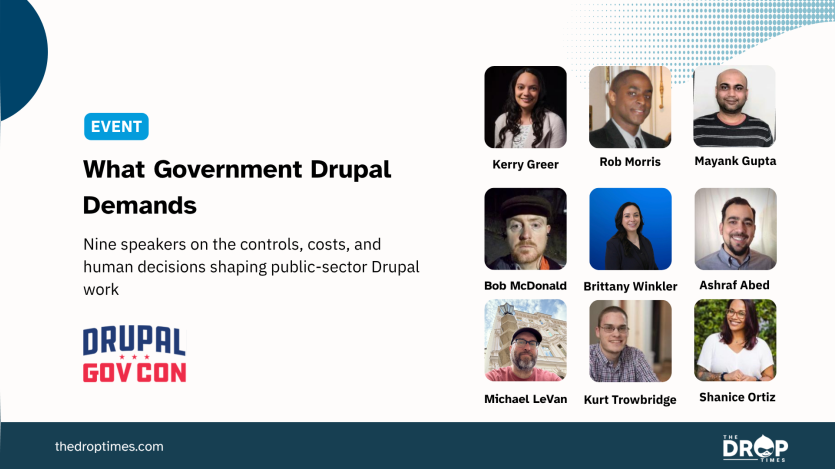
For Kerry Greer, account director for the public sector at Forum One, the Wednesday programme begins with In Defense of Paragraphs: Why Structured Content Beats Drag-and-Drop at Scale. According to the Drupal GovCon programme, the session challenges the assumption that greater visual freedom necessarily makes a content-management system better when teams are managing thousands of government pages under accessibility requirements and design-system constraints. The programme describes the Paragraphs module as a way to give editors defined presentation options rather than an unrestricted page canvas.
The programme says constrained authoring can still allow choices such as approved background palettes, image alignment, and component styles while preserving responsive layouts, design-system consistency, Section 508 accessibility requirements, and structured data. It also connects that structure to decoupled Next.js frontends, where Paragraphs can map predictably to frontend components and expose machine-readable data. The session description further links structured content with AI search, summarisation, chatbots, and automation by reducing the need for AI systems to interpret complex page-builder output.
Kerry’s second Wednesday session, Evolving FWS.gov: A Headless Migration Tale of AI, React, and Drupal 10, is presented with Keith Setliff and Bryson Jones. In her written response to The Drop Times, Kerry described the session as covering the “messy, real-world reality” of moving a large federal site to Drupal 10 and Next.js. She highlighted mapping Drupal Paragraphs to React, handling a phased agile migration without breaking legacy technology, and using AI to assist with the migration of more than 14,000 pages without losing data integrity.
The programme adds that the U.S. Fish & Wildlife Service migration uses Drupal 10 on Acquia with a Next.js frontend and maps Paragraphs to React components for component-based editorial control. It describes a phased approach that prioritises high-traffic landing pages while maintaining legacy stability and standardising complex legacy data into more consistent schemas. Kerry said the part she is most interested in discussing is the human review needed when AI is used for classification and migration at that scale.
It’s all about finding that sweet spot between automation and the editorial oversight needed for government-level compliance.
–Kerry Greer, account director, public sector, Forum One
Kerry’s Paragraphs session is scheduled from 09:00–09:45 EDT on 12 August 2026, while the FWS.gov session runs from 15:00–15:45 EDT the same day. The programme also lists Kerry for Keynote 2: Kerry Greer during Drupal GovCon.
Rob Morris, senior solutions architect at CTAC, starts from a related production question in Building Secure, Adaptable AI Modules in Drupal: Best Practices for Government Digital Platforms. In his written response to The Drop Times, Rob said the session is less about showing what AI can do in Drupal and more about moving from demonstrations to systems that can meet government production requirements. He said the intended audience includes Drupal developers, architects, product owners, and government digital teams moving beyond experimental AI integrations.
AI prototypes are relatively easy to build. Turning them into secure, maintainable, and accountable government digital services is much harder.
–Rob Morris, senior solutions architect, CTAC
Rob plans to show how existing Drupal capabilities can provide a control layer around AI rather than treating a model as a one-off external API. His proposed architecture separates the user interface, policy, orchestration, providers, retrieval, and reporting so individual components can change as the AI ecosystem develops. Permissions, configuration schemas, Form API validation, queues, logging, cache metadata, centralised services, workflows, content governance, and Drupal’s extension system all form part of that model.
A second part of the session concerns the AI data boundary: what information may be sent to an AI service, who can access it, what should be logged, how long information should be retained, and where human review should enter a workflow. Rob also wants implementations to remain flexible across providers and models instead of hard-coding a current model into an application that later becomes difficult to change. His practical examples include the AWS Bedrock Chat module created at CTAC and released to the Drupal community, along with CTAC’s AI Content Optimizer.
The Drupal GovCon programme lists AWS Bedrock, large language models, AWS OpenSearch Serverless, Amazon S3 Vectors, and API-driven workflows among the technologies referenced in Rob’s session. His written response also outlines repeatable test prompts, safety testing, source-grounded factuality checks, regression testing, feedback loops, cost controls, observability, rate limits, and fallback paths for operating AI after launch. A 90-day governed pilot roadmap is intended to move from use-case selection and governance through architecture, evaluation, operational controls, and release readiness.
Rob said he is particularly interested in comparing those practices with the experience of other government teams under pressure to explore AI. He also has a personal connection to the setting as a University of Maryland graduate returning to the campus as a speaker. His session is scheduled from 14:00–14:45 EDT on 12 August 2026.
Mayank Gupta, senior technical account manager at Acquia, is approaching performance through AI made my Drupal a little Rusty!. In his written response to The Drop Times, Mayank said he will demonstrate how he handled CPU-intensive processes, including PDF generation that frequently caused service interruptions for an enterprise implementation. His intended takeaways include using Rust binaries within Drupal modules, optimising long-running processes, exploring client-side site search without Solr, Elastic, or traditional database queries, and using AI-assisted development in systems programming integrations.
If you're dealing with performance bottlenecks in Drupal, this session is for you.
Mayank said he will demonstrate how selected workloads can be handled through Rust binaries within Drupal modules and discuss an approach to high-performance client-side search without Solr, Elastic, or a conventional database backend for search queries. He also wants to examine how AI-assisted development can help people work across Drupal and systems programming, including people who do not consider themselves conventional programmers, while still understanding enough of the resulting system to remain confident in it.
Mayank said he is also looking forward to reconnecting with friends and colleagues from other Drupal events and meeting new people. He is particularly interested in the wider programme of sessions dealing with AI-assisted development. His session runs from 11:00–11:45 EDT on 12 August 2026.
Bob McDonald, Drupal practice lead at Kalamuna, is focusing on problems that can be caught earlier in the development cycle. His Pre-Flight Checklist: Local Code Quality for Drupal Developers session centres on a DDEV add-on he created to simplify the setup of PHPCS, PHPStan, ESLint, Stylelint, Prettier, CSpell, and composer validate on Drupal projects. Bob said the setup allows developers to catch a class of problems quickly and surface violations in their IDE as they are introduced.
Bob McDonald
Bob McDonald
Without this addon, the setup is genuinely hard, so I’m trying to get the word out, so more people can benefit.
–Bob McDonald, Drupal practice lead, Kalamuna
Bob plans to walk through the individual tools and show how their findings can be used to repair issues. The broader purpose is to catch coding-standard, formatting, static-analysis, spelling, and configuration problems locally rather than allowing them to reach continuous integration or later review stages. His session is scheduled from 13:00–13:45 EDT on 12 August 2026.
Ashraf Abed, chief executive officer at Debug Academy, is looking at overhead across the project rather than inside a single development task. His session, An Easier, More Cost-Effective Way to Build with Drupal - without limits, starts from the view that Drupal’s power and flexibility can bring upfront and recurring costs that are difficult to justify on smaller projects. In his written response to The Drop Times, Ashraf said the session will approach those costs from both technical and project-management perspectives.
Drupal is incredibly powerful, but that power can come with a lot of overhead - both up-front and ongoing overhead - which is not always worth it for smaller projects.
–Ashraf Abed, chief executive officer, Debug Academy
Ashraf plans to discuss site building, development, theming, management, tool selection, and ongoing maintenance as areas where teams can either introduce unnecessary work or deliberately reduce it. His intended takeaways include choosing tools and approaches according to the type of work, avoiding unnecessary development and maintenance overhead, and structuring smaller-budget sites so they remain worthwhile for both clients and Drupal professionals.
Ashraf also wants lower initial costs to preserve future flexibility rather than locking a customer into a restrictive implementation. A smaller initial scope, he said, should still be able to expand when more budget becomes available. He is teaching two training classes during Tuesday’s programme before his Wednesday session, which is scheduled from 10:00–10:45 EDT on 12 August 2026.
Ashraf said he is looking forward to the informal exchange that happens around the conference as much as the scheduled programme. He expects to spend much of GovCon in the exhibit hall and said conversations with experienced practitioners remain one of the reasons he continues to attend.
Michael LeVan, information architect at Ad Hoc LLC, is using an emergency migration as a project-management case study in 36 Hours to Rescue a Site: Lessons Learned from an Emergency Migration, presented with Michael Weeks. In his written response to The Drop Times, Michael described what initially appeared to be a straightforward Drupal site cloning and hosting move that became more complicated in a government context. The experience provides the basis for a broader discussion of migration friction.
Michael LeVan
Michael LeVan
But, of course, simple things often aren't simple at all, especially in government contexts.
–Michael LeVan, information architect, Ad Hoc LLC
Michael said the session will provide a practical framework that can be applied to Drupal migrations beyond the original case. It will document the surprises the team encountered so other practitioners can anticipate similar points of friction and will draw out both technical and human lessons from the experience. His session is scheduled from 09:00–09:45 EDT on 12 August 2026.
Michael said he is most looking forward to hearing how other Drupal practitioners have handled government projects and learning from their experiences. That gives the session a second purpose beyond recounting one unusually compressed project: comparing migration assumptions and practices across teams.
Kurt Trowbridge, front-end development team leader at Gravity Works, turns from moving websites to moving between professional roles in Ctrl+Alt+Delegate: Making The Shift from Developer to Manager. In his written response to The Drop Times, Kurt said the session is aimed primarily at developers considering management now or later, although some of its lessons can also help developers improve their relationship with their own managers. He bases the session on his own transition from development into management.
I think the biggest takeaway is that becoming a manager is a role change, not necessarily a promotion—the skillset is different—and that it requires a lot of focus on delegating work to your team, where you previously might have done it yourself.
–Kurt Trowbridge, front-end development team leader, Gravity Works
Delegation is central because work a developer once completed personally has to be entrusted to other people once responsibility shifts toward the performance of a team. Kurt connects that delegation with trust and open communication and plans to share systems and processes he has developed to help the team accomplish work more efficiently. He said those practices can be useful to managers and to developers working with their own managers.
Kurt first attended Drupal GovCon two years ago and said sessions about government and nonprofit Drupal work gave him useful comparisons for projects at Gravity Works. He is looking forward to returning to the University of Maryland campus and continuing those conversations. His session is scheduled from 14:00–14:45 EDT on 12 August 2026.
Brittany Winkler, senior GTM manager at GovDash, moves further upstream in the project lifecycle with What FY27's Federal Budget Means for Digital Services Contractors. In her written response to The Drop Times, Brittany said federal budget requests can provide contractors with signals about where government digital investment is heading before related requests for proposals are released. Her session is intended to show how teams can work through agency budget justifications without getting lost in the volume of material.
Brittany Winkler
Brittany Winkler
The federal budget request is the single most reliable roadmap for where government digital investments are heading, but most contractors never read it because parsing hundreds of pages of agency justifications is overwhelming.
–Brittany Winkler, senior GTM manager, GovDash
Brittany plans to provide a framework for finding digital-service investments in agency budget documents and identifying where fiscal year 2027 digital modernisation, AI funding, and security shifts are concentrated across civilian and defence agencies. She also describes a repeatable process for turning public budget data into business-development planning for capture and proposal pipelines. Capture work refers to the research and preparation contractors carry out around a potential opportunity before a formal proposal is developed.
Brittany said she is also looking forward to discussing how AI and automation are changing business-development work and hearing how other teams are responding to changes in federal digital infrastructure. Her session is scheduled from 14:00–14:45 EDT on 12 August 2026.
Shanice Ortiz, client partner at Four Kitchens, addresses a different point where project problems can become visible too late. Her session, Scope creep isn't a contract problem, it's a conversation you didn't have, focuses on what happens when expectations shift after meaningful communication has weakened during delivery. In her written response to The Drop Times, Shanice placed sustained communication and active listening at the centre of preventing those disagreements from hardening into contract disputes.
This session starts with three pitfalls of when scope creep starts as a contract problem and why it doesn’t have to be. It concludes with three tactics to combat scope creep by means of active listening and communication.
–Shanice Ortiz, client partner, Four Kitchens
Shanice said meaningful communication should continue throughout an engagement rather than being concentrated around the period leading to kickoff. Her session moves from three ways scope creep can become framed as a contract problem to three tactics intended to address it through active listening and continued communication. The objective is to build enough trust for changing expectations to be discussed before they become contractual disputes.
The appearance will also be Shanice’s first Drupal GovCon as both an attendee and selected presenter. She said she is looking forward to sharing her thinking and engaging with colleagues in discussion. Her session is scheduled from 15:00–15:45 EDT on 12 August 2026.
Taken together, the written responses show Wednesday speakers approaching government Drupal from different parts of the delivery system. Kerry and Rob focus on content structure, AI governance, and human review; Mayank and Bob on performance and code quality; and Ashraf on the cost and maintainability of Drupal projects. Michael, Kurt, Brittany, and Shanice extend those operational concerns into migration planning, management, federal budgets, and client communication.
The Wednesday sessions sit within a wider Drupal GovCon programme that continues through 13 August 2026 with technical, accessibility, strategy, community, and public-sector topics. The conference programme provides the complete schedule and further event information.
Image Attribution Disclaimer: At The Drop Times (TDT), we are committed to properly crediting photographers whose images appear in our content. Many of the images we use come from event organizers, interviewees, or publicly shared galleries under CC BY-SA licenses. However, some images may come from personal collections where metadata is lost, making proper attribution challenging.
Our purpose in using these images is to highlight Drupal, its events, and its contributors—not for commercial gain. If you recognize an image on our platform that is uncredited or incorrectly attributed, we encourage you to reach out to us at #thedroptimes channel on Drupal Slack.
We value the work of visual storytellers and appreciate your help in ensuring fair attribution. Thank you for supporting open-source collaboration!
Disclosure: This content is produced with the assistance of AI.
Note: The vision of this web portal is to help promote news and stories around the Drupal community and promote and celebrate the people and organizations in the community. We strive to create and distribute our content based on these content policy. If you see any omission/variation on this please reach out to us at #thedroptimes channel on Drupal Slack and we will try to address the issue as best we can.















 Kazima AbbasKazima Abbas is a sub-editor at The Drop Times