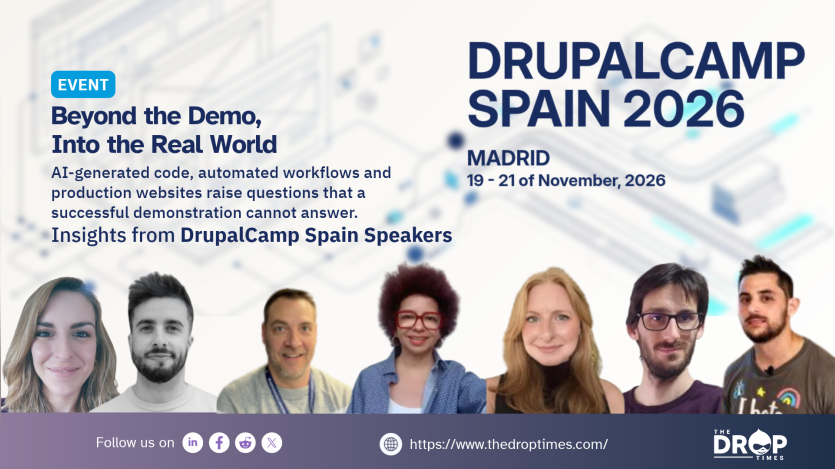
Speakers preparing for DrupalCamp Spain 2026 have shared their perspectives with The DropTimes on the growing use of artificial intelligence in Drupal development, content management and business operations. Their sessions examine how teams can verify AI-generated code, maintain control over automated workflows, manage production challenges and make informed decisions as AI tools become more capable. The responses draw on practical implementation experience, technical research and professional perspectives on accountability and collaboration.
For Drupal practitioners, these discussions raise questions about what AI systems can accomplish independently and where human oversight remains necessary. Automated audits can identify known problems, but they cannot establish whether an implementation meets every project requirement. Similarly, AI-generated pages and retrieval-based applications must operate within the architectural, editorial and access controls of the websites that use them.
Organised by the Asociación Española de Drupal, DrupalCamp Spain 2026 will take place from 19–21 November 2026 at Talent Garden in Madrid. The event opens with a Business Day on 19 November, followed by technical sessions, workshops and community activities on 20–21 November. The programme brings together developers, technical leaders and business professionals working across the Drupal ecosystem.
David Galeano on Building Auditable AI Workflows With FlowDrop
David Galeano, a Drupal developer at Factorial GmbH who is involved in the Drupal AI Initiative, will present "Harness Engineering con FlowDrop." The session explores how Drupal teams can create workflows in which AI models operate within defined processes rather than make decisions independently. David's focus is on making those processes visible, auditable and manageable.
In his written responses to The DropTimes, David explained that a language model should be treated as one component within a broader system, or harness, responsible for controlling execution. He advocates using deterministic operations wherever possible, introducing AI when needed and evaluating results before allowing consequential changes.
David Galeano
David Galeano
The model is only a piece inside a Harness
–David Galeano, Drupal developer, Factorial GmbH
The approach connects with the architecture of the FlowDrop contributed module, which provides visual workflow orchestration through connected processing nodes. Its documented capabilities include traceable executions, configurable workflow stages and human approval steps. The workflows can combine conventional Drupal operations with AI-powered tasks while keeping the sequence of actions available for inspection.
The significance lies in separating the model's ability to generate an output from the system's authority to act on it. A workflow can define which operations run automatically, where an AI response is needed and when a person must approve the next step. This gives developers a way to examine execution history and investigate failures without relying entirely on a model's explanation of its own behaviour.
The DropTimes previously explored the importance of visible orchestration in an interview with FlowDrop creator Shibin Das, who discussed execution ownership and boundaries between deterministic workflows and AI-driven operations. David's DrupalCamp session extends that discussion into practical harness engineering within Drupal. He is also looking forward to meeting the Spanish community and sharing developments from the Drupal AI Initiative.
Robert Menetray Caballero on Auditing AI-Generated Drupal Code
Robert told The DropTimes that AI tools can complete substantial portions of development tasks quickly, creating an impression that the resulting code is ready for use. He considers apparently correct output particularly concerning because developers may approve it without sufficient scrutiny. For Drupal projects, he also points to the possibility of models reproducing outdated development patterns learned from documentation and examples covering older Drupal versions.
His proposed approach uses the Drupal Site Audit contributed module to introduce deterministic quality checks into development workflows. The module includes checks covering project configuration, security-related conditions, caching, performance and custom code quality. Robert developed it from scripts used during his own project audits, with the aim of making those inspections repeatable.
One application involves inherited Drupal projects. Developers can run audits to establish the condition of a site before beginning new work, identifying configuration problems, maintenance requirements and areas needing further investigation. Another involves integrating audits with AI coding agents through Drush.
Robert described a workflow in which an agent runs automated checks after completing a task, reads the reported failures, makes corrections and repeats the checks before handing the result to a developer for review. The module's Drush commands support machine-readable output, allowing automated tools to interpret the results without depending on another AI model to judge the original code.
Robert Menetray Caballero
Robert Menetray Caballero
An agent passing every audit doesn’t mean the work is good, just that it doesn’t have the issues the module knows how to detect. The final call on the architecture is still mine.
–Robert Menetray Caballero, maintainer, Drupal Site Audit
That limitation is central to Robert's argument. Automated checks can identify conditions they are designed to detect, but they cannot independently establish whether an implementation meets every business requirement or represents an appropriate architectural decision. Tests generated by the same agent may also reproduce its misunderstanding of the original task.
Robert previously discussed the development of DruScan, his dashboard for monitoring Drupal project health, in an interview with The DropTimes. DruScan is also sponsoring this year's DrupalCamp Spain. Robert said he is particularly interested in comparing practical experiences with other developers as AI changes how Drupal teams write and review code.
Alexis Martínez Martínez on the Realities of Drupal Canvas AI in Production
The project involved a large Drupal installation undergoing a phased design migration. The existing theme had to remain operational while the team introduced a new theme and component system. The challenge was not simply generating landing pages, but ensuring that every new page followed the website's established design rules and could be used by the content team.
Alexis Martínez Martínez
Alexis Martínez Martínez
The first time I asked the AI for a landing page it was genuinely impressive. The second time, same prompt, it built a completely different page.
–Alexis Martínez Martínez, tech lead, Hiberus
Alexis identified several implementation problems behind that inconsistency. One involved Canvas's relationship with the active theme, which affected the components available through its library when the site was operating with two themes. Another concerned the placement of Single Directory Components (SDCs). Components stored in the new theme were not appearing where the team expected them, making component architecture a significant consideration during the migration.
His team eventually adopted a division of responsibilities in which developers controlled the landing-page structure and AI generated content within those boundaries. They also built a custom orchestrator that requested information before constructing a page instead of allowing the model to decide the structure independently.
The official session description also identifies maintenance problems arising from customising Canvas ahead of contributed-project changes. A relatively small behavioural modification required copying an entire controller, creating a separate implementation that could fall behind subsequent upstream improvements. Alexis intends to explain the resulting maintenance costs and the decisions involved in adopting experimental functionality.
These experiences have wider relevance following the release of Drupal CMS 2.0 on 28 January 2026, which introduced Canvas as the default visual editing experience and included optional AI-powered capabilities. For existing production websites, however, adopting Canvas involves questions about theme compatibility, reusable components and migration architecture that are not necessarily visible in a new-site demonstration.
Alexis said he is looking forward to comparing experiences with other teams already using Canvas in production, particularly those trying to benefit from AI without sacrificing control over their design systems.
Omar Lopesino on Building Reliable Applications With RAG
Omar told The DropTimes that a central challenge in building applications with generative AI is obtaining dependable responses. Language models may produce answers that are incomplete, inaccurate or disconnected from the latest information available within an organisation. His presentation will demonstrate how RAG techniques can help applications retrieve relevant information and supply it to a model when a user submits a request.
Retrieval-augmented generation combines information retrieval with text generation. Instead of depending entirely on knowledge represented in a model's parameters, the application retrieves material from an external information source and adds it to the context used to generate an answer. This can make an application better suited to tasks involving organisational documents, frequently updated information and domain-specific content.
Omar's session will include several application examples, including a Drupal implementation. He plans to explain the contributed modules, possible customisations and development stages involved in creating retrieval-based applications.
Beyond improving the reliability of AI-generated answers, Omar wants to demonstrate how RAG can support applications and features he believes would have been difficult to build with earlier technologies.
Omar Lopesino
Omar Lopesino
I would love to share how applications that are using RAGs are not only able to create AI robust applications, but to build features that I think it would not be possible to develop and provide with traditional technologies (previous to AI era).
–Omar Lopesino, senior Drupal developer, Metadrop
The Drupal ecosystem already provides relevant building blocks through projects such as AI Search. That module integrates semantic search with Drupal's Search API, supports vector database providers and provides retrieval functionality for AI agents and chatbots. Its documentation also describes content chunking, relevance filtering and post-query entity access checks.
Those capabilities illustrate why RAG applications require attention beyond the language model itself. Teams must decide which content to index, how to retrieve useful passages, how to respect Drupal's access permissions and how to evaluate the answers produced from retrieved material. Retrieval can improve the information available to a model, but it does not by itself guarantee that the final response will be accurate.
Omar is particularly interested in showing how RAG can support application features that he believes would have been difficult to deliver using earlier approaches. His presentation will connect those possibilities with the practical work of building and maintaining the systems behind them.
Samuel Solís Fuentes on Understanding How Language Models Work
Samuel Solís Fuentes will take a different approach to AI adoption in "Inteligencia artificial sin artificios." His session moves away from specific Drupal modules to examine the mechanisms behind language models and the behaviour developers encounter when using AI tools.
Samuel begins with a basic question: how does a language model select its next token? His presentation will explain token prediction and the roles played by model parameters, context windows and temperature. The official session description also covers embeddings, model training, fine-tuning and retrieval-augmented generation.
Samuel Solís Fuentes
Samuel Solís Fuentes
To really master a tool, you need to understand how it works under the hood.
Understanding token prediction helps explain why language models generate plausible responses without independently verifying whether every statement is correct. Context windows determine how much information can be considered within a request, while sampling settings such as temperature influence how tokens are selected. These concepts also help developers understand why changing a prompt or its context can change the resulting output.
For Drupal developers increasingly using AI-assisted coding, content-generation tools and agents, that knowledge can support more informed decisions about where models are useful and where additional validation is necessary. It also provides technical context for the challenges raised by Robert, Alexis and Omar, whose sessions demonstrate how model behaviour affects production development.
Samuel said he is looking forward to spending time with the open-source community and discussing the generational changes AI is bringing to the technology industry.
Osmani Redondo on Critical Thinking and Responsibility in the Age of AI
The keynote examines the responsibilities that arise when AI systems move beyond generating suggestions and begin taking actions. Osmani told The DropTimes that agents capable of editing content, executing code and publishing information raise questions about who remains accountable for their decisions. Those questions are particularly relevant to Drupal installations serving public institutions, universities, media organisations and other environments where published information and system access require careful management.
Osmani Redondo
Osmani Redondo
AI has moved from assistants to agents that act on their own: they edit content, run code and publish.
Osmani's response identifies human oversight, least-privilege access, auditability and accountability as practical principles for governing AI agents. In Drupal, these concerns connect with existing mechanisms such as user permissions, content workflows and revisions. Such controls provide a foundation for limiting what automated tools can do and recording changes, although the effectiveness of any agent integration depends on how those controls are implemented.
The official keynote description introduces another important dimension: the evaluation of AI safety in Spanish. Osmani and Marisa will examine how systems trained and assessed predominantly in English may behave differently when used in Spanish-language contexts. Their presentation will consider scenarios involving algorithmic systems, professional responsibility, regulation and copyright.
Through iaS, Osmani works on making AI safety knowledge available in Spanish, supporting professional training and encouraging evaluation that accounts for Spanish-language users. The organisation's stated mission is to make reviewed information about advanced AI risks accessible to people who teach, communicate and make decisions across the Spanish-speaking world.
Osmani also plans to discuss the difficulty of independently assessing increasingly capable systems, including concerns about models responding differently under evaluation. The presentation places critical thinking alongside technical safeguards, asking professionals to question AI-generated results rather than treating them as authoritative.
Beyond the keynote, Osmani hopes to build connections between iaS and a Drupal community with a longstanding commitment to open collaboration and accountable technology development.
Megan Pratt on Human Agency and Business Collaboration
Megan Pratt, a Business Humanizer at Innate Motion, brings a business and organisational perspective to DrupalCamp Spain. In a session she described to The DropTimes as "Fueling Business Growth Through Human Agency and Collaboration," she will join her colleague Gilda Zárate Chabluk to examine how strategy, culture and brand influence business growth.
Their session centres on human agency, understood as the ability of people to make choices and act on them individually and collectively. Megan argues that technical expertise alone is insufficient for business growth. Organisations also need clarity about where to focus their efforts, how teams work together and what makes their services valuable to clients.
Megan Pratt
Megan Pratt
Technical expertise is essential, but growing a business also requires clear choices about where to focus, how people work together and why clients should choose you.
–Megan Pratt, Business Humanizer, Innate Motion
Megan and Gilda work with leadership teams to connect business strategy, organisational culture and brand positioning. At DrupalCamp Spain, they intend to combine practical discussion with opportunities for participants to examine their own businesses and identify potential collaborators.
The planned takeaways include recognising where an organisation needs attention across strategy, culture and brand, understanding how those areas reinforce one another and identifying a concrete next step. Participants will also have opportunities to connect with others whose skills or experience complement their own.
For Drupal agencies and service providers, the discussion addresses business decisions that remain important regardless of changes in development technology. Faster tools and new technical capabilities do not independently establish which markets to serve, how to differentiate an offering or which partnerships are worth pursuing.
Megan is returning to DrupalCamp Spain for a third year and said she is looking forward to reconnecting with the community. She is particularly interested in hearing how Drupal businesses are evolving and exploring what can happen when organisations make their expertise more visible to one another.
Marisa Martín Serrano on Curiosity and Understanding AI Beyond Everyday Prompts
Marisa Martín Serrano, an engineering manager and solutions architect at EcoVadis, will join Osmani Redondo for the keynote on critical thinking and responsibility in the age of AI. Marisa has approximately 20 years of international experience across technical and management roles. Her professional background includes software architecture, platform engineering and mentoring through Step4ward and Tech SHEssions.
Marisa approaches the keynote from the perspective of curiosity and informed engagement with technology. In her written response to The DropTimes, she encouraged attendees to look beyond the prompts they use in everyday AI tools and explore how the underlying systems work. Her emphasis is on understanding both the possibilities of AI and the limitations that users need to recognise when relying on its outputs.
Marisa Martín Serrano
Marisa Martín Serrano
Be curious, be critical, be informed about how AI works, about its limits and its possibilities
–Marisa Martín Serrano, engineering manager and solutions architect, EcoVadis
The joint keynote provides a specific setting for that approach. According to the official session description, many AI systems are trained and evaluated primarily in English, leaving questions about whether their assessed safety extends to Spanish-language use. The presenters will examine five scenarios involving algorithmic training, evaluation, professional responsibility, legal frameworks and copyright.
These questions matter when organisations deploy AI applications for people communicating in different languages. A model's performance in one language does not necessarily establish how well it will respond in another. Evaluating AI therefore requires attention to the contexts in which systems will operate, rather than relying only on general claims about their capabilities or safety.
Marisa's wider professional experience also connects with the keynote's emphasis on critical thinking and adaptability. Her background in engineering leadership and mentoring involves helping people navigate technical decisions and changes in the technology industry. For attendees, her contribution offers an opportunity to examine AI from a broader perspective than immediate productivity gains or the convenience of individual tools.
Marisa said she is particularly excited about becoming part of the Spanish Drupal community and delivering the keynote alongside Osmani. She also described preparing the session as an opportunity for exploration and learning, an experience consistent with the curiosity she hopes attendees will bring to the discussion.
Practical Questions Across the DrupalCamp Spain Programme
Although the eight respondents approach different subjects, their accounts identify several practical decisions facing Drupal developers, site builders and business leaders. Workflow orchestration determines which actions an AI system can perform; automated audits examine known technical conditions; component architecture limits how generated pages can be assembled; and retrieval systems determine what information an AI application can use.
The speakers also recognise limits to these mechanisms. Passing automated checks does not establish that an architectural decision is appropriate, supplying relevant documents does not guarantee a correct answer, and generating a landing page does not ensure that it meets an organisation's design requirements. Model literacy, professional judgment and organisational accountability remain necessary parts of the process.
DrupalCamp Spain 2026 will give participants an opportunity to compare these approaches with their own project experiences. The technical and business sessions will also examine how Drupal professionals can apply their expertise and collaborate as development practices continue to change.
Image Attribution Disclaimer: At The Drop Times (TDT), we are committed to properly crediting photographers whose images appear in our content. Many of the images we use come from event organizers, interviewees, or publicly shared galleries under CC BY-SA licenses. However, some images may come from personal collections where metadata is lost, making proper attribution challenging.
Our purpose in using these images is to highlight Drupal, its events, and its contributors—not for commercial gain. If you recognize an image on our platform that is uncredited or incorrectly attributed, we encourage you to reach out to us at #thedroptimes channel on Drupal Slack.
We value the work of visual storytellers and appreciate your help in ensuring fair attribution. Thank you for supporting open-source collaboration!
Disclosure: This content is produced with the assistance of AI.
Note: The vision of this web portal is to help promote news and stories around the Drupal community and promote and celebrate the people and organizations in the community. We strive to create and distribute our content based on these content policy. If you see any omission/variation on this please reach out to us at #thedroptimes channel on Drupal Slack and we will try to address the issue as best we can.













 Allen JasonAllen without organs