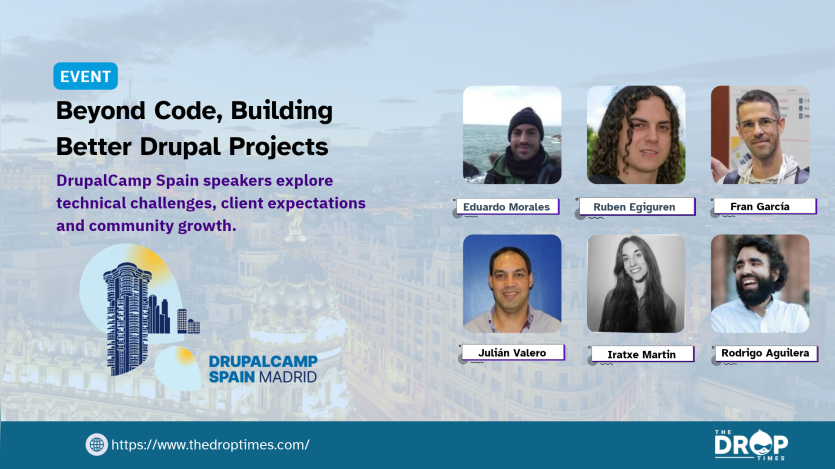
Speakers preparing for DrupalCamp Spain 2026 have told The DropTimes how they approach technical SEO, Drupal 11 development, changes to Drupal.org contribution workflows, client communication and local community organising. Their responses, collected ahead of the Madrid gathering, focus on problems they have encountered and lessons they intend to share. This is the first instalment of The DropTimes' speaker insights coverage of the event.
Scheduled for 19–21 November 2026 at Talent Garden in Madrid, DrupalCamp Spain 2026 is organised by the Asociación Española de Drupal (AED). The gathering aims to promote Drupal and connect experienced professionals with newcomers to the platform. Business Day takes place on 19 November, followed by technical presentations, hands-on workshops and networking activities on 20 and 21 November.
The speakers' responses go beyond their published session descriptions, drawing on experiences with production websites, Drupal development, infrastructure changes and project delivery. They offer practical perspectives on identifying the causes of technical problems, communicating Drupal's value to clients and building professional relationships through community participation.
Eduardo Morales Alberti Examines Technical SEO and Editorial Debt at Scale
Managing search engine optimisation across thousands of Drupal content items becomes increasingly difficult as defects accumulate across individual pages, translations, and shared templates. Eduardo Morales Alberti, senior Drupal developer and maker at Metadrop, will examine these challenges through his session, "SEO técnico y deuda editorial en Drupal a escala" (Technical SEO and Editorial Debt in Drupal at Scale), on 20 November at 12:00 CET.
Eduardo told The DropTimes that manually examining every page on a website containing more than 5,000 pieces of content is extremely difficult. His presentation draws on real-world websites to demonstrate where technical and editorial problems originate, how they can be measured and which Drupal tools can expose them. On one website he analysed, more than 99% of translations had at least one issue, according to Eduardo. This illustrates how problems can accumulate across multilingual content without necessarily being apparent during routine editorial work.
External tools such as Google Search Console and SEO crawlers help identify problems through the pages delivered to visitors and search engines. Eduardo explained, however, that these tools have limitations when identifying the underlying cause. Drupal's internal information can help pinpoint the node, field or template responsible, giving development teams a more specific starting point for corrective action.
He considers the distinction between technical debt and editorial debt particularly important. A technical defect arising from a shared template or implementation can potentially be resolved once at its source, while editorial problems may require individual content updates. Identifying the category of each issue helps teams determine whether developers or content editors should address it and prevents resources from being spent on repeated corrections that leave the underlying problem unresolved.
Eduardo explained the purpose of that diagnostic approach:
Eduardo Morales Alberti
Eduardo Morales Alberti
"Understanding this information helps us to plan strategies and resolve problems using quantifiable data, rather than proceeding blindly."
– Eduardo Morales Alberti, senior Drupal developer and maker, Metadrop
The official session description expands on these methods by examining how Drupal's reporting capabilities could be applied to content quality. Eduardo points to Watchdog and Drupal's status report as examples of tools that already make infrastructure problems visible. His presentation will explore how similar visibility can be introduced for content issues, including errors related to rendering, headings, internal links and search optimisation.
Several contributed modules will form part of that discussion. Entity Mesh examines relationships between content entities and helps expose problems involving internal links, broken references and redirect chains. Content First presents content without layout distractions and provides ways to inspect its structure, including headings. Eduardo will also discuss Redirect Audit, which identifies redirect chains and loops, alongside Redirect and Metatag, which support URL management and metadata configuration.
Beyond his presentation, Eduardo is interested in seeing how other developers are adapting to changes in technology. He observed that many tools now being adopted in Drupal projects did not exist a year earlier. For him, DrupalCamp provides an opportunity to learn how these developments are being applied in production environments and to reconnect with the professionals using them.
Ruben Egiguren Brings a Decade of Workshop Experience to Drupal 11 Development
Learning Drupal through practical development remains the central idea behind Ruben Egiguren's workshop. The CTO and founder of ESAREA will lead "Introducción al desarrollo de módulos en Drupal 11" (Introduction to Module Development in Drupal 11), a two-hour workshop scheduled for 20 November at 15:00 CET.
Ruben first delivered a version of this workshop at DrupalCamp Spain in 2014, using Drupal 7. He subsequently updated it for Drupal 9 in 2022 and Drupal 10 in 2023, before preparing the 2026 edition around Drupal 11. Although the underlying architecture and development practices have changed considerably across those versions, he has retained the workshop's original principle of teaching development by building a working project.
Participants will create a custom Drupal 11 module step by step, beginning with a professional development environment using DDEV. Ruben plans to explain module structure before introducing routes, controllers and permissions. The workshop will then explore services, dependency injection, forms, plugins and hooks, providing a practical introduction to the mechanisms developers use to extend Drupal.
The session will also introduce tools that support day-to-day development. Drush will be covered as a command-line utility, Xdebug for troubleshooting PHP code, PHPCS for checking coding standards and PHPStan for static analysis. Ruben wants attendees to understand how these tools fit into a development workflow that prioritises maintainability and code quality.
He summarised the intended outcome:
Ruben Egiguren
Ruben Egiguren
"The aim is simple: by the end of the session, you'll not only understand how to develop a module in Drupal 11, but you'll also be able to create your own."
– Ruben Egiguren, CTO and founder, ESAREA
The official workshop page identifies Drupal 11, a working local development environment and an integrated development environment as useful prerequisites. It also recommends contributed modules such as Devel, Coder and Examples and provides prepared development-environment options to help attendees follow the exercises. The workshop is classified as beginner-level, although Ruben believes experienced developers seeking a better understanding of Drupal's modern architecture can also benefit.
His involvement with DrupalCamp Spain extends beyond teaching. Ruben recalled participating in the organisation of community gatherings since 2010 and said the event's sessions have evolved over the years. He values the relaxed atmosphere as an opportunity to exchange knowledge and reconnect with former colleagues, friends and business partners.
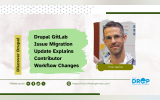
Fran García-Linares Explains the Migration from Drupal.org Issues to GitLab
Drupal.org's issue queues have supported bug reports, feature requests, patches and community collaboration for nearly two decades. Moving these workflows to GitLab involves migrating extensive development records while preserving the references and contribution practices on which maintainers depend. Fran's presentation will examine both the technical implementation and the adjustments required of people using the system.
Fran told The DropTimes that his session will explain why the migration was undertaken, how the new workflow operates and what difficulties remain. He also plans to share figures illustrating the scale of the transition and introduce the custom tools developed to support integration between Drupal.org and GitLab. His aim is to help contributors understand the reasoning behind the change rather than simply learning how to navigate a different interface.
The official session description identifies several technical challenges, including working with GitLab APIs, preserving existing issue identifiers and implementing redirects so historical links continue to function. The migration also requires Drupal.org concepts such as issue states, priorities, shared forks and contribution credits to be represented in the new system. According to the presentation outline, the transition concerns hundreds of thousands of issues and comments associated with thousands of projects.
Fran described what he wants attendees to understand:
Fran García-Linares
Fran García-Linares
"They'll have a better understanding about why this change was made and how it serves the community."
– Fran García-Linares, senior Drupal developer, Drupal Association
The presentation will not be limited to technical implementation. Fran plans to examine improvements introduced through GitLab alongside capabilities and working practices that have become more difficult to reproduce. The published programme also identifies Drupal Canvas, Drupal AI and Drupal CMS as initiatives whose experiences with the new issue workflow will be discussed, including feedback from contributors who preferred aspects of the former Drupal.org system.
These questions have direct relevance for maintainers and developers who depend on the issue infrastructure to coordinate releases, review changes and record contributions. Fran is also looking forward to meeting members of the Spanish community and learning how different organisations are using Drupal, providing another opportunity to hear practical feedback about the evolving contribution environment.
Julián Valero Discusses Selling Drupal CMS Beyond Its Technical Architecture
Winning projects against software-as-a-service and no-code competitors requires Drupal agencies to rethink how they communicate the platform's benefits, according to Julián Valero, DXP Drupal Tech Lead at hiberus. His session, "Vender Drupal CMS en la era del No-Code" (Selling Drupal CMS in the No-Code Era), takes place on 20 November at 16:00 CET and focuses on commercial positioning rather than code.
Julián believes agencies have sometimes lost potential projects because they concentrated on Drupal's architecture while buyers were more concerned with launch schedules and the independence of their teams. He argues that Drupal CMS, Canvas and site templates provide an opportunity to present the platform differently, emphasising deployment speed, visual editing, ownership and scalability rather than only technical architecture.
He summarised the challenge in his response:
"For years, Drupal agencies have lost projects to SaaS and no-code platforms, not because of technology, but because of how we pitched it."
– Julián Valero, DXP Drupal Tech Lead, hiberus
His session will explore how agencies can turn technical strengths into commercial arguments based on speed, editorial autonomy and long-term control. The published session description refers to demonstrations involving Experience Builder and Recipes, while Julián's responses emphasise Canvas and site templates as part of the Drupal CMS proposition. He plans to explain how to prepare a demonstration using a prospective client's branding, ask the right questions during discovery and show how the client's team could manage the resulting website.
Responding to concerns about price, development time and usability will form another part of the presentation. Julián intends to discuss how agencies can structure proposals around phased delivery and pilot projects instead of presenting an extensive implementation as the only option. This includes explaining the boundaries of the proposed work and linking technical choices to outcomes the client can evaluate.
Artificial intelligence is also becoming part of these discussions. Julián believes Drupal's potential to offer control over data and models can provide a useful point of differentiation when clients evaluate AI capabilities. His session will consider how agencies can position AI credibly, align promises with realistic implementations and incorporate AI-related requirements into proposals and pricing without undervaluing development work.
The session represents a change in subject matter for Julián himself. He said it has been some time since his previous conference presentation and that this will be his first non-technical talk. Although he acknowledged feeling nervous about the outcome, the presentation addresses a commercial challenge familiar to agencies that must explain Drupal's value to decision-makers who may have little interest in its underlying architecture.
Iratxe Martin Examines Communication Failures Behind Project Problems
Misunderstandings between technical and business teams can undermine projects even when the underlying technology works as intended. Iratxe Martin, digital project manager at hiberus, will examine this problem through "¿Puedes hacer un cambio pequeñito?" (Can You Make a Small Change?), scheduled for 20 November at 17:00 CET.
Iratxe told The DropTimes that project problems often arise because different participants interpret the same request differently. A client, designer, developer and project manager may believe they have agreed on a requirement while holding conflicting expectations about its scope or delivery. Such misunderstandings can develop as requirements move through meetings, documents, estimates and technical decisions.
Her presentation will explain how technical teams can communicate more effectively with business stakeholders. Rather than describing implementation details alone, she recommends explaining what is happening, what it means for cost, time or risk, and which decision is needed. That approach helps stakeholders understand the consequences of a request without requiring them to interpret specialist technical language.
Iratxe also highlighted the importance of setting realistic expectations:
Iratxe Martin
Iratxe Martin
"A 'yes' you can't deliver is a 'no' with interest."
– Iratxe Martin, digital project manager, hiberus
To handle requests that cannot be delivered as proposed, she recommends a four-part approach: agree with the intended goal, explain why the suggested method is unsuitable, present available options and obtain a decision. The method allows teams to remain constructive without accepting commitments that could create delivery problems later.
Documenting assumptions, agreeing on communication protocols and managing crises are other subjects she intends to cover. The official session description follows the journey of a business requirement as it moves through different project roles, showing how its meaning can change before implementation begins. Expectations and trust are central to the discussion, including how difficult conversations can prevent smaller misunderstandings from becoming serious project problems.
Iratxe describes the presentation as a discussion about the human foundations of professional collaboration, particularly language. Her argument is that clearer communication and shared expectations can prevent many difficulties that might otherwise be mistaken for technical failures.
Rodrigo Aguilera Explores How Local Drupal Meetups Create Professional Opportunities
Rodrigo believes professional participation in technology should involve more than hardware, code and collaboration with immediate colleagues. Informal events allow people to share knowledge, compare different approaches to common problems and establish relationships that may not develop through routine project work. He also considers these connections valuable for professional growth, as relationships formed during community gatherings can lead to opportunities later in participants' careers.
His presentation will offer practical guidance for people who want to establish a local Drupal group or participate in an existing one. Rodrigo explained that prospective organisers can seek help from the Spanish Drupal association and, where appropriate, local authorities. The session will address the steps involved in finding like-minded participants and building an environment where people can meet regularly or occasionally.
Rodrigo described one of the intended outcomes:
"People can get info on how to start a regular meeting of like-minded drupalistas and get support from the Spanish Drupal association and even local authorities."
– Rodrigo Aguilera, DrupalCamp Spain 2026 speaker
The official programme describes local groups as small communities that may organise talks, workshops, contribution sprints, translation activities or informal conversations. Regular meetings are not a requirement. International events such as Global Sprint Weekends can also provide opportunities for local Drupal users to meet, collaborate and contribute without establishing a permanent programme of activities.
Remote working adds another reason to encourage these gatherings. The session description notes that working away from shared offices can make it harder to exchange concerns, build professional relationships or spend time with people who have similar interests. Rodrigo will discuss how existing communities operate, how organisers can identify meeting spaces, promote activities and seek support from AED.
The session also has a practical follow-up objective. According to the published programme, organisers intend to collect contact information from attendees interested in establishing local groups so they can be connected with AED for further assistance. This could help turn the discussion into new community activities in different cities or regions.
Rodrigo considers DrupalCamp Spain one of the year's important opportunities for these exchanges. He looks forward to hearing how fellow community members have experienced developments over the past year and comparing those firsthand perspectives with the more pessimistic discussions that sometimes circulate on social networks.
Practical Lessons Ahead of DrupalCamp Spain 2026
The speakers featured in this first instalment address different subjects, but their sessions share an emphasis on practical experience. Eduardo approaches site quality through measurable problems and Drupal diagnostics, Ruben uses hands-on development to teach current practices, and Fran examines the decisions and compromises behind infrastructure changes. Julián, Iratxe and Rodrigo extend the discussion to business relationships, project delivery and the professional communities that support Drupal's development.
DrupalCamp Spain 2026 will take place at Talent Garden in Madrid from 19 to 21 November 2026. The programme includes Business Day on 19 November, followed by technical talks, workshops and networking opportunities on 20 and 21 November. Regular admission is listed at €100, while Business Day admission is €65, according to the event website.
Further details about the programme, individual session descriptions, registration and participation are available on the official DrupalCamp Spain 2026 website.
Image Attribution Disclaimer: At The Drop Times (TDT), we are committed to properly crediting photographers whose images appear in our content. Many of the images we use come from event organizers, interviewees, or publicly shared galleries under CC BY-SA licenses. However, some images may come from personal collections where metadata is lost, making proper attribution challenging.
Our purpose in using these images is to highlight Drupal, its events, and its contributors—not for commercial gain. If you recognize an image on our platform that is uncredited or incorrectly attributed, we encourage you to reach out to us at #thedroptimes channel on Drupal Slack.
We value the work of visual storytellers and appreciate your help in ensuring fair attribution. Thank you for supporting open-source collaboration!
Disclosure: This content is produced with the assistance of AI.
Note: The vision of this web portal is to help promote news and stories around the Drupal community and promote and celebrate the people and organizations in the community. We strive to create and distribute our content based on these content policy. If you see any omission/variation on this please reach out to us at #thedroptimes channel on Drupal Slack and we will try to address the issue as best we can.












 Kazima AbbasKazima Abbas is a sub-editor at The Drop Times