



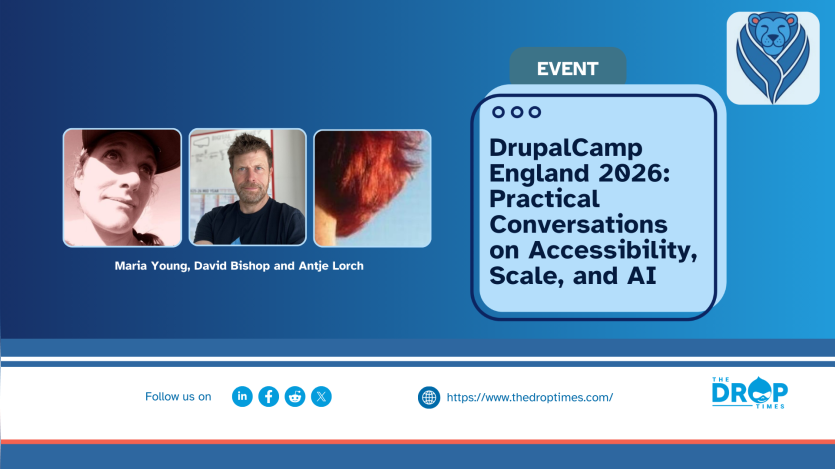
DrupalCamp England 2026: Practical Conversations on Accessibility, Scale, and AI

In our previous article, we shared insights from speakers driving AI innovation, architectural evolution, and performance improvements at DrupalCamp England 2026. That conversation focused on progress and possibility.
This time, the lens is different.
Alongside technical acceleration, this year’s programme also creates space for harder conversations. Not about what Drupal can do next, but about what happens when our work meets reality. When accessibility assumptions fail. When AI systems hit scale. When innovation carries consequences we did not factor in.
These sessions are less about showcasing capability and more about examining impact.
Tab Traps, Focus Fails, and ARIA Fixes: Real Drupal Accessibility Challenges
Maria Young’s session tackles a familiar blind spot. Most Drupal developers understand accessibility fundamentals. Semantic markup. Alt text. Logical headings. The problems begin when interaction becomes complex.
Accordions, disclosure widgets, and custom navigation patterns often pass visual inspection but break under assistive technology. Keyboard users can become trapped in loops. Screen reader users can lose context entirely. These are not edge cases. They are patterns that appear regularly in production builds.
“I spend a lot of time thinking about how people actually experience the interactive elements we build.”
That mindset frames the session. It is not about compliance checklists. It is about lived experience.
Maria will walk through real examples, explain what is going wrong and why, and clarify when ARIA supports usability and when it makes things worse. The takeaway is practical. Developers leave with clearer testing approaches and concrete coding patterns they can apply immediately.
Accessibility here is not theoretical. It is hands-on and specific to the kinds of components Drupal teams build every day.
Drupal Websites That Dream of Content Improvement
David Bishop’s session explores what happens when AI ambitions meet infrastructure constraints.
His case study asks a bold question. What would it take for a website to analyse thousands of editorial pages overnight and prepare improvements for human review by morning?
“My ultimate goal was to review 4,000 editorial pages, running 40,000 AI chats, in less than one sleep (8 hours).”
Reaching that target required multiple architectural re-factorings. Bottlenecks emerged around API throughput, orchestration, and fault tolerance. Each iteration added resilience and scalability.
This session is grounded in what breaks under load. It looks at automation frameworks, infrastructure design, and the practical realities of running AI across large editorial estates. It also examines the trade-offs between cloud services and local AI deployments.
At one stage, the project left the cloud entirely.
“I’ll also be sharing why my project dropped out of the clouds into my cool dark cellar, the ideal breeding ground for a low-cost, low-energy, micro AI server farm.”
It is a vivid reminder that AI is not just about prompts and interfaces. It is about servers, energy use, cost, and long-term sustainability.
We Need to Talk About AI
If many sessions explore how to build with AI, Antje Lorch’s session steps back and asks whether we have fully considered what that building entails.
“We have a lot of sessions about what or how developers could build something with AI, but it's also our responsibility to look at the bigger picture.”
That bigger picture includes environmental impact, energy consumption, supply chains, and the effects AI tools may have on vulnerable communities. It also includes internal consequences for open-source collaboration, review processes, and contributor wellbeing.
“We can't just pretend that our work exists in a vacuum.”
This is not a technical deep dive. It is an invitation to widen perspective. AI adoption should not be automatic simply because it is possible. It should be informed, deliberate, and aware of trade-offs.
Across 28th February and 1st March at the University of Salford, DrupalCamp England 2026 will showcase innovation. But it will also create space for reflection.
Accessibility that holds up under real use. AI that survives contact with scale. Technology choices that acknowledge environmental and community impact. Find more details about the event here.
ASK: Drupal Community Needs Your Support
View all →
Note: The vision of this web portal is to help promote news and stories around the Drupal community and promote and celebrate the people and organizations in the community. We strive to create and distribute our content based on these content policy. If you see any omission/variation on this please reach out to us at #thedroptimes channel on Drupal Slack and we will try to address the issue as best we can.

Related Event Sessions


Related Events


Related People


You may also like