



GovCMS Moves From Drupal 9 Prototype Testing to Drupal 11 Completion

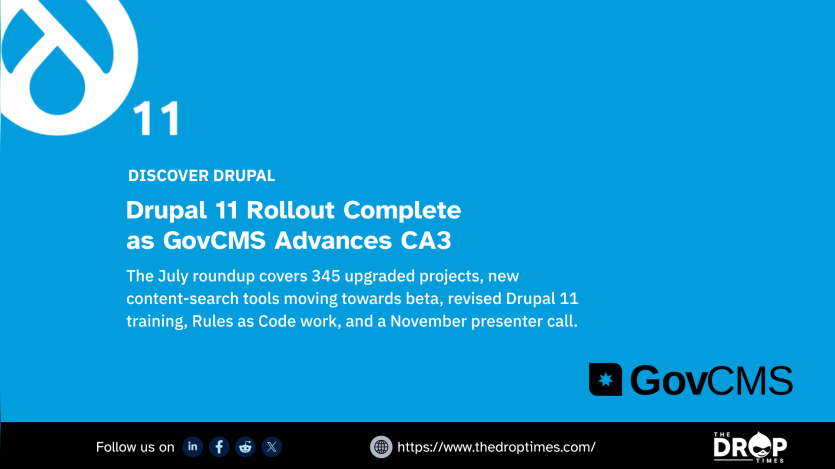
Government agencies using GovCMS have moved from testing an early Drupal 9 distribution in 2020 to completing a platform-wide Drupal 11 rollout in 2026. A GovCMS update published on 8 September 2020 described the Drupal 9 release as an early prototype and asked community members to test it in local environments. Six years later, GovCMS reported that 345 projects had been upgraded to Drupal 11 across almost 200 business areas and more than 120 agencies.
The two points in the platform's history show a change in the scale of GovCMS version-transition work. The 2020 Drupal 9 distribution was not production-ready and was described as a bare-bones proof of concept intended to expose problems and gather feedback for later releases. By 2026, GovCMS was documenting the completion of a Drupal 10-to-11 transition that had taken almost two years and involved agencies, delivery teams, and the wider GovCMS community.
The early Drupal 9 work placed community testing directly in the development process. GovCMS asked developers to submit issues and pull requests through GitHub, while general feedback, bugs, improvements, and site functionality were to help inform the release backlog. At that stage, its immediate priority was making the Drupal 8 distribution compatible with Drupal 9 ahead of Drupal 8's end of life in November 2021.
Community participation also appears in GovCMS's account of the later Drupal 11 transition. The agency says participating organisations prepared sites, took part in testing, worked through changes, and managed migration timelines during the rollout. The final three and a half months were particularly intensive as the programme worked towards the Drupal security deadline.
The completed migration has also moved supporting GovCMS material onto the current Drupal version. GovCMS released a rewritten Introduction to Content Management training manual with its structure and content updated for Drupal 11 and the current platform. New videos are still being produced, while the Advanced Content Management manual is also being revised.
GovCMS is now directing part of its community testing towards Content as an API, or CA3, as the programme moves from alpha towards beta. Five connected capabilities are being developed for semantic search, verification of artificial intelligence responses, detection of overlapping or conflicting information, website and document migration, and aggregated search and site analytics. GovCMS plans to give agencies early access to the tools for experimentation, testing, and feedback, continuing a documented pattern of involving users in platform development without establishing a direct causal link between the testing programmes of 2020 and 2026.
References


ASK: Drupal Community Needs Your Support
View all →
Note: The vision of this web portal is to help promote news and stories around the Drupal community and promote and celebrate the people and organizations in the community. We strive to create and distribute our content based on these content policy. If you see any omission/variation on this please reach out to us at #thedroptimes channel on Drupal Slack and we will try to address the issue as best we can.

Related Organizations

You may also like