



Gábor Hojtsy Introduces Two Drupal Modules for Configuration Language Drift

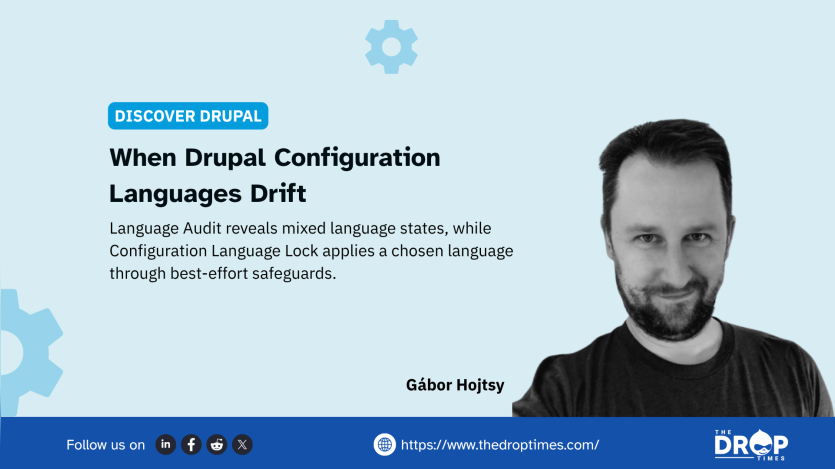
New contributed modules from Drupal core initiative coordinator Gábor Hojtsy help multilingual Drupal sites diagnose and control inconsistent configuration-language states. In a blog post published on 7 August 2026, Gábor introduced Language Audit, which provides diagnostic information about configuration and content languages, and Configuration Language Lock, which provides best-effort enforcement of a selected configuration language. He developed the projects after investigating problems involving recipes on non-English Drupal CMS sites and Drupal Canvas and is also seeking feedback on a related Drupal core proposal.
Drupal configuration can acquire language information through several paths, which can leave the same site with configuration objects carrying different langcode values. The related core issue documents influences including the current request language, explicit language selectors on some configuration entities, language codes shipped in YAML files, recipes, and the site default language during certain extension installations. Changing the site default language does not consistently realign existing configuration, and recipe-provided configuration can retain a language regardless of whether that language is configured on the site. Gábor's investigation grew from testing how these behaviours affect Drupal CMS recipes and Canvas on multilingual installations.
Language Audit is intended to expose those states without changing site data. It provides language-distribution summaries, detail views, translatable-value inspection, source detection, and snapshots that can be compared after activities such as recipe runs, updates, or manual changes. The project treats the site default language as its expected baseline and flags deviations as potential problems for administrators to investigate rather than declaring every difference an error. Drupal.org currently lists only a development release for Language Audit, with no supported stable version.
Configuration Language Lock takes the enforcement side of the problem. After an administrator selects a lock language, the module can normalise configuration entity language on save, limit language selectors on relevant forms, protect the selected language from deletion, rewrite configuration after module or theme installations, normalise recipe-imported configuration, and optionally follow changes to the site default language. The project describes these protections as best effort and intentionally does not enforce the lock during configuration synchronisation. Since Gábor's original announcement, version 1.0.0 was released on 18 August 2026 for Drupal 11.2 and later Drupal 11 releases as well as Drupal 12, with the stable release covered by Drupal's security advisory policy. Drupal.org lists Acquia as a supporting organisation for both modules. Gábor cautioned when announcing the projects that both were fresh and not yet widely proven.
Gábor is also seeking contributor feedback on a Drupal core proposal to introduce a dedicated configuration default language separate from the site default language. The proposal has not landed in core and the issue is currently marked Needs work; a 13 August review identified a blocking dependency around reliably determining whether configuration contains translatable values, together with additional testing and scope questions. Drupal's release schedule requires Drupal 12 beta requirements to be completed by 11 September 2026. Gábor is asking multilingual site maintainers to test the contributed tools and comment on whether the proposed core approach addresses their use cases.

ASK: Drupal Community Needs Your Support
View all →
Disclosure: This content is produced with the assistance of AI.
Note: The vision of this web portal is to help promote news and stories around the Drupal community and promote and celebrate the people and organizations in the community. We strive to create and distribute our content based on these content policy. If you see any omission/variation on this please reach out to us at #thedroptimes channel on Drupal Slack and we will try to address the issue as best we can.

Related People


You may also like