


Public-Sector Drupal Scale Puts Upstream Funding in Focus

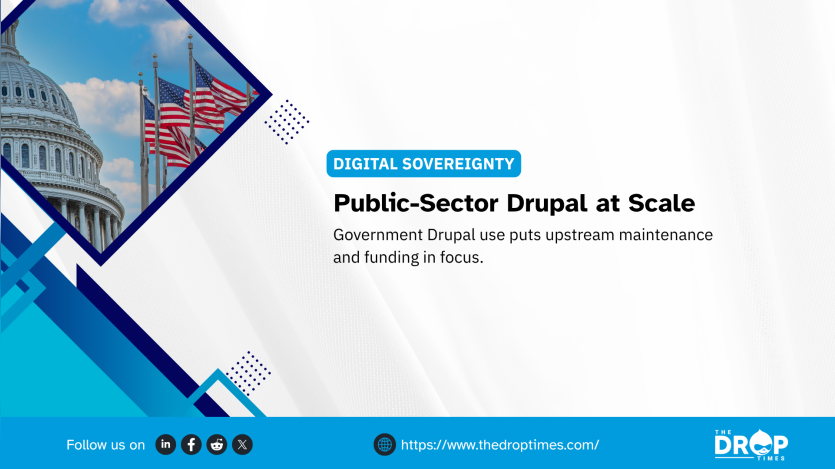
Public-sector Drupal deployments now operate at substantial scale across European and Australian government services. The European Commission's 2026 Open Source Strategy explicitly ties technological sovereignty to the long-term maintenance, security and sustainability of open-source technologies. Germany's Sovereign Tech Agency has separately funded upstream work in Drupal and PHP, showing one mechanism for directing public money into shared software infrastructure.
The issue is gaining additional visibility this month. DrupalCon Rotterdam's Government Summit will bring public-sector organisations together on 28 September 2026, while the conference's Digital Sovereignty & Open Web track includes sessions on government control of digital infrastructure and open technologies. Together, the programme places deployment, policy and long-term software stewardship in the same Drupal-specific discussion.
Drupal already operates at significant scale inside that public-sector environment. Drunomics' coverage of Drupal4Gov EU 2026 reported that European Commission presenters described the Europa Web Publishing Platform as supporting 770 live sites across 44 services, with about 700 million visits and 2.2 billion page views annually. The DropTimes previously covered the same Drupal4Gov EU deployments in the context of European digital sovereignty and public-sector reuse. Australia's GovCMS provides another large-scale example: the government service says its Drupal-based platform hosts more than 370 websites for more than 115 agencies and can process information classified up to OFFICIAL:Sensitive.
Other Drupal programmes demonstrate a different form of public-sector reuse. In the Netherlands, DICTU supports the GovNL CMS Project as a Drupal starting point for government websites, combining recommended modules, security settings and development tooling. LocalGov Drupal applies a collaborative model to local government, where councils and suppliers share code instead of repeatedly commissioning similar functionality in isolation. Its 18 August 2026 discussion of code sharing argues that publicly funded improvements can create value beyond an individual council or contract.
European institutions have also developed mechanisms intended to support the software beneath public digital services. The Commission's 2026 Open Source Strategy calls for an Open Source Maintenance Instrument to provide sustained financial support for the maintenance and security of essential components, while earlier public-sector guidance identified software maintenance and community sustainability as long-term concerns. Earlier analysis by The DropTimes examined the strategy's procurement, stewardship and proposed maintenance measures in greater detail. EU-FOSSA 2 provides an earlier security-focused example: 15 bug-bounty programmes resulted in 200 accepted vulnerabilities and more than €200,000 in rewards to ethical hackers, with Drupal and PHP Symfony among the selected projects.
Germany's Sovereign Tech Agency provides a more sustained example. It records €278,700 invested in Drupal across 2023–2024 for work including software supply-chain security, package signing, security audits and developer infrastructure, followed by another €201,000 across 2025–2026. The DropTimes reported the €201,000 investment in October 2025, when the funding was directed toward GitLab infrastructure, security workflows, continuous integration and contributor tooling. PHP received €205,000 across 2023–2024 for ecosystem infrastructure, security, documentation and testing work, followed by another €223,680 across 2025–2026. These programmes direct public funding toward infrastructure and maintenance intended to benefit users beyond a single government implementation.
The scale of PHP's broader maintenance operation provides another part of the picture. The PHP Foundation's 2025 transparency report records $730,534 in contributions from 536 organisations and individuals, with $645,191 received after fees and $784,376 in expenses. Foundation-funded developers authored roughly 42% of PHP core commits during the year, alongside work on security, runtime development, infrastructure, documentation and ecosystem tooling. The Foundation said expenses exceeded received contributions by about $139,000 as a deliberate decision to maintain technical headcount while strengthening fundraising. The DropTimes previously covered Sovereign Tech Agency-backed work on PHP's streams subsystem, another example of public funding reaching upstream language infrastructure.
Those figures cannot be directly compared with government website or migration budgets. Procurement, hosting, integration, content migration, application maintenance, Drupal infrastructure and development of the PHP language all pay for different work. PHP Foundation board member Sebastian Bergmann nevertheless argued in a 2 September 2026 essay that public institutions' dependence on PHP has developed without an established mechanism that routinely converts that dependence into maintenance funding. He described the result as a structural gap while pointing to Sovereign Tech Agency investment as evidence that mechanisms for direct upstream funding already exist.
The independently documented evidence supports a narrower conclusion. Governments are increasingly treating open source as part of digital sovereignty, European policy now recognises long-term maintenance and sustainability as part of that strategy, and public bodies have demonstrated several ways to finance upstream work directly. The DropTimes has previously examined proposals to make upstream maintenance an explicit part of public-sector procurement, including recommendations discussed by Tiffany Farriss at Drupal4Gov EU 2026. Whether those mechanisms become routine parts of public-sector procurement and platform stewardship remains an open question. DrupalCon Rotterdam brings that question into a Drupal-specific setting as government deployments, policy and upstream investment increasingly appear on the same agenda.
References
-
Digital Sovereignty Is Written in PHP (2 September 2026)
-
EU-FOSSA 2 - the EU’s open source cybersecurity project ends (14 July 2026)
 Kazima AbbasKazima Abbas is a sub-editor at The Drop Times
ASK: Drupal Community Needs Your Support
View all →
Disclosure: This content is produced with the assistance of AI.
Note: The vision of this web portal is to help promote news and stories around the Drupal community and promote and celebrate the people and organizations in the community. We strive to create and distribute our content based on these content policy. If you see any omission/variation on this please reach out to us at #thedroptimes channel on Drupal Slack and we will try to address the issue as best we can.

You may also like