



Why Drupal AI Built a Full-Site Demo for Rotterdam

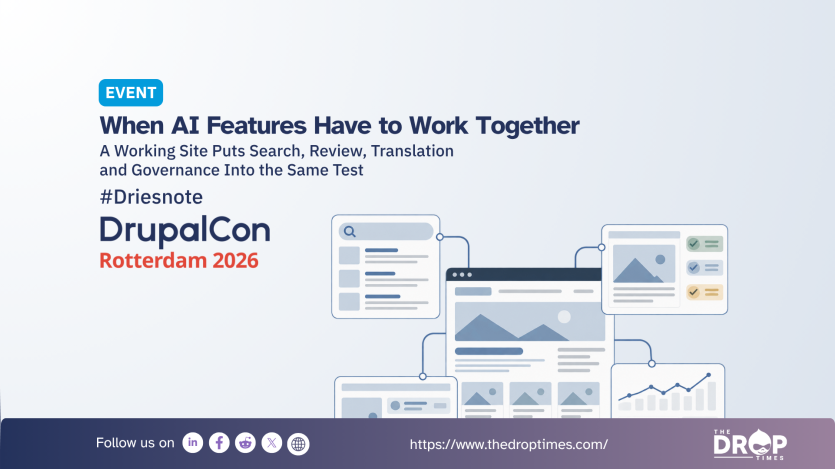
Prospective users can explore Drupal AI through a prepared site designed to show several AI capabilities working in the same environment. The Drupal AI Initiative built the demonstration with Drupal Forge for Dries Buytaert’s 29 September 2026 Driesnote at DrupalCon Rotterdam. Rather than presenting AI tools as separate demonstrations, the team wanted people to experience them against the same body of realistic content.
That distinction shaped the project. A 23 July account by Christoph Breidert, product lead for Inside AI, said most of the planned capabilities already worked individually. The goal for Rotterdam was to “let people see them working together on one site.” Reaching that point required more than putting functioning modules beside one another: recipes, configuration, prompts and realistic content had to produce results the team could demonstrate consistently.
The need for realistic content is central to that test. Search needs enough material to retrieve useful answers, review needs content with meaningful differences to inspect, and translation needs material that can reveal whether context survives across languages. Breidert wrote that the team deliberately wanted a site with enough depth for those capabilities to do something meaningful rather than simply confirm that each feature could run.
Aidan Foster, whom the initiative identified as the demo lead, gave The DropTimes a content-review example aimed at a sceptical marketer. He said he would start with older pages, where outdated facts, changes in organisational voice and other small inconsistencies can accumulate over time. “Content at scale is hard. Small inconsistencies multiply, and generic checkers only know generic rules,” he wrote in response to a contributor questionnaire.
Foster’s example asks the system to evaluate content against the organisation’s own tone, facts and rules rather than only applying generic writing checks. Suggested corrections then remain subject to review instead of becoming automatic changes. That gives the demonstration a practical question to answer: whether AI can identify problems across existing content while leaving the final editorial decision with a person.
The example also explains why a full site matters. One carefully prepared page can demonstrate that a content-review feature runs, but it says much less about whether the same system can detect inconsistencies distributed across older material. A deeper site gives evaluators something closer to the conditions under which search, review and other AI-assisted workflows would actually be used.
Breidert’s July account described AI Search, an AI chatbot, content review and translation operating over the same content, with observability and security underneath. Search was the most requested capability among Drupal AI partners, while content review and translation formed part of a broader group of priorities. The project treated the demo and the underlying feature work as connected because the recipes and configurations needed to make a capability work reliably in the demonstration are also relevant to making it usable on a Drupal project.
The official Drupal AI demo page now presents a ready-to-use hosted environment with example workflows rather than requiring visitors to assemble Drupal AI themselves. Its current examples include AI Search, content categorisation, editorial assistance in CKEditor, simplified text and compliance-oriented content checks, alongside an area for more advanced experimentation. The page identifies amazee.ai as the hosting environment for the demonstration.
That makes the Rotterdam demo less a catalogue of AI features than a test of how they behave once they share a site, its content and its rules. Visitors can use the prepared environment to examine the workflows directly and decide which approaches merit closer investigation for their own Drupal projects.

ASK: Drupal Community Needs Your Support
View all →
Disclosure: This content is produced with the assistance of AI.
Note: The vision of this web portal is to help promote news and stories around the Drupal community and promote and celebrate the people and organizations in the community. We strive to create and distribute our content based on these content policy. If you see any omission/variation on this please reach out to us at #thedroptimes channel on Drupal Slack and we will try to address the issue as best we can.

Related Drupal Initiatives

Related Organizations


Related People


You may also like