



Drupal Developer Explains DevDeck's Design as Windows Beta Arrives

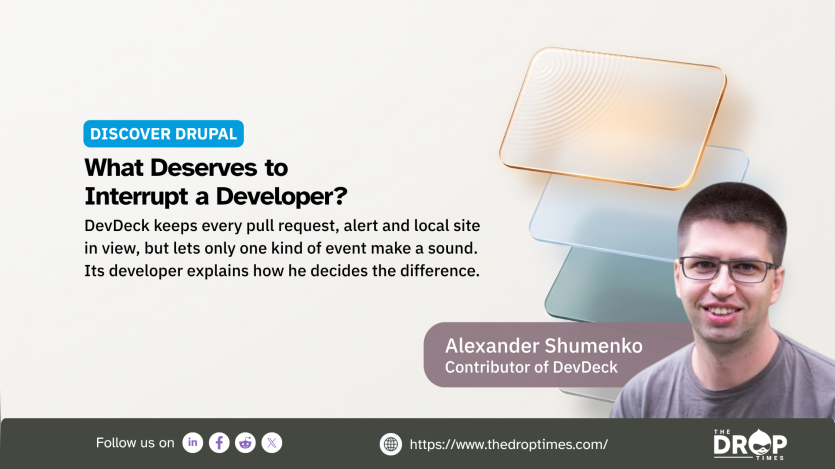
After bringing DevDeck to Windows 11 as a beta on 11 October 2026, Drupal contributor Alexander Shumenko released a further update the following day. Version 0.21 adds Azure DevOps pull-request tracking and lets the desktop development tool register itself with the Claude Code and Codex coding agents. Both releases arrive alongside a licence that makes DevDeck's source public without making it open source.
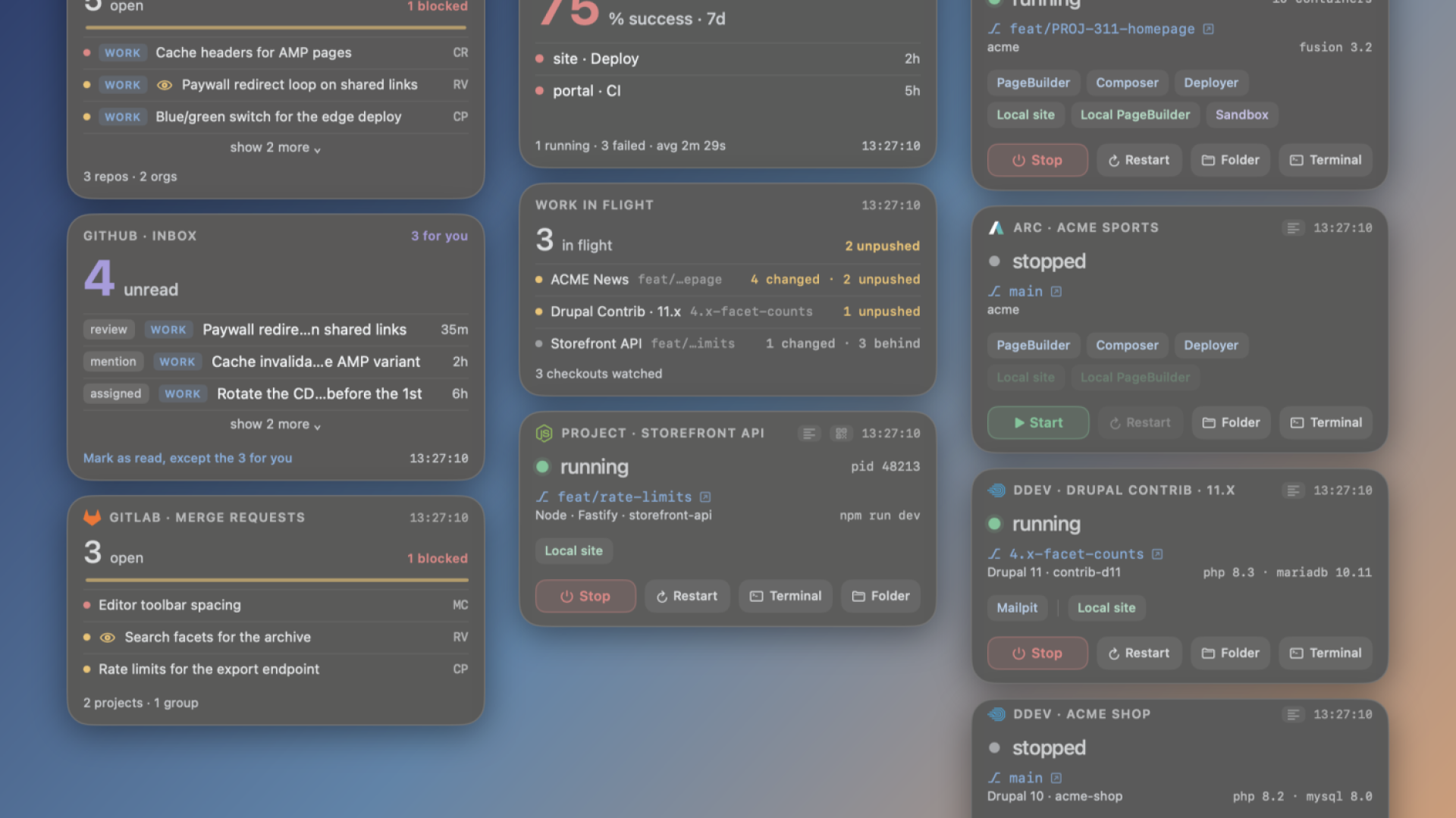
DevDeck gathers information that developers otherwise check across several services into desktop panels: pull requests, review requests, notifications, continuous integration (CI) results and the state of local projects. It supports GitHub, GitLab and Azure DevOps, with dedicated project cards for Arc XP and DDEV and a generic card for other local stacks. For Drupal developers moving between repositories and client sites, the DDEV card places a site's state, links and start and stop controls next to their review queue.
The new Azure DevOps card lists pull requests a developer has opened and those awaiting their vote, ordered with the most serious first in the same way as the GitHub and GitLab cards. According to the release notes, it reads health from merge checks and votes, but not from build results or policies. Version 0.20 introduced the Windows 11 beta, which runs the same engine as the macOS application behind a native Windows interface and supports projects in Windows folders and Windows Subsystem for Linux (WSL) distributions. The Windows installer requires Windows 11 22H2 or later and is unsigned, so SmartScreen warns on first run, while the macOS build is signed and notarised.
DevDeck also includes a Model Context Protocol (MCP) server that lets coding agents on the same computer query its cards. According to the project documentation, agent access is off by default and can be set to read-only or read-and-control. The latter allows agents to start, stop and restart projects, mark notifications as read, add or update project cards and open pages. Turning the setting on in version 0.21 registers the server with Claude Code and Codex through their own command-line tools, and the endpoint is restricted to the signed-in user, with nothing listening on a network port.
Alexander, who maintains Drupal projects including Advanced Varnish and Config Pages, first described DevDeck in a LinkedIn article on 27 September 2026. The article presents the application as his response to repeatedly reopening the same pages to check multiple accounts, repositories and local stacks throughout the day. In written responses to The DropTimes, he explained how that personal tool was adapted for other developers.
"The biggest lesson was to generalise the shape of the work and not the stack," he said. Most of what he checks during a day, he explained, takes one of two forms: a list of items needing attention, such as pull requests and notifications, or a project to start, stop, watch and debug. Although DevDeck has dedicated cards for Arc XP and DDEV, Alexander said the plain project card had turned out to be the most important, because it can hold stacks such as Next.js, Node or .NET.
He draws a line between settings that belong to the individual and behaviour that belongs to the tool. Accounts, organisations, watched repositories, browser profiles, commands and card links are configurable. How the deck behaves is not: lists are sorted with the most serious items first, arriving data never moves a card, and card positions are tied to each display so that unplugging a monitor does not scatter them. Making those behaviours optional, he said, "would mean nobody gets that calm."
The same reasoning shapes DevDeck's notifications. The application sorts events into four tiers: someone waiting on the developer, something that needs fixing, the developer's own stuck work, and information that is good to know. Only the first tier makes a sound, and the project's README says banners are reserved for the first two.
The rule I hold onto is that the tool decides how loudly to say something, never whether to show it.
Alexander said nothing is hidden: every pull request, notification and project state stays on its card, and the tiers decide only what reaches the developer when they are not looking. To avoid false alarms, a card does not turn red on a single failed poll, and a project that is running but silent is reported only after two minutes. The state found at launch is not announced, nothing is announced twice, and when Docker stops, the projects that depend on it collapse into a single row about Docker. These safeguards reflect the developer's design, and their effectiveness across different working environments has not been independently assessed.
DevDeck's licence draws a different kind of boundary. Its source code is public on GitHub, but its custom licence states that it is not open-source software. Users may run it for personal or commercial purposes, read and build the source, and change it only to propose changes back as pull requests, while distributing it, publishing a lasting fork or running a changed version requires the author's written permission.
Asked why he chose that arrangement, Alexander pointed to what the application handles: GitHub and GitLab tokens, and commands run on the user's computer. Publishing the source lets anyone read what DevDeck does with them, he said, while controlling distribution keeps one trusted build that is signed, notarised and updated from a single place. That description currently fits the macOS release, as the Windows beta installer is not yet signed. He also wants to keep the freedom to revise the application's design while the project is young.
Alexander said he has no plans to make DevDeck a paid product and would move to a conventional open-source licence if he became confident that would be better. For now, the contributions he values most are not necessarily code: reports of first-launch problems, missing cards and real workflows that do not fit the generic project card. Pull requests for new providers, project types, fixes and translations are welcome, and the application already supports six languages. What he wants to avoid is DevDeck splitting into versions that behave differently, which the licence prevents by withholding the redistribution and modification rights associated with open-source software.
References
 Allen JasonAllen without organs
Image Attribution Disclaimer: At The Drop Times (TDT), we are committed to properly crediting photographers whose images appear in our content. Many of the images we use come from event organizers, interviewees, or publicly shared galleries under CC BY-SA licenses. However, some images may come from personal collections where metadata is lost, making proper attribution challenging.
Our purpose in using these images is to highlight Drupal, its events, and its contributors—not for commercial gain. If you recognize an image on our platform that is uncredited or incorrectly attributed, we encourage you to reach out to us at #thedroptimes channel on Drupal Slack.
We value the work of visual storytellers and appreciate your help in ensuring fair attribution. Thank you for supporting open-source collaboration!

ASK: Drupal Community Needs Your Support
View all →
Disclosure: This content is produced with the assistance of AI.
Note: The vision of this web portal is to help promote news and stories around the Drupal community and promote and celebrate the people and organizations in the community. We strive to create and distribute our content based on these content policy. If you see any omission/variation on this please reach out to us at #thedroptimes channel on Drupal Slack and we will try to address the issue as best we can.

Related People


You may also like