



Independent Audit Verifies Three Accessibility Fixes in Convivial for GovCMS

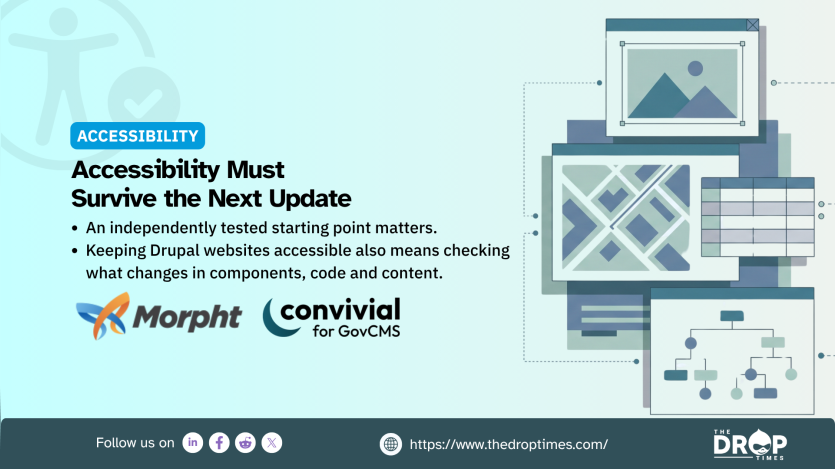
An independent accessibility follow-up has verified three fixes in Convivial for GovCMS, a Drupal-based starter site for Australian government websites. Accessibility consultancy IncluD recorded no outstanding issues or warnings across 52 audited pages in its WCAG 2.2 Level AA verification report, dated 9 October 2026. Developer Morpht announced the result on 14 October.
The result followed an initial accessibility assessment that identified three barriers in reusable components. Morpht corrected the issues, after which IncluD retested the affected functionality and ran automated regression checks across the 52-page audit scope. The 11-page follow-up report confirms the three resolutions, but does not describe a fresh comprehensive manual audit of every interaction on every page.
One issue affected the image lightbox: opening an enlarged image left keyboard and screen-reader focus on the page behind it, rather than moving focus into the lightbox. A second concerned a geographic chart whose population figures depended on colour and mouse hover, leaving the data inaccessible to keyboard and screen-reader users. IncluD classified these under WCAG success criteria 2.4.3 (Focus Order) and 1.1.1 (Non-text Content), respectively.
The third issue appeared in a decision-flow component. Returning to an earlier step changed the visible question, but focus remained on the Back button, so screen-reader users were not informed that the previous step had reappeared. IncluD assessed this against WCAG 2.4.3. The report records all three problems as resolved, but does not identify the exact code changes used for each fix.
Convivial for GovCMS provides reusable components and design patterns for government Drupal websites. Fixing barriers in shared components can improve the starting point for sites built with them. The published audit, however, does not establish which Convivial release contains the remediations or whether existing deployments have received the changes.
The findings are relevant to the Australian Government's Digital Inclusion Standard, which addresses accessibility throughout the design and delivery of digital services. Government teams must still evaluate their own implementations, including content, configuration, custom components and third-party integrations, rather than treating the starter-site assessment as certification of a finished website.
Morpht says it also uses automated accessibility checks in its development pipelines, manually tests changed interactive components and trains editors to publish accessible content. These are the company's stated practices, not processes independently assessed by IncluD's published follow-up report.
IncluD's report likewise limits its conclusions to the agreed scope and the implementation as tested. It recommends continued automated monitoring, targeted manual testing when functionality changes and separate accessibility assessments of websites built using Convivial. The verified fixes demonstrate progress in the starter site's tested components, not a permanent guarantee of WCAG conformance for every site that adopts them.
References
-
-
-
Criterion 4. Make it accessible, Australian Government Digital Transformation Agency
-
-
ASK: Drupal Community Needs Your Support
View all →
Disclosure: This content is produced with the assistance of AI.
Note: The vision of this web portal is to help promote news and stories around the Drupal community and promote and celebrate the people and organizations in the community. We strive to create and distribute our content based on these content policy. If you see any omission/variation on this please reach out to us at #thedroptimes channel on Drupal Slack and we will try to address the issue as best we can.

Related Organizations



You may also like