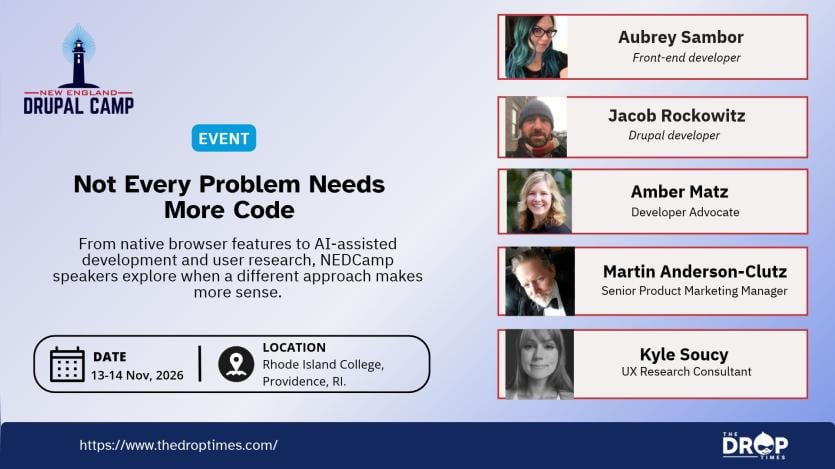
Rethinking familiar development practices, from replacing JavaScript with native browser features to managing the growing demands of AI-assisted coding, will be among the subjects explored at New England Drupal Camp (NEDCamp) 2026, scheduled for 13–14 November 2026 at Rhode Island College in Providence, Rhode Island. Ahead of the volunteer-organised event, five speakers shared insights with The DropTimes into their upcoming sessions, offering practical perspectives on how Drupal teams can build, review, and improve websites.
Aubrey Sambor will demonstrate how modern HTML and CSS can replace certain JavaScript implementations, while Jacob Rockowitz will explore how AI-assisted programming is changing his development practices. Amber Matz will examine the pressure that faster development places on software reviewers and how teams can distribute quality checks more effectively. Martin Anderson-Clutz will discuss building reusable Drupal site templates, and Kyle Soucy will explain how focused user research can help teams make better design decisions. Their presentations form part of a wider programme covering development, design, accessibility, AI, and community collaboration.
The camp begins on Friday, 13 November, with a higher education summit, training, contribution activities, and a community social. Saturday, 14 November, will feature technical sessions across development, design, accessibility, AI, and project management, alongside a keynote by web designer and writer Ethan Marcotte. The five featured presentations are scheduled for Saturday, with all times in Eastern Standard Time (EST, UTC−5).
Aubrey Sambor on Building Interactive Interfaces Without JavaScript
Front-end developer Aubrey Sambor will examine how modern browser capabilities can simplify common interface development tasks in her session, "You Don't Need JS for That." Scheduled from 09:00 to 09:45 in Gaige Hall 202, the presentation will cover nine HTML and CSS features that can replace JavaScript in specific situations, making it relevant to both front-end and back-end developers.
Aubrey explained that advances in HTML and CSS have made it possible to implement interactive features that previously required custom JavaScript. Dialogs, popovers, tooltips, and page transitions are among the examples she intends to discuss, illustrating how browser-native functionality can reduce the amount of scripting needed for certain interactions.
Aubrey Sambor
Aubrey Sambor
My session will discuss 9 HTML and CSS features that replace JavaScript, most of which can be used today.
–Aubrey Sambor, front-end developer
The presentation will introduce the Invoker Commands API, which provides declarative ways to trigger supported actions, and the Popover API, which helps developers manage temporary interface elements. Sambor will also cover CSS anchor positioning for placing elements relative to others, interest invokers for contextual interactions, and view transitions for managing visual changes between page or application states.
These techniques offer alternatives to writing custom scripts for tasks that browsers can increasingly handle themselves. Their practical value includes simpler implementations and the potential to reduce unnecessary JavaScript, although developers must still consider browser support, accessibility, and the behaviour required by each project. Sambor plans to explain the features in an accessible way so that attendees can identify opportunities to use them in their own work.
Beyond the technical session, Aubrey said she is especially looking forward to reconnecting with Drupal community members. She identified the community social, informal hallway conversations, and after-party as favourite parts of Drupal events, describing NEDCamp as one of the gatherings she particularly enjoys attending and speaking at.
Jacob Rockowitz on AI Coding, Developer Skills and the Future of Drupal
Drupal developer Jacob Rockowitz of The Big Blue House will take a more personal approach to technological change in "AI ate my Work, and I'm okay with that," scheduled from 10:00 to 10:45 in Gaige Hall 204. Drawing on a year of experimenting with AI coding agents and documenting those experiences publicly, Jacob will explore how AI-assisted development is changing his work and challenging assumptions about what developers need to do themselves.
Rather than focusing on adding AI features to a Drupal website, Jacob intends to discuss using AI to create Drupal software. His presentation will examine AI-assisted programming and vibe coding, including the processes of directing coding agents, reviewing their output, and deciding which development responsibilities should remain under human control.
Jacob Rockowitz
Jacob Rockowitz
|
Drupal.org
My presentation isn’t about using AI inside or outside Drupal. Instead, it explores how to use AI to build and vibe-code Drupal.
–Jacob Rockowitz, Drupal developer
One of the central examples in his session proposal concerns an AI Schema.org JSON-LD module that he says he developed in four days. In his assessment, the result superseded four years of his earlier work on Schema.org Blueprints. The comparison, presented as his own experience rather than an independently measured productivity result, illustrates both the possibilities he has encountered and the discomfort of seeing substantial previous work overtaken by a much faster development process.
Jacob has also questioned whether increased reliance on AI could weaken certain programming skills. His session outline discusses the possibility of losing debugging proficiency through reduced practice, even while gaining more opportunities to concentrate on planning and software architecture. He also intends to address the widening gap he perceives between experienced developers who can effectively direct AI agents and newcomers who are still developing the knowledge needed to evaluate generated code.
Practical safeguards will form another part of the discussion. Jacob's published outline emphasises reviewing AI-generated code, using test-driven development, and involving a second AI review before accepting generated work. He will also discuss how improvements in coding models led him to abandon elaborate agent instructions and supporting files that he had previously spent time maintaining.
His preparation for NEDCamp demonstrates the same willingness to reconsider established practices. Jacob disclosed that he used AI to generate his session proposal from a year of personal writing and considered the result better than what he could have produced himself. The experience has prompted him to examine not only what AI can accomplish but also how developers might respond when familiar measures of expertise and productivity begin to change.
Jacob said he is also looking forward to travelling to NEDCamp with close friends and reconnecting with people he has met through previous editions of the event.
Amber Matz on Reducing Review Bottlenecks in AI-Assisted Development
As AI-assisted development makes it easier to produce code, reviewing that work can become a growing burden for the people responsible for software quality. Amber Matz, developer advocate at Tugboat, will address this challenge in her session, "Every Day Is Judgment Day." Scheduled from 09:00 to 09:45 EST on Saturday, 14 November, in Gaige Hall 204, the presentation will examine how development teams can distribute quality checks across automated tools, individual reviewers, and collaborative decision-making.
Matz explained that discussions about AI-assisted development increasingly involve reviewer bottlenecks, mounting workloads, and burnout. While keeping humans involved remains essential, she argues that expecting one person to evaluate every change can concentrate too much responsibility at a single point in the development process. Her session will examine how teams can identify different kinds of judgment calls and introduce appropriate checks before problems accumulate.
Amber Matz
Amber Matz
By understanding the types of judgment calls that are vital to every web project, we can put in place both automated and manual checks at the right points in our process to help distribute the load.
–Amber Matz, developer advocate, Tugboat
Her presentation will organise software quality decisions around four questions: Was the work built correctly? Does it function correctly? Was the right solution built in the first place? And will that solution remain dependable over time? These questions require different forms of evaluation, from checking coding standards and identifying technical defects to confirming that the finished work actually meets the needs of users and stakeholders.
Matz will distinguish the checks involved in verification, quality assurance (QA), and user acceptance testing (UAT). Automated methods such as static analysis, automated tests, accessibility checks, and visual regression testing can identify many problems without requiring a person to inspect every detail. Other decisions, particularly whether a feature meets its intended purpose or satisfies stakeholder expectations, still require discussion with developers, project managers, content editors, or clients.
A central takeaway will be the value of introducing these checks earlier and evaluating smaller sets of changes. According to Matz, early feedback can reduce the stress and expense associated with discovering problems late in development. Her session description illustrates the difference between reviewing a working pull-request preview while a change is still being discussed and questioning a decision only after the feature has been released.
The presentation will also explore how teams can combine automated checks with preview environments to make changes easier to examine and approve. Matz noted that Tugboat is one example of a quality-checking tool she will discuss, but her intention is to provide a broader view of the available approaches rather than focus on a single product. The objective is to help teams determine which checks can be automated, which require human judgment, and how responsibility can be shared instead of falling repeatedly on a senior developer.
Beyond the session, Matz said she is looking forward to meeting community members she has previously known only through online interactions. This will be her first NEDCamp, and she is interested in learning how the regional camp is organised and who participates. She will also have a Tugboat table at the event, where attendees can speak with her about their experiences managing software review workloads and AI-assisted development.
Martin Anderson-Clutz on Turning Drupal Recipes Into Reusable Site Templates
Martin will share his experience developing Summit, his first Drupal site template, using the Event Platform Starter Recipe as the foundation. His presentation will trace the process of transforming that starting point into a more complete solution, including the configuration, packaging, testing, and publishing work required along the way.
Martin Anderson-Clutz
Martin Anderson-Clutz
My first live demo of installing a new site using Summit
–Martin Anderson-Clutz, senior product marketing manager for Drupal, Acquia
An important objective is to clarify the distinction between Drupal recipes and site templates. Recipes help apply defined functionality and configuration to a Drupal installation, while site templates provide reusable starting points for building new websites. Understanding where one ends and the other begins can help development teams decide how best to package functionality for future projects.
Martin will demonstrate what Summit provides when a new Drupal website is created and explain the tools and decisions involved in building it. He will also cover the process of submitting a completed template to the marketplace, helping attendees understand the steps involved in making their work available to other Drupal users.
The session has practical relevance for agencies and developers who regularly begin projects with similar requirements. By creating reusable site templates, teams can reduce repeated setup work and provide more consistent foundations for new installations. Martin's experience also illustrates a way for developers to contribute complete starting solutions to Drupal's growing collection of reusable tools.
Among the aspects he is most looking forward to is his first live demonstration of installing a new site using Summit. Martin also mentioned the opportunity to learn from Drupal contributors in the region, reconnect with community members, and enjoy seafood during his visit.
Kyle Soucy on Replacing Design Assumptions With User Research
Independent UX research consultant Kyle Soucy of Usable Interface, LLC will examine how website teams can make more informed design decisions without committing to large or expensive research programmes. Her session, "Stop Guessing: Lightweight User Research for Teams Building Digital Experiences," is scheduled from 15:00 to 15:45 in Gaige Hall 203 and is intended for attendees across experience levels.
Kyle explained that teams frequently make decisions based on assumptions about what users need, what they understand, and how they interact with digital services. Research can test those assumptions, but she argues that useful findings do not always require a substantial budget or an extended study.
Kyle Soucy
Kyle Soucy
My session, Stop Guessing: Lightweight User Research for Teams Building Digital Experiences, will explore how even small, focused research efforts can help teams make more informed decisions without requiring a large budget or weeks of work.
–Kyle Soucy, independent UX research consultant, Usable Interface, LLC
The presentation will help attendees connect common website questions with suitable research approaches. Interviews can reveal users' needs and expectations, concept testing can examine proposed ideas before extensive development begins, and usability testing can identify problems people encounter while completing tasks. Kyle will also consider how qualitative research can explain behaviour that analytics alone may not fully account for.
Another focus will be choosing the appropriate amount of research for a particular decision. Kyle explained that a few interviews or a focused usability study may be enough to address some questions. More involved products, especially those evolving through multiple prototypes or releases, may benefit from repeated research sessions or longer-term observation to understand adoption and changes in user experience.
Rather than offering a catalogue of research methods, Kyle plans to use real-world scenarios to help designers, developers, project managers, and content teams recognise which approaches suit different stages of a website's development. The session will also address the limitations of do-it-yourself research, common mistakes that can lead to misleading findings, and circumstances in which specialist expertise may be necessary.
Kyle said she is interested in hearing about the challenges Drupal teams encounter while developing and improving digital experiences. She hopes to demonstrate that research can become a more accessible and routine part of their work, helping teams make decisions based on user evidence rather than relying solely on internal assumptions.
Technical Learning and Community Connections at NEDCamp
New England Drupal Camp began in 2014 as a community initiative organised by Drupal enthusiasts, primarily from Rhode Island. The event remains attendee-driven and volunteer-run, with a stated mission to grow Drupal expertise and strengthen the community across New England. Its programme combines technical learning with opportunities for developers, designers, contributors, and newcomers to exchange experiences outside formal presentations.
The five speakers approach development from different perspectives, but their sessions address connected challenges. Sambor examines where native browser capabilities can simplify implementation, while Rockowitz explores how AI is changing software creation. Matz addresses the corresponding responsibility to verify and evaluate that work without overwhelming reviewers. Martin's presentation focuses on reusing and sharing development solutions, while Soucy considers how teams can determine whether those solutions meet users' actual needs.
Saturday's programme will also include a keynote titled "The Work We Want" by Ethan Marcotte, scheduled from 13:15 to 14:15 in the Gaige Hall Auditorium. The keynote will examine changes affecting the technology industry and the choices available to people working within it.
Image Attribution Disclaimer: At The Drop Times (TDT), we are committed to properly crediting photographers whose images appear in our content. Many of the images we use come from event organizers, interviewees, or publicly shared galleries under CC BY-SA licenses. However, some images may come from personal collections where metadata is lost, making proper attribution challenging.
Our purpose in using these images is to highlight Drupal, its events, and its contributors—not for commercial gain. If you recognize an image on our platform that is uncredited or incorrectly attributed, we encourage you to reach out to us at #thedroptimes channel on Drupal Slack.
We value the work of visual storytellers and appreciate your help in ensuring fair attribution. Thank you for supporting open-source collaboration!
Disclosure: This content is produced with the assistance of AI.
Note: The vision of this web portal is to help promote news and stories around the Drupal community and promote and celebrate the people and organizations in the community. We strive to create and distribute our content based on these content policy. If you see any omission/variation on this please reach out to us at #thedroptimes channel on Drupal Slack and we will try to address the issue as best we can.











 Kazima AbbasKazima Abbas is a sub-editor at The Drop Times