



Drupal Can Track Content Rights, but AI Training Rules Remain Disconnected

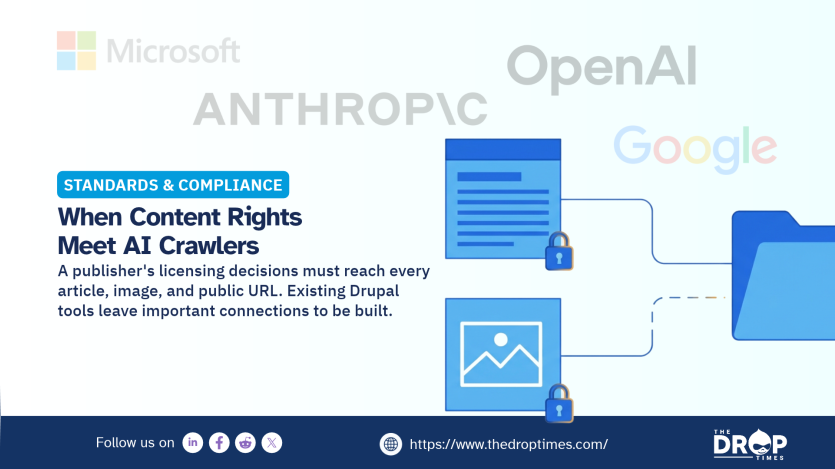
Publishers using Drupal can record licensing information for articles and images, but the documented tools do not automatically convert those records into the proposed cross-vendor AI-training preference signal. An examination by The DropTimes of Drupal modules, technical documentation and proposed web standards identifies gaps involving media access, URL changes and historical permission records. Those gaps matter when publishers assign different permissions to articles, photographs or licensed distribution channels.
The examination comes amid industry commitments to support a shared robots.txt training-preference signal proposed by Kevin Kelley of Anthropic on 30 October 2026 and revised on 16 November. OpenAI, Google, Microsoft and Anthropic have been associated with support for the approach, but implementation commitments and schedules differ; the proposal itself does not demonstrate that all four already honour it. The individual Internet-Draft, Machine-Readable Training Preference Signal, introduces the __usage_ai-training policy token so publishers can express preferences for whole sites or specified paths using ordinary Allow and Disallow rules. It is not an IETF-endorsed standard. The token concerns use of retrieved assets to train generative models; it neither blocks crawling by itself nor creates enforceable licensing rights.
Drupal Already Has Licensing Infrastructure
An existing contributed module provides part of the infrastructure publishers would need. The Attribution & Licensing module supports licensing and attribution fields for Drupal content entities, including nodes and media. Its documentation describes support for SPDX licence identifiers, custom licences, field formatters and attribution information. Version 1.2.2, released on 19 October 2026, supports Drupal 10.5, Drupal 11.2 and Drupal 12 within the project's stated version constraints.
These capabilities allow publishers to associate licensing information with individual content records instead of relying on a single website-wide declaration. However, a conventional content licence does not automatically express permission for generative AI training. The module's documented functionality does not establish an automatic connection between its licensing fields and the proposed AI-training signal. A publisher would still need a policy mechanism to interpret the relevant rights and generate the corresponding public instructions.
Drupal also provides components for publishing those instructions. The RobotsTxt module generates editable robots.txt content dynamically, while the Metatag module supports configurable page metadata. Neither project's documented general functionality establishes a complete rights-to-AI-policy integration. An implementation would need to connect content-level decisions to the appropriate robots.txt rules, page metadata or HTTP response headers, including responses handled outside Drupal by a web server or content delivery network.
Media Rights Do Not Automatically Follow Articles
Drupal's own media documentation identifies a complication for publishers handling photographs and other third-party assets. The guide Setting up private access to Media items states that media assets do not inherit permissions from their parent entities. It explains that files stored through Drupal's private file system can remain accessible to anonymous visitors when their media item is published, even if the article containing that media has different access restrictions. More granular access requires additional implementation.
Consider a publisher that permits AI training on an article's text but holds a photograph under a more restrictive licence. The article and photograph may have separate public URLs, and the photograph may also appear through image derivatives or other distribution channels. A training preference applied only to the article URL would not necessarily express the intended treatment of the separately retrieved image. The publisher would need to manage the image's rights independently and ensure that every relevant delivery path applies the appropriate policy.
URL changes create a related problem. Drupal's Pathauto module generates content aliases, while Redirect can preserve access through older URLs. A rights policy generated from current aliases alone could overlook retained redirects, alternative routes or previously published asset locations. A reliable implementation would need to account for those routes when generating and validating AI-training preferences.
Drupal.org Shows the Difference Between Policy and Signal
The Drupal Association provides a concrete example of the distinction between a published policy and a machine-readable preference. Its Use of Automation Tools, including AI policy, last updated on 7 April 2026, prohibits using content scraped from Drupal.org to train commercial AI models without explicit written permission. It also describes approval requirements, rate limits and other restrictions for automation interacting with Drupal.org.
A review of the publicly accessible Drupal.org robots.txt on 12 November 2026 recorded conventional crawler instructions but did not find a __usage_ai-training declaration at that time. This does not mean that Drupal.org permits commercial AI training or lacks other technical protections. The draft explicitly says that, where the policy-token group is absent, no preference under this mechanism is expressed; absence does not override Drupal.org's written policy or other controls. The observation illustrates how an organisation can already have an explicit AI-use policy without expressing it through this particular machine-readable mechanism.
Revision History Cannot Establish What Crawlers Received
Maintaining a record of changing permissions introduces another challenge. Drupal supports entity revisions, allowing publishers to retain earlier versions of content and related metadata. Those revisions can help establish when an editorial decision changed, but they do not automatically prove which robots.txt file or HTTP header an external crawler received. The distinction matters when a licensing agreement expires, an embargo ends or a publisher withdraws an earlier permission.
The 16 November revision of the training-preference draft associates an asset with the robots.txt preferences in effect when it was retrieved, while distinguishing usage preferences from crawler-specific access rules. The existing Robots Exclusion Protocol, RFC 9309, permits crawlers to cache robots.txt and generally recommends against retaining a cached copy for more than 24 hours unless the file is unreachable. Consequently, a changed Drupal content record, an updated public rule and a crawler's subsequent retrieval may occur at different times.
A more complete implementation would preserve dated copies of the rules actually published, record the associated content revisions and retain evidence of when those rules became available. HTTP delivery logs could help establish that a crawler requested particular resources, although they would not prove how the recipient subsequently processed the content. These records would require additional engineering beyond Drupal's ordinary editorial revision history.
There is also a scaling consideration. RFC 9309 requires crawler parsers to handle at least 500 KiB of robots.txt content, but does not guarantee that every crawler will process an unlimited file. Generating a separate path rule for every article may become impractical for a large publication archive, particularly where individual licensing exceptions prevent simple grouping by URL prefix.
An older States Newsroom case study, published by Vardot in December 2021, illustrates the scale of Drupal-based news aggregation. It documents a customised RSS pipeline that had imported more than 100,000 articles from affiliate publications, supported by automated tagging, Solr search and editorial administration tools. The case study does not claim to implement AI-training rights management. It demonstrates the volume of structured content that a publisher might have to govern if individual rights decisions were translated into crawler-facing rules.
New Standards Propose More Granular Controls
The shared robots.txt policy token is one proposed way to express a preference for or against generative AI training, rather than a universal mechanism for all AI content uses. A separate IETF working-group draft, Associating AI Usage Preferences with Content in HTTP, describes a Content-Usage response header and an additional robots.txt directive. Its examples include Content-Usage: train-ai=n, which expresses a preference against training on the content delivered in an HTTP response. This could provide a way to associate preferences with individual documents or media responses, but the draft remains unfinished and public commitments to the shared robots.txt policy token do not establish support for the proposed header.
Microsoft has announced a separate, more immediate implementation. According to its 30 October announcement, publishers will be able to set AI-training preferences for individual pages through meta tags or HTTP headers, overriding the applicable robots.txt preference. Microsoft is also introducing independent page-level controls for AI grounding, which concerns using retrieved content to inform generated responses. Microsoft says it plans to begin honouring the new preferences on 1 February 2027 as content is crawled; this is a future implementation commitment, not evidence that every published preference is currently enforced. These additional page-level controls are Microsoft-specific rather than part of the shared robots.txt mechanism. They must not be confused with the IETF draft's vendor-neutral training-preference token.
Other proposed standards address exceptions and accountability. An individual Internet-Draft from LicenseFoundry describes signed, verifiable permission grants that could identify an authorised recipient and the permitted use of particular content. A separate proposal by Lawrence John Reilly Jr. describes compliance records intended to document whether processing organisations observed published preferences. Neither proposal is an approved IETF standard or an established enforcement mechanism.
What a Drupal Implementation Still Needs to Demonstrate
The documented Drupal capabilities suggest a possible architecture in which article and media fields store rights information, a custom policy service evaluates those records, and separate delivery mechanisms publish the resulting rules. Drupal's core JSON:API security documentation confirms that API responses respect existing entity and field access controls, but also states that JSON:API does not add an independent access-control layer. Authorised licensing feeds would therefore require correctly configured access permissions and, where necessary, additional subscriber-specific controls.
Such an implementation would need to demonstrate that changing an article's rights updates the published preference, that restrictive media permissions reach direct asset URLs, and that scheduled expirations and URL changes do not leave contradictory rules in circulation. It would also need to account for cached responses and retain evidence of earlier published policies. These are implementation requirements inferred from the documentation review, not findings from a working Drupal installation tested by The DropTimes. The review also does not establish which AI services currently honour the draft token in production.
The findings establish that Drupal has existing content-modelling, licensing and access-control components relevant to AI rights management. They do not establish that those components can be assembled into an interoperable solution without custom development, nor that a published preference can compel an AI company to comply. The immediate technical question for Drupal publishers is how reliably an editorial rights decision can reach every place where the corresponding content is delivered.
References
-
Machine-Readable Training Preference Signal (draft-kelley-aipref-training-preference-signal-01), Anthropic (16 November 2026)
-
-
RFC 9309: Robots Exclusion Protocol, Internet Engineering Task Force
-
Associating AI Usage Preferences with Content in HTTP, Internet Engineering Task Force (19 August 2026)
-
Verifiable Compliance Records for AI Usage Preferences (2 August 2026)
-
Your content, your choice: clearer preferences for training and grounding, Microsoft (30 October 2026)

ASK: Drupal Community Needs Your Support
View all →
Disclosure: This content is produced with the assistance of AI.
Note: The vision of this web portal is to help promote news and stories around the Drupal community and promote and celebrate the people and organizations in the community. We strive to create and distribute our content based on these content policy. If you see any omission/variation on this please reach out to us at #thedroptimes channel on Drupal Slack and we will try to address the issue as best we can.

You may also like