



Drupal Context Control Center RC3 Changes How AI Agents Select Guidance

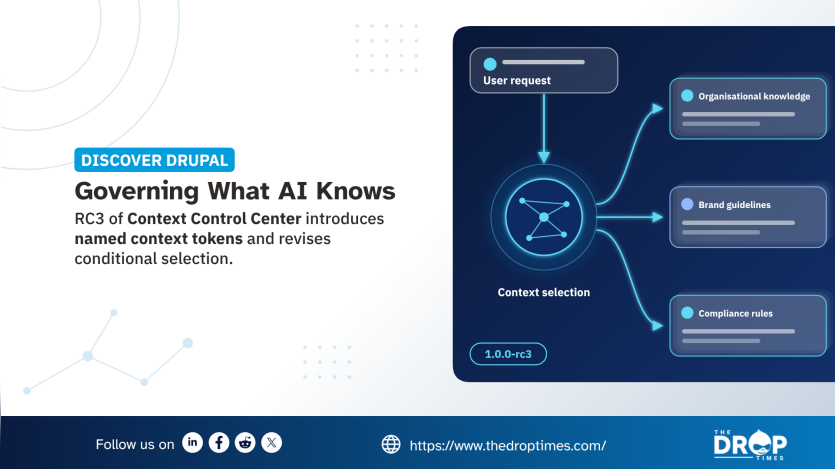
The third release candidate of Drupal's Context Control Center changes how AI agents select conditional guidance. The module now bases automatic conditional subcontext decisions on the user's request rather than the agent's instructions. According to the release notes published on 24 November 2026, version 1.0.0-rc3 addresses 37 credited issues and is the last release candidate currently planned before version 1.0.0.
Context Control Center allows Drupal sites to maintain organisational knowledge, brand guidelines, editorial standards and compliance requirements as moderated content items that AI tools can consume. The change makes conditional selection responsive to individual requests rather than the general instructions assigned to an agent. It also changes what information the module sends to the AI provider responsible for deciding which guidance applies.
Context items can contain required and conditional child items, collectively known as subcontext. Required children accompany their parent when they meet the applicable selection and access requirements, subject to the token budget. Conditional children introduce an additional AI decision to determine whether their guidance is relevant to the task.
The earlier technical examination of Context Control Center published by The DropTimes, based on version 1.0.0-rc1, documented how the module used an agent's standing instructions for this decision. An agent handling several kinds of enquiries could therefore present the same task description to the decision provider, regardless of the user's question. RC3 changes that behaviour by using the user request as the selection task during agent execution; when there is no user text, the task is empty.
For example, a university could maintain a parent context item containing general institutional guidance, with conditional children covering admissions, tuition fees and student support. A single enquiry agent could now use the visitor's question to determine which of these supplementary instructions applies. The effectiveness of that selection would still depend on how the context items are configured and how the decision model interprets the request.
The documentation accompanying RC3 specifies that the selection prompt includes up to 500 characters from the beginning of the current task. It also contains an excerpt from the parent item's content and the identifiers and Purpose fields of candidate children. The decision provider is configured through AI Provider/Model under the module's general settings and can differ from the provider that runs the agent itself.
This distinction matters for organisations handling personal or commercially sensitive information. A request submitted to an agent may also reach another provider during conditional selection, even when that provider does not generate the final answer. Administrators must therefore consider the data-handling arrangements of both providers when configuring such workflows.
Administrators can configure the same provider for conditional decisions and agent execution or turn off Enable conditional subcontext AI decisions in CCC settings. Using the same provider avoids introducing a separate provider into this processing step but does not prevent request information from being transmitted. Disabling conditional decisions prevents the additional AI call but changes which guidance reaches the agent.
With conditional decisions disabled, the module excludes conditional children from normal subcontext resolution while retaining eligible required children. Conditional items may still reach consumers through other selection paths, including the Always include list and custom scopes. Organisations relying on conditional guidance for particular tasks should account for this behaviour before disabling the feature.
RC3 also introduces a Token name field for context items. A user with the Administer AI Context permission can assign an item a name such as brand_voice and reference it in an agent's system prompt through [ai_context:item:brand_voice]. The token resolves published content that the current user can view, including eligible required children.
Named tokens provide a direct alternative to automatic selection for guidance that needs to appear in a particular prompt. However, context-selection scopes, including Roles, do not govern token resolution. The tokens can also be used outside AI prompts wherever Drupal's token application programming interface (API) processes them. Site builders must distinguish rules that determine relevance from permissions that determine whether content may be viewed.
The release supports Drupal 10.5 and later within Drupal 10, and Drupal 11.2 and later within Drupal 11. Its revised AI module dependency is ~1.4.12 || ^1.5.2 || ^2. The issue documenting the dependency change explains that, on AI 1.4.11 and earlier, context sent through Automator and other generic chat requests did not reach OpenAI-based providers even though usage records and debug logs indicated successful delivery.
Existing installations must run drush updatedb followed by drush cr. Sites using Scheduler must also review the replacement scheduling permissions and applicable moderation transition permissions. Administrators should run drush config:export and commit the updated configuration before deployment. Importing configuration exported before the permission migration can restore the removed permissions and discard their replacements.
Multilingual installations that identify languages through URL path prefixes require additional checks. Site Section patterns without a language prefix now match across languages, making an explicit Language scope necessary where such patterns must remain language-specific. Administrators should also review previously detached, translated context items that inherited their parent's scope, because the update does not retrospectively correct their publication states.
These changes follow version 1.0.0-rc2, released on 13 November 2026, which introduced stricter access and translation checks. RC2 also increased the default context budget for new installations from 1,200 to 20,000 tokens. Existing installations retain their previously configured budget, so sites upgrading from RC1 should not assume that their settings match those of a fresh installation.
Context Control Center remains without a supported stable release. Among its documented limitations, the Load AI Context Items tool can retrieve published, viewable items by identifier without applying the Roles scope. The project has opted into Drupal's security advisory coverage for eligible stable releases, but release candidates are not covered. The maintainers recommend testing RC3 on a copy of an existing site before deploying the update.
ASK: Drupal Community Needs Your Support
View all →
Disclosure: This content is produced with the assistance of AI.
Note: The vision of this web portal is to help promote news and stories around the Drupal community and promote and celebrate the people and organizations in the community. We strive to create and distribute our content based on these content policy. If you see any omission/variation on this please reach out to us at #thedroptimes channel on Drupal Slack and we will try to address the issue as best we can.

You may also like