



Accessibility Contributors Discuss Continuity, Governance, and AI Ahead of GAAD

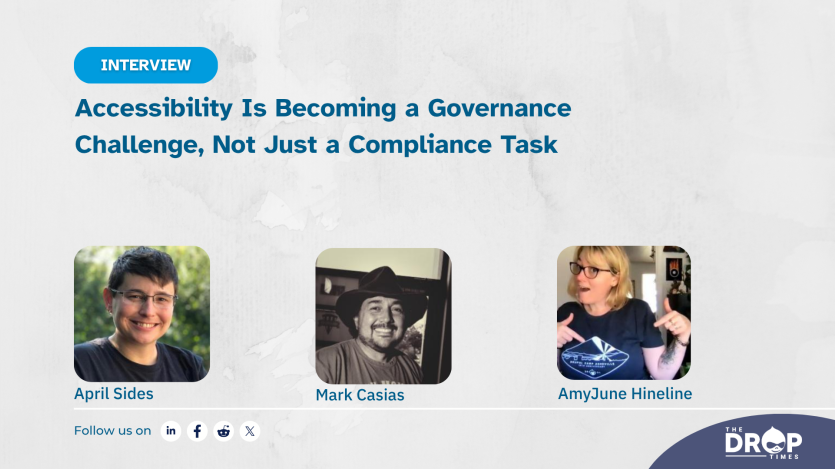
Contributors associated with the Drupal accessibility community said long-term accessibility work often becomes difficult to sustain when organizations treat accessibility as an isolated compliance requirement rather than an operational responsibility embedded into everyday workflows.
The discussions were conducted by The DropTimes ahead of Global Accessibility Awareness Day, observed annually to promote awareness and discussion around digital accessibility and inclusive technology practices.
Contributors connected to A11yTalks, a community initiative with roots in the Drupal ecosystem, repeatedly described continuity and governance as recurring operational challenges in accessibility work. Their responses focused on how accessibility systems survive staff turnover, remain integrated into organisational infrastructure, and continue functioning beyond individual advocacy efforts.
When asked about the operational impact of embedding accessibility into design systems and workflows from the beginning, accessibility ally April Sides, Principal Software Engineer at Red Hat, said, “fixing accessibility bugs for a single site or an entire portfolio of sites becomes way easier when accessibility is built into a design system or CMS.” Sides added that shared systems allow contributors to resolve issues collaboratively instead of repeating the same fixes across multiple projects.
Several contributors identified continuity as one of the most persistent weaknesses in accessibility programs. Accessibility advocate Mark Casias, Front End Developer at Interpersonal Frequency, said many initiatives lose momentum after experienced contributors leave organisations or projects.
“Sadly, I have seen many teams lose key proponents of accessibility, and once they leave, the initiative stays on the vine.”
Certificate Community Architect at the Linux Foundation and Drupal accessibility contributor, AmyJune Hineline, similarly argued that accessibility systems deteriorate when organisations treat accessibility as a temporary project rather than an ongoing operational responsibility.
“Accessibility systems break down when they depend on only a few passionate contributors. Staff turnover, deadlines, lack of continuous training, and acting as though accessibility is a one-off, rather than a continuous improvement, lead to decay over time, especially when new content is constantly added.”
The discussions also examined how AI-assisted development workflows may affect accessibility implementation. Contributors acknowledged that automation could potentially improve baseline accessibility support while warning that accessibility governance cannot be delegated entirely to automated systems.
Mark said AI-generated systems could theoretically encourage more accessible defaults within interface-generation workflows, although he also expressed caution about relying too heavily on automated systems: “In theory, the AI would be more keen on making things accessible by default. Not that I am a proponent of AI-generated stuff, but in theory, the logic is already there for it.”
AmyJune argued that accessibility decisions remain inseparable from human-driven design and lived user experience, saying “AI does not use software and applications the same way humans do; real humans need to lead the user experience, and I believe development workflows are a user experience as well.”
Contributors also connected accessibility leadership within open-source communities to broader questions surrounding participation, governance, and project culture. Mark Casias described the Drupal ecosystem as a “Do-ocracy,” adding that many people in the community remain strongly committed to accessibility work.
AmyJune said open-source communities often approach accessibility and inclusion as foundational characteristics of sustainable technology ecosystems rather than edge-case requirements.
“Open source communities tend to be more inclusive, and that inclusivity extends beyond end users to the developers and contributors who build the projects. I believe open source understands that accessibility and inclusion are not edge cases. They are part of creating healthier, more sustainable communities and technology for everyone.”
Looking ahead, contributors suggested that organisations embedding accessibility into long-term operational culture rather than treating it solely as a regulatory obligation may ultimately distinguish themselves from organisations responding only to audits or compliance requirements.
April Sides said:
“Authenticity, connecting with people, and building relationships are becoming increasingly important during current societal shifts. In theory, organizations that demonstrate inclusive values and show genuine care about empowering people through digital accessibility will build stronger human connections and will have greater organizational success.”
The DropTimes has also received responses from Mike Gifford of CivicActions as part of its Global Accessibility Awareness Day coverage. Those responses will be published separately tomorrow.
 Allen JasonAllen without organs
ASK: Drupal Community Needs Your Support
View all →
Note: The vision of this web portal is to help promote news and stories around the Drupal community and promote and celebrate the people and organizations in the community. We strive to create and distribute our content based on these content policy. If you see any omission/variation on this please reach out to us at #thedroptimes channel on Drupal Slack and we will try to address the issue as best we can.

Related Drupal Initiatives

Related Organizations




Related People


You may also like