


Dries Buytaert Uses Contentful Acquisition to Highlight Digital Sovereignty Concerns

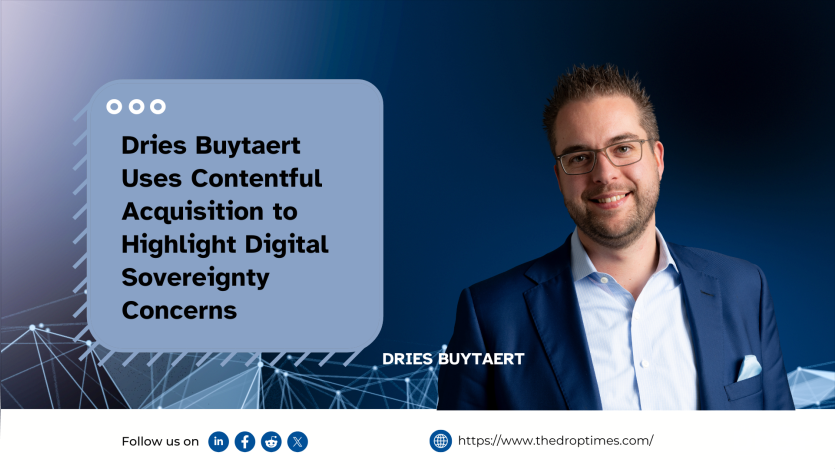
Salesforce's planned acquisition of Contentful has reignited debate around digital sovereignty, with Drupal founder Dries Buytaert arguing that the deal illustrates the limitations of a "Buy European" strategy when ownership of software platforms can change through acquisition.
In a blog post examining the implications of the proposed transaction, Dries congratulated Contentful's founders and team, describing the acquisition as validation of the company, its product, and its customer base. He also argued that the deal gives Salesforce a mature enterprise CMS offering that complements its broader software portfolio.
Beyond the business rationale, Dries focused on the broader implications for governments, public institutions, and regulated industries that view European vendors as part of their digital sovereignty strategy. He noted that Contentful was founded in Germany and has operated for more than a decade as one of Europe's most prominent enterprise software providers. If the acquisition closes, however, the company would become part of Salesforce and fall under U.S. jurisdiction.
Dries pointed to the U.S. CLOUD Act as an example of how ownership can affect legal obligations. He argued that the legislation demonstrates how a company’s geographic origins do not necessarily guarantee long-term sovereignty protections once ownership changes, because U.S. companies can be required to provide access to data under their control even when that data is stored outside the United States.
The post stresses that the issue is not specific to either Contentful or Salesforce. Instead, Dries presents the acquisition as evidence that software sovereignty strategies based solely on vendor nationality may not provide lasting guarantees. According to his analysis, a single acquisition can shift governance structures, legal oversight, and compliance obligations regardless of where a company was originally founded.
Dries also acknowledged his own position within the market, noting that Drupal competes with Contentful and that Acquia, the company he co-founded, is itself a U.S.-based organisation. He argued, however, that open source software provides customers with alternatives unavailable in proprietary platforms, including the ability to change hosting providers, self-host applications, or fork codebases if governance or ownership concerns arise.
The discussion builds on Dries's previous advocacy around software sovereignty, including concepts such as the Software Sovereignty Scale and the Sovereignty Prerequisite, which he has submitted as feedback to the European Commission during discussions surrounding cloud sovereignty frameworks.
While praising Contentful's growth into one of Europe's most successful software companies, Dries concluded that software sovereignty strategies should be evaluated according to long-term control over code, data, and infrastructure rather than the nationality of individual vendors. He argued that sovereignty must remain intact even when ownership structures change through acquisitions or market consolidation.
ASK: Drupal Community Needs Your Support
View all →
Disclosure: This content is produced with the assistance of AI.
Note: The vision of this web portal is to help promote news and stories around the Drupal community and promote and celebrate the people and organizations in the community. We strive to create and distribute our content based on these content policy. If you see any omission/variation on this please reach out to us at #thedroptimes channel on Drupal Slack and we will try to address the issue as best we can.
Related People


You may also like