



TDT Town Hall Links Newsroom Changes With Drupal’s Wider Future

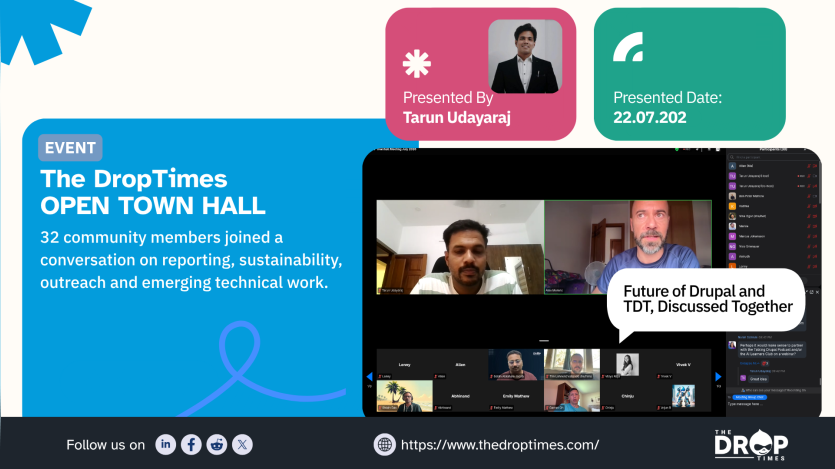
Community members and newsroom staff met at The DropTimes Open Town Hall on 22 July 2026 for a constructive discussion about Drupal’s future and the publication’s role in reporting on the ecosystem. Thirty-two unique attendees joined the Zoom call, with at least 29 present for most of the meeting. The conversation covered editorial standards, open-source sustainability, external outreach, technical initiatives and routes for community participation.
The meeting linked changes inside the TDT newsroom to practical ways for contributors to influence reporting priorities, provide technical context and extend Drupal coverage beyond established audiences. Tim Hestenes Lehnen, CTO of the Drupal Association, and community participants Norah Schrum and Lenny Moskalyk were among those who offered reporting leads and collaboration. Alex Moreno Lopez, a member At-Large on the Drupal Association board representing the community, contributed proposals for reaching audiences outside the Drupal ecosystem.
Sebin A. Jacob, Chief Editor at The DropTimes, said the newsroom is deliberately publishing fewer stories while spending more time examining each subject. He said reporters increasingly use release notes, issue queues, project documentation, security advisories, public records, data and direct responses to test claims. The aim is to move beyond single-source summaries and document what developments mean for people who use, maintain or govern Drupal technology.
Sebin cited TDT’s coverage of Drupal 11.4 as an example of this approach. Rather than treating the release as a single feature announcement, the newsroom followed performance work, the experimental native command-line interface, dependency concerns, maintenance releases and regressions reported after the release. He also said TDT had added recurring coverage channels for policy and governance, and for standards and compliance.
Kazima Abbas, a sub-editor at The DropTimes, said the content team is becoming more selective about the external articles it covers. She described a shift away from straightforward summaries towards stories that use additional sources and explain why a development matters to Drupal users. The change is intended to make the publication’s archive more useful as long-term documentation.
Ben Peter Mathew, who presented TDT’s marketing and community update, reported 9,585 followers at the end of the period, including 215 new followers. The publication recorded 74,632 impressions and 10,071 engagements during the same period. TDT also published 248 social posts, promoted 20 Drupal events and said it was connected with 366 organisations.
The update counted 117 Drupal-related job listings and 40 organisations that received support with marketing and branding, including case studies, articles and blog posts. Ben said TDT had begun working with Goodtech.info to distribute DrupalCon Rotterdam summit coverage beyond the existing Drupal community. Norah later proposed a media partnership with CMSWire to bring enterprise Drupal coverage to its audience, and Ben said he would contact the publication after receiving its media-partnership address.
Tarun Udayaraj, Head of Community Relations at The DropTimes, proposed involving journalism students near DrupalCon Rotterdam and future events. Under the proposal, students would report from sessions, gather interviews and receive guidance from community members and the TDT editorial team. Tarun also suggested building a shared database of local and technology media contacts that Drupal organisations could use to distribute relevant announcements.
Digital sovereignty became one of the meeting’s main subjects. Tim said he might not have capacity to write a digital-sovereignty article from scratch but offered to collaborate with a TDT reporter, drawing on discussions held during UN Open Source Week. He argued that governments and institutions need to treat open-source software as shared infrastructure rather than depend on volunteers and companies to maintain it without reliable funding.
The discussion identified procurement rules, public-sector maintenance funding and comparable measures of open-source contribution as possible reporting questions. Lenny proposed interviews involving Dutch government and Drupal community representatives. Tarun said the subject could also support a webinar or panel discussion, with possible guidance from Sachiko Muto, a Drupal Association board member whose work includes digital sovereignty and open-source policy.
Alex Moreno said the difficulty of reaching people outside established project audiences is shared across open-source communities and is not unique to Drupal. He encouraged participation in local meetups and wider technology events instead of waiting for potential users and customers to encounter Drupal independently. Tim added that the Drupal Association was considering contribution-credit incentives for companies operating Drupal-branded booths at external conferences.
Darren Oh of Drupal Forge said instant Drupal demonstrations were available at drupal.org/ai/demos. He said another Drupal AI Initiative demonstration had recently been completed and was expected to be added. Shibin Das, a Drupal orchestration contributor, said recent reporting had helped move discussion away from perceived competition between modules and towards shared workflow requirements.
Andy Marquis, a community participant, asked TDT to examine outdated Drupal documentation and the limited visibility of the project’s decoupled capabilities. He noted that some documentation still refers to Drupal 7 and suggested returning to the subject in greater detail at a future Town Hall. Other participants supplied possible leads involving government adoption of open source, public-sector programme offices, software preservation and Drupal Association governance.
Towards the end of the meeting, Tarun outlined plans for a community Editorial Working Group. He presented the group as an early step towards wider community participation in TDT’s editorial operations. Volunteer contributors would be invited to propose subjects, help shape editorial priorities, review interview questions, assess technical framing and collaborate on articles with support from TDT editors.
Norah volunteered to participate, while other attendees offered subject expertise, interviews and contacts. The group is expected to begin in a dedicated Slack channel, with some form of weekly coordination planned. Its precise structure, responsibilities and meeting arrangements remain to be finalised after the group becomes active.
In a separate call for support, Tarun invited contributors to help with digital-sovereignty coverage. Other follow-up work includes contacting subject experts, exploring student reporting at future events and developing relationships with media outlets beyond the Drupal ecosystem. TDT plans to report progress at its next Town Hall.

ASK: Drupal Community Needs Your Support
View all →
Disclosure: This content is produced with the assistance of AI.
Note: The vision of this web portal is to help promote news and stories around the Drupal community and promote and celebrate the people and organizations in the community. We strive to create and distribute our content based on these content policy. If you see any omission/variation on this please reach out to us at #thedroptimes channel on Drupal Slack and we will try to address the issue as best we can.

Related Organizations

Related People


You may also like


![Symfony 8.2 to Add Declarative Controller Locking With #[Lock] Attribute](https://www.thedroptimes.com/sites/thedroptimes.com/files/styles/t4/public/2026-10/symfony_8.2_to_add_declarative_controller_locking_with_lock_attribute.png?h=d1cb525d&itok=BWy6BpbI)