



Marcus Johansson Tests AI Workflow for Drupal Tutorial Video Production

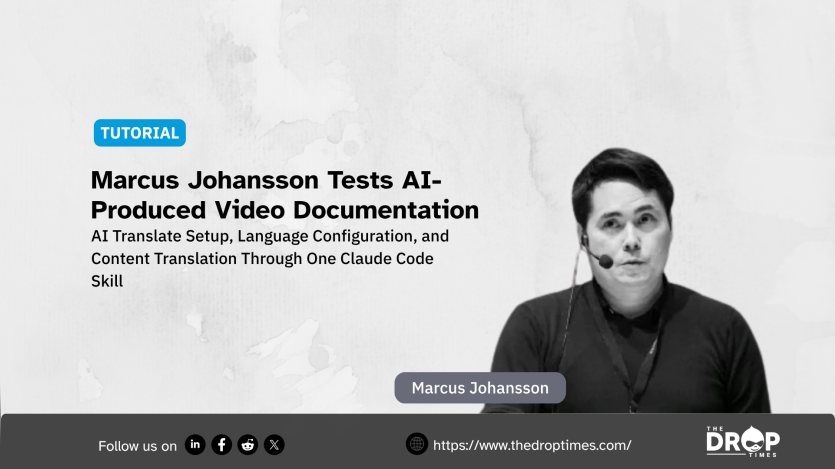
Drupal developer Marcus Johansson, tech lead for the Drupal AI Initiative, shared an AI-produced tutorial showing how to configure the AI Translate module. In a LinkedIn post, Johansson said one Claude Code skill and one prompt handled the research, scripting, staging, screen recording, and narration. A person reviewed and approved the storyboard before production, and Johansson described the result as a rough first iteration with timing and other production defects.
The drupal-tutorial-video skill tests whether a repeatable agent workflow can make narrated setup videos more practical for Drupal modules with limited documentation. Johansson presented it as a possible starting point for less-covered projects rather than a replacement for tutorials recorded by human presenters. The experiment moves much of the initial research and production work into an automated pipeline while retaining a human approval point before recording.
The demonstration covers AI Translate, a Drupal AI Initiative workstream led by Valery Lourie. The module sends translatable Drupal content to a configured AI provider and writes the returned translation into the target language. The prompt shown with Johansson’s post asked the agent to add French and Japanese, configure an AI provider, and demonstrate content and interface translation.
Before recording, the skill reads the module’s metadata, documentation, configuration forms, permissions, routes, and services to derive a followable setup path. It then drafts a storyboard divided into recording units called beats, with each beat pairing one narration sentence with a corresponding on-screen action and caption. Recording does not begin until the user approves the proposed storyboard, creating a human review point between the agent’s research and production stages.
Browser activity runs inside a DDEV web container on a 1,920-by-1,080-pixel virtual display. agent-browser reads the page’s accessibility tree and locates interface elements, while xdotool moves the visible pointer, clicks, and types so FFmpeg records the same actions shown on screen. Commands involving Composer, Drush, or DDEV are rendered as still command cards because the original workflow does not capture a live terminal.
The skill uses Awaz and ElevenLabs to generate narration for each beat, fits the recorded action to the spoken line, overlays a caption bar, and joins the completed clips into one MP4 file. Johansson acknowledged imprecise timing and other defects in the first result. He suggested that Deepgram or Whisper could improve synchronisation, although neither forms part of the documented workflow.
The post and repository do not provide measurements for tutorial accuracy, production time, cost, accessibility, or long-term maintenance. The workflow also leaves open how maintainers would detect interface changes, verify generated instructions against new module releases, and update videos after configuration paths change. Those questions would need to be addressed before the approach could support documentation at scale.
The original skill can be installed with npx skills add ivanboring/drupal-skills --skill drupal-tutorial-video. Production requires a running DDEV project, site credentials, an ElevenLabs API key, and the documented browser, virtual-display, recording, and narration dependencies. The repository contains the full workflow and supporting scripts for teams evaluating the prototype.
Jim Birch, engineering director and AI practice lead at Kanopi Studios, later credited Johansson’s work as the basis for a broader implementation. His Automating Screen Recordings Using Screencast Skills post from 31 July 2026 describes separate skills for storyboarding and production, with an approval gate retained between them. The Screencast Skills repository runs on macOS and uses VHS for terminal demonstrations, Playwright and visible cursor control for browsers, and FFmpeg still-motion sequences for native applications. Birch describes the system as a generalisation of the Drupal-specific pipeline rather than a fork or replacement.
References
-
Automating screen recordings using Screencast Skills (31 July 2026)

ASK: Drupal Community Needs Your Support
View all →
Disclosure: This content is produced with the assistance of AI.
Note: The vision of this web portal is to help promote news and stories around the Drupal community and promote and celebrate the people and organizations in the community. We strive to create and distribute our content based on these content policy. If you see any omission/variation on this please reach out to us at #thedroptimes channel on Drupal Slack and we will try to address the issue as best we can.
Related Drupal Initiatives

Related People


You may also like