



Annotations Builds Human-Curated Context Layer for Drupal

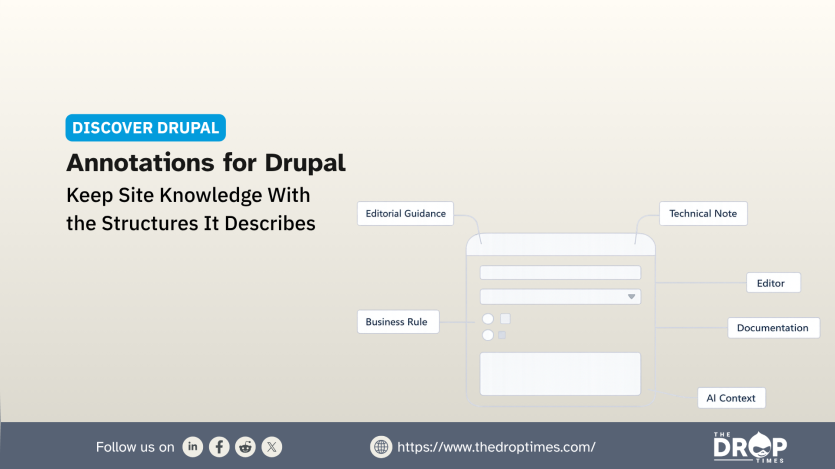
Drupal sites can use the Annotations module suite to attach structured notes to content types, custom entities, fields, roles, vocabularies, and other site structures without changing the underlying content model. Those notes can remain with the structures they describe and be reused as contextual guidance, documentation, or selected context for AI tools. In written responses to The DropTimes, maintainer Nik LePage said the idea grew from difficulties documenting complex forms in an earlier Drupal application.
The project treats site-specific knowledge as content that Drupal can govern rather than information kept separately in videos, handover documents, or team memory. Annotation entities support features including revisions, translation, workflows, and configurable permissions, while consumer modules determine where that information is exposed. The project remains experimental: Drupal.org lists no supported stable release and currently reports two sites using Annotations.
Annotations 2.0.0-alpha4 was released on 27 July 2026 and requires Drupal 11.2 or later. Its release notes state that all modules received code review and that automated tests cover all base modules and about half of the main consumer modules that are not still changing. The release also adds per-user annotation-type suppression through Profile integration and fixes access-control, query, schema, and workflow issues.
Nik traced the original problem to a Drupal application he built to audit progress and track resources across hundreds of locations. Its custom entities produced complex forms for users who needed more guidance than conventional Drupal help text could provide, leading him to create instructional videos that could become outdated as interfaces changed. He said the broader idea came together after hearing “context” discussed during an AI-focused session at LGD Camp in March 2026.
Had the module existed on that earlier project, Nik said he could have shipped default annotations with custom entity modules and recipes, placed explanations directly beside individual form elements, and stored technical notes explaining the purpose of fields. Teams can create different annotation types for editorial guidance, technical information, rules, or other purposes. Per-type consume permissions determine which annotations a role can receive through overlays, context output, and AI integrations.
Nik described Annotations as “very much a human-in-the-loop system, by design.” He said the aim is to preserve knowledge written by people who understand the site, product, or organisation rather than depend on an AI system to infer that knowledge. The Annotations Documents submodule can use permitted annotations to generate material for a specified audience and language, while generated documents remain unpublished in Drupal until a person reviews and publishes them.
The Annotations Tool API also exposes selected human-written context to function-calling AI agents. Access is filtered by the calling user's consume permissions and by whether an annotation type has been explicitly permitted for AI context, allowing an agent to retrieve relevant information about a content type or field without receiving every annotation stored on the site. Nik described more advanced recommendations and possible business-intelligence uses as future directions rather than current capabilities.
Annotations is also part of a LocalGov Drupal Community Fund project, according to Nik. He identified LocalGov Drupal's complex forms as an immediate use case for the contextual guidance that prompted the module and said additional funding will be sought from councils and suppliers. The earlier application used across hundreds of locations inspired Annotations but was not itself a deployment of the module.
Before a stable release, Nik said the suite still needs to be organised into suitable groups of modules, remaining architectural questions need to be resolved, and review and testing must continue. This does not contradict alpha4's statement that all modules received code review; it describes additional work required as the architecture develops toward stable. The project page also discloses that AI helped generate Annotations and its submodules, while saying their design and development were guided and curated by the maintainer.
 Allen JasonAllen without organs


ASK: Drupal Community Needs Your Support
View all →
Disclosure: This content is produced with the assistance of AI.
Note: The vision of this web portal is to help promote news and stories around the Drupal community and promote and celebrate the people and organizations in the community. We strive to create and distribute our content based on these content policy. If you see any omission/variation on this please reach out to us at #thedroptimes channel on Drupal Slack and we will try to address the issue as best we can.

Related Drupal Initiatives

Related Organizations

Related People


You may also like